
This high-performance methanethiol gas sensor delivers accurate and reliable detection for CH3SH in the 0–10 ppm or 0–100 ppm range. Designed with advanced electrochemical technology, it ensures excellent sensitivity, fast response, and strong anti-interference capabilities, making it suitable for a variety of industrial and environmental monitoring applications.
Specification
| Model | ATO-S4-CH3SH |
| Target Gas | Methanethiol (CH3SH) |
| Detection Principle | Three-Electrode Electrochemical |
| Detection Range | 0–10 ppm / 0–100 ppm |
| Sensitivity | 700 ± 150 nA/ppm |
| Maximum Load Concentration | 20 ppm |
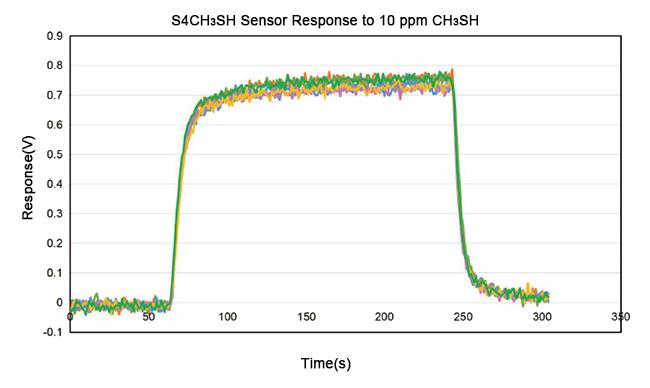
| Response Time | ≤ 40 s |
| Resolution | 0.1 ppm |
| Operating Temperature | -30 ℃ to 50 ℃ |
| Operating Humidity | 15% to 90% RH (non-condensing) |
| Repeatability | < ±2% |
| Long-term Stability | < 2% signal loss per month |
| Lifespan | 2 years |
Feature
- The methanethiol sensor gas detector provides high-precision detection of Methanethiol (CH3SH) gas.
- This CH3SH gas sensor detector exhibits strong anti-interference capability for reliable performance.
- The methanethiol sensor offers a fast response time for timely gas concentration alerts.
- This gas leak sensor boasts a long operational lifespan ensuring durability.
- The compact size and low power consumption of this gas sensor facilitate easy integration.
Cross-interference Gas Table
The methanethiol gas sensor may also respond to gases other than the target gas. The following table lists the typical response characteristics to several common interfering gases for reference.
| Interfering Gas | Test Concentration (ppm) | Reading Value (ppm CH3SH) |
| CO | 50 | 0.0 |
| SO2 | 5 | 0.8 |
| NO2 | 10 | -3.5 |
| H2 | 1000 | 0.2 |
| H2S | 25 | 42.0 |
| NH3 | 50 | -0.1 |
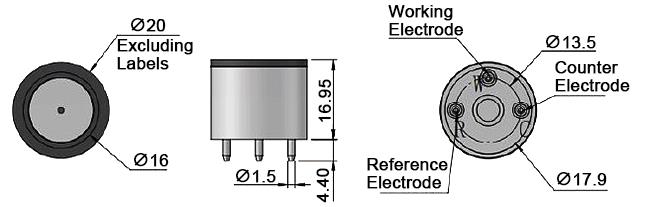
Details and Dimensions (Unit: mm)
Characterization
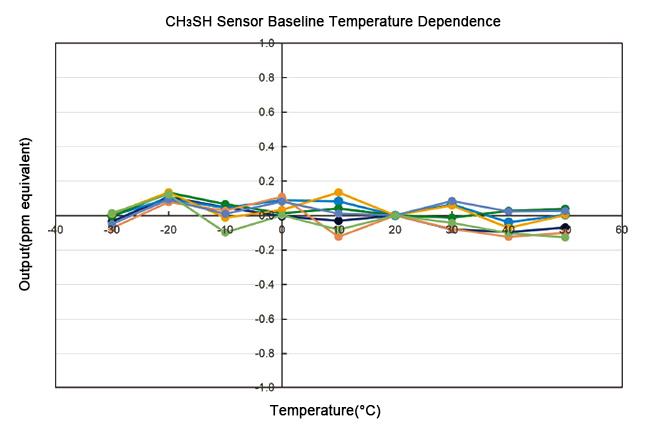
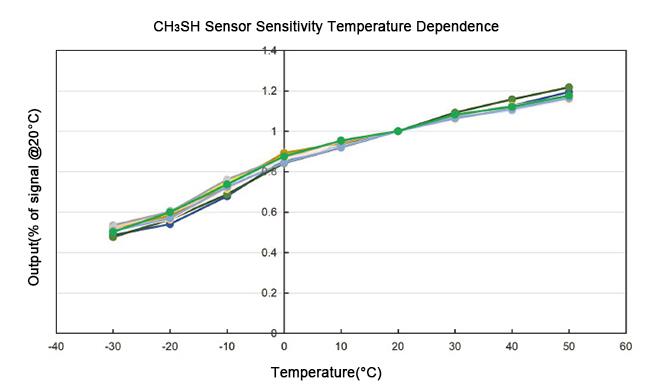
Application

5 Tips for Methanethiol (CH3SH) Gas Sensor
- Avoid exposing the methanethiol sensor to organic solvents, alcohols, oils, high-concentration gases, and corrosive environments, as these can damage the sensing element.
- For accurate calibration of this CH3SH gas sensor, always use standard target gas balanced in clean air. Avoid using interfering gases for calibration due to potential inaccuracies.
- Do not test the gas sensor with non-standard methods, such as exposing it directly to concentrated vapors (e.g., from ammonia water, alcohol, or human breath), as extremely high concentrations can permanently damage it.
- Ensure stable and gentle airflow during calibration or testing of the gas sensor to simulate gas diffusion conditions; unstable or forceful airflow can lead to poor accuracy and repeatability.
- The gas detector sensor pins must be connected via a PCB socket; soldering directly onto the pins or bending them can cause damage.
Product reviews
Works Well for Gas Monitoring
Orlaith

9/28/2026 7:07 PM
We installed this methanethiol gas sensor for routine gas monitoring, and it has performed consistently. The compact size made installation straightforward, while the low power consumption was useful for continuous monitoring. The readings have been stable and reliable, making it a practical choice for our application.
Was this review helpful?
(0/0)
Only registered users can write reviews
Related products

Ammonian (NH3) Gas Sensor, 0-100ppm
ATO-GS-NH3
$269.68
The ammonian (NH3) gas sensor is a highly accurate detector for domestic and industrial use, detecting NH3 in the range of 0-100ppm. It utilizes electrochemical three-electrode technology, with a resolution of 1ppm, an error of ≤±3%, a repeatability of ≤±1%, a DC 5V power supply, a power consumption of ≤1W, and a fast response time of 90 seconds, as well as reliable Modbus-RTU communication. With 90 seconds fast response and reliable Modbus-RTU communication, it is an ideal choice for home/ industry gas detection.

Carbon Monoxide (CO) Gas Sensor, 0 to 1000ppm
ATO-GS-CO-ACM
$54.22
Factory price CO gas sensor provides electrochemical principle, 0ppm to 1000ppm detection range, high sensitivity, low power consumption, fast response & recovery and simple driving circuit, perfect for Carbon Monoxide leak detection for residential or industrial use.

Chlorine (Cl2) Gas Sensor, 0-20ppm/0-50ppm/0-100ppm
ATO-GS-CL2
$206.34
Chlorine (Cl2) gas sensor sold at a discount, measures 0~20ppm, 0~50ppm, and 0~100ppm ranges with ±10% accuracy and resolutions of 1ppm or 0.1ppm, operates on 10~30V DC with RS485 and 4-20mA/0-5V/0-10V output signals, consuming 0.12W or 0.25W. Suitable for workshops, chemical plants, electronic industry, confined living places and other occasions that require real-time monitoring of chlorine concentration.

Formaldehyde (CH2O) Gas Sensor, 0-10ppm
ATO-GS-CH2O
$165.71
ATO formaldehyde (CH2O) gas sensor, now on sale, offers precise detection with a 50 ppm load concentration and 0.55 ± 0.15 μA/ppm sensitivity at 20°C. Engineered for stability with <1 ppm baseline drift and 0.1 ppm resolution, it operates from -20°C to +50°C, ideal for home environmental monitoring and industrial safety. Act now to secure this high-quality CH2O sensor at a competitive price.