
This air quality sensor measures temperature (-40~+80°C), humidity (0%RH-100%RH), and particulate matter (PM2.5, PM10, PM1.0) with a range of 0-1000μg/m3 and a resolution of 1μg/m3. It offers an accuracy of ±3%FS (@0-100μg/m³, 25°C, 50%RH).
Specification
| Power Supply (DC) | 10~30V DC |
| Power Consumption | 0.5W |
| PM2.5 Measurement Range | 0~1000μg/m3 |
| PM10 Measurement Range | 0~1000μg/m3 |
| PM1.0 Measurement Range | 0~1000μg/m3 |
| Temperature Measurement Range | -40~+80℃ |
| Humidity Measurement Range | 0%RH-100%RH |
| Operating Humidity | 0% RH~95% RH (non-condensing) |
| Transmitter Circuit Operating Environment | -20°C~+60°C |
| Output Signal | RS485, 4-20mA, 0-5V, 0-10V optional (4G/wifi contact customer service) |
| Communication Interface | RS485 (ModBus) Protocol |
| Baud Rate | 2400, 4800, 9600 (default) |
| Data Length | 8 bits |
| Parity Check Mode | None |
| Stop Bits | 1 |
| Default ModBus Address | 1 |
| Parameter Configuration | Configured via provided software through RS485 interface |
| Resolution | PM2.5/PM10/PM1.0: 1 µg/m3 |
| Temperature: 0.1°C | |
| Humidity: 0.1% RH | |
| Accuracy (default) | PM2.5: ±3%FS(@0~100μg/m3, 25℃, 50%RH) |
| Temperature: ±0.5℃(25℃); Humidity: ±3%RH(60%RH, 25℃) |
Feature
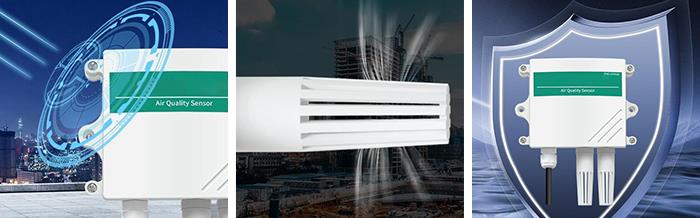
- Automatic Calibration with High Consistency: Air quality sensor equipped with dual-frequency data collection and automatic calibration technology, ensuring high consistency of up to ±10%.
- Advanced Laser Dust Reduction Technology: Utilizes cutting-edge laser dust reduction technology to ensure long-term stable data without drift.
- Fast Response and High Accuracy: Air quality sensor uses a series sampling probe with fast response speed and higher accuracy for better measurement precision.
- Multiple Signal Outputs: Industrial air quality sensor supports multiple output signals such as RS485, 4-20mA, 0-5V, 0-10V, WiFi, and 4G to meet different monitoring requirements in various environments.
- High Protection for Outdoor Use: Designed with high protection for outdoor use, resistant to dust, rain, and snow, making it suitable for monitoring in harsh weather conditions.
Dimension
Wiring Method
| Gray | Power Supply (+10~30V DC) |
| Black | Power Supply (Negative) |
| Yellow | Communication (RS485-A) |
| Blue | Communication (RS485-B) |
Application
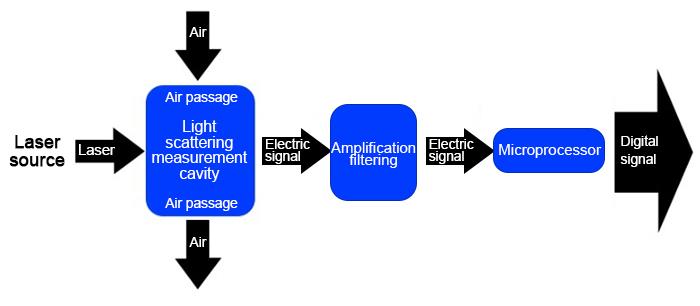
Tips: What is the laser scattering principle for air quality sensors?
The laser light is scattered on the suspended particles in the air, and the scattered light is collected at a specific angle to obtain the curve of the scattered light intensity with time. The microprocessor then uses an algorithm based on Mie theory to derive the equivalent particle size of the particulate matter and the number of particles of different sizes per unit volume.
Only registered users can write reviews
Related products

Air Quality Monitor Sensor, CH2O/CH4/CO2, RS485/WIFI Output
ATO-AQS-SMG111
$276.34
High-quality air quality monitor sensor supports formaldehyde (CH2O), carbon dioxide (CO2) and methane (CH4) detection, low cost, wide detection range, support DC 10-30V power supply, power consumption as low as 1.5W, with RS485 or WIFI signal output, easy to remote monitoring and data transmission.

Indoor Air Quality Sensor, Temp/Humidity/PM2.5/PM10/H2S/CO2
ATO-AQS-HAQS
$317.56
Indoor air quality sensor low price for sale, measures temperature -20°C~+60°C, humidity 0~100% RH, PM2.5 0-1000ug/m3, PM10 0-2000ug/m3, H2S 0~100ppm, CO2 0~2000ppm, illumination 0-200Klux. Air particle sensor uses RS485 communication method, 12-24VDC power supply. The air quality sensor is suitable for a wide range of indoor locations, homes, schools, underground garages, hospitals and more.

Laser PM2.5 Air Quality Sensor
ATO-AQS-D7
$64.31
The highly efficient, low-energy laser PM2.5 air quality sensor has a particulate matter measurement range of 0.3–10 µm, and it provides PWM and UART outputs for particulate matter concentrations, making it suitable for a variety of air quality monitoring applications.