3 Axis Accelerometer Sensor, 4–20mA Output, ±2g to ±40g

$1,289.60
Current output accelerometer sensor at affordable price, with 4-20mA output current, three measuring axis X, Y, Z, deviation temperature coefficient 0.01%/°C or 0.05%/°C, 500Hz frequency response. Three axis accelerometer sensor can be used in vibration testing, impact testing and other fields.
SKU: ATO-AS-AKF398
*
*
Free Shipping
Delivery date: 8-12 days

Lower cost 3-axis accelerometer sensor with 21μg/ Hz or 86.6μg/ Hz noise density, MIL-HDBK-217, Grade 2 reliability. It offers low power consumption which has been calibrated, and a solid structure and stable output.

Parameters

ModelATO-AKF398
Measuring Range±2g±4g±8g±10g±20g±40g
Sensitivity4±10% (mA/g)2±10% (mA/g)1±10% (mA/g)0.8±10% (mA/g)0.4±10% (mA/g)0.2±10% (mA/g)
Lateral Vibration Sensitivity Ratio1%1%2%5%5%5%
Nonlinearity<0.5% FS (highest)<0.5% FS (highest)<0.8% FS (highest)<1% FS (highest)<1% FS (highest)<1% FS (highest)
Deviation Temperature Coefficient0.01%/°C (Typical value)0.01%/°C (Typical value)0.01%/°C (Typical value)0.05%/°C (Typical value)0.05%/°C (Typical value)0.05%/°C (Typical value)
Cross-axis Sensitivity1%1%1%2%2%2%
Resonance Frequency2.4kHz2.4kHz2.4kHz5.5kHz5.5kHz5.5kHz
Noise Density21μg/Hz21μg/Hz21μg/Hz86.6μg/Hz86.6μg/Hz86.6μg/Hz
0g Output 12mA<0.005<0.005<0.005<0.003<0.003<0.003
Deviation Calibration<1mg
Measuring AxisX, Y, Z
Up/ off Power Repeatablity<2mg (highest)
Resolution/ Threshold<1 @1Hz (mg) (highest)
Frequency Response500Hz
Bandwidth1000 (3Db) (Hz)
Output Current4-20mA
ReliabilityMIL-HDBK-217, Grade 2
Shock Resistance100g@11ms, Triaxial And Identical (Half Sine Wave)
Recovery Time<1ms (1000g, 1/2 Sin 1ms, Shock Acting On The i Axis)
Vibration20g Rms, 20-2000Hz (Random Noise, o, p, i Per Axis For Action 30 Minutes)
Input9-36 VDC (Vdd_Vss)
Running Current Consumption<60mA @ 12 VDC
ConnectorIndustrial standard M12 connector
Weight73.5g
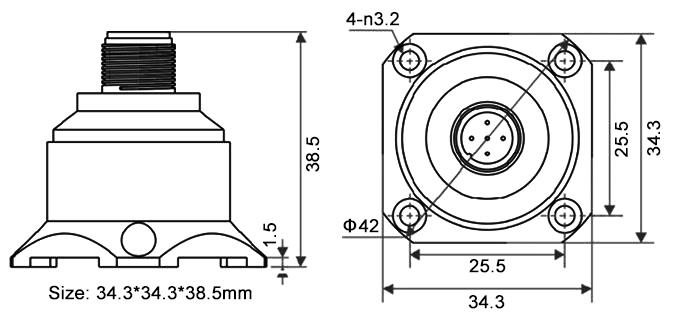
Dimension34.3*34.3*38.5mm
CertificateCE
Warranty12 months


Dimension (unit: mm)

Dimension of 3 axis accelerometer sensor

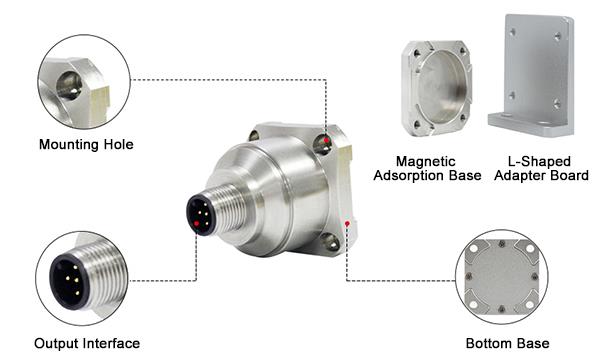
Details

3 axis accelerometer sensor details

Dimension of Mounting Fittings (unit: mm)
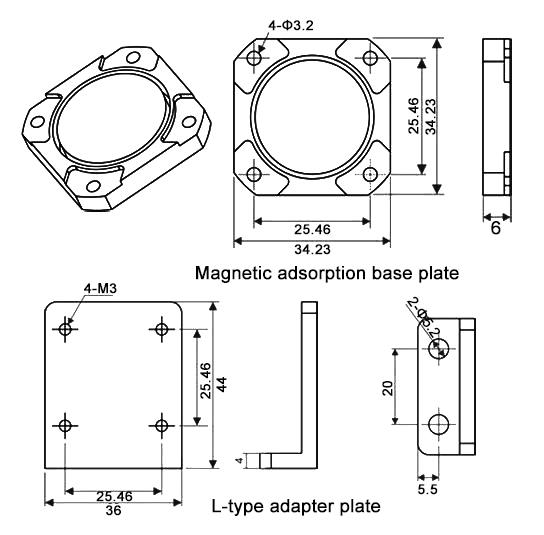
Mounting dimension of 3 axis accelerometer sensor

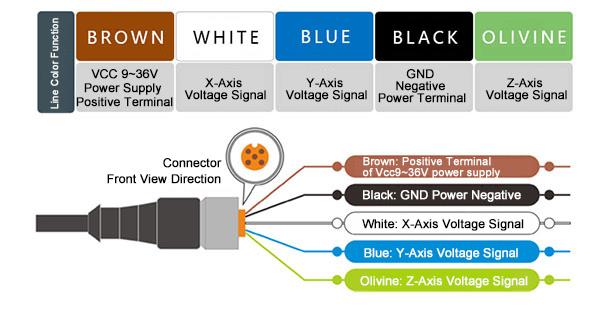
Electrical Connection

Electrical connection of 3 axis acceleromrter sensor

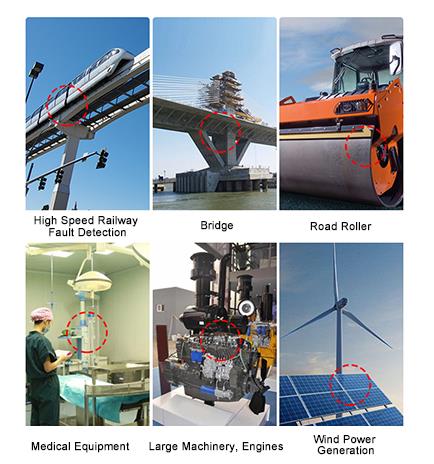
Applications

3 axis accelerometer sensor applications

Tips: Selection Guide of Triaxial Accelerometer Sensor

Sensitivity

Generally speaking, the more sensitive the better. The more sensitive the sensor is more sensitive to changes in acceleration within a certain range, and the greater the change in output voltage, which makes it easier to measure and obtain more accurate measurement values. The minimum acceleration measurement value is also called the minimum resolution. Taking into account the noise problem of the post-amplification circuit, it should be as far away as possible from the minimum available value to ensure the best signal-to-noise ratio. The maximum measurement limit should consider the non-linear influence of the accelerometer itself and the maximum output voltage of the subsequent instrument. The estimation method is: the maximum measured acceleration × the charge/voltage sensitivity of the sensor.

Whether the above value exceeds the maximum input charge/voltage value of the supporting instrument, it is recommended that if the measured acceleration range is known, it can be selected in the "reference range range" in the sensor index (taking into account the frequency response and weight). At the same time, in the frequency response and weight If allowed, the sensitivity can be considered higher to increase the input signal of subsequent instruments and improve the signal-to-noise ratio.

Product reviews
I like their service very much
5
Deeje
Avatar
11/22/2021 11:27 PM
Since I bought a three-axis accelerometer sensor for the first time, I don't know how to use it. I asked the customer service a lot of simple and basic questions, the customer service was not impatient, and the answer to each question was very professional.
Was this review helpful? Yes No (0/0)
Optimised output interface
5
Zarchary
Avatar
9/8/2023 2:08 AM
What sets this sensor apart is its current output interface. It simplifies the wiring and integration process, and the output signal is not affected by cable length, which is a significant advantage in my setup. The sensor's current output is not only reliable but also easily adaptable to various data acquisition systems.
Was this review helpful? Yes No (0/0)
Write your review
  • Only registered users can write reviews
*
*
  • Bad
  • Excellent
*
*
*
*

Lower cost 3-axis accelerometer sensor with 21μg/ Hz or 86.6μg/ Hz noise density, MIL-HDBK-217, Grade 2 reliability. It offers low power consumption which has been calibrated, and a solid structure and stable output.

Parameters

ModelATO-AKF398
Measuring Range±2g±4g±8g±10g±20g±40g
Sensitivity4±10% (mA/g)2±10% (mA/g)1±10% (mA/g)0.8±10% (mA/g)0.4±10% (mA/g)0.2±10% (mA/g)
Lateral Vibration Sensitivity Ratio1%1%2%5%5%5%
Nonlinearity<0.5% FS (highest)<0.5% FS (highest)<0.8% FS (highest)<1% FS (highest)<1% FS (highest)<1% FS (highest)
Deviation Temperature Coefficient0.01%/°C (Typical value)0.01%/°C (Typical value)0.01%/°C (Typical value)0.05%/°C (Typical value)0.05%/°C (Typical value)0.05%/°C (Typical value)
Cross-axis Sensitivity1%1%1%2%2%2%
Resonance Frequency2.4kHz2.4kHz2.4kHz5.5kHz5.5kHz5.5kHz
Noise Density21μg/Hz21μg/Hz21μg/Hz86.6μg/Hz86.6μg/Hz86.6μg/Hz
0g Output 12mA<0.005<0.005<0.005<0.003<0.003<0.003
Deviation Calibration<1mg
Measuring AxisX, Y, Z
Up/ off Power Repeatablity<2mg (highest)
Resolution/ Threshold<1 @1Hz (mg) (highest)
Frequency Response500Hz
Bandwidth1000 (3Db) (Hz)
Output Current4-20mA
ReliabilityMIL-HDBK-217, Grade 2
Shock Resistance100g@11ms, Triaxial And Identical (Half Sine Wave)
Recovery Time<1ms (1000g, 1/2 Sin 1ms, Shock Acting On The i Axis)
Vibration20g Rms, 20-2000Hz (Random Noise, o, p, i Per Axis For Action 30 Minutes)
Input9-36 VDC (Vdd_Vss)
Running Current Consumption<60mA @ 12 VDC
ConnectorIndustrial standard M12 connector
Weight73.5g
Dimension34.3*34.3*38.5mm
CertificateCE
Warranty12 months


Dimension (unit: mm)

Dimension of 3 axis accelerometer sensor

Details

3 axis accelerometer sensor details

Dimension of Mounting Fittings (unit: mm)

Mounting dimension of 3 axis accelerometer sensor

Electrical Connection

Electrical connection of 3 axis acceleromrter sensor

Applications

3 axis accelerometer sensor applications

Tips: Selection Guide of Triaxial Accelerometer Sensor

Sensitivity

Generally speaking, the more sensitive the better. The more sensitive the sensor is more sensitive to changes in acceleration within a certain range, and the greater the change in output voltage, which makes it easier to measure and obtain more accurate measurement values. The minimum acceleration measurement value is also called the minimum resolution. Taking into account the noise problem of the post-amplification circuit, it should be as far away as possible from the minimum available value to ensure the best signal-to-noise ratio. The maximum measurement limit should consider the non-linear influence of the accelerometer itself and the maximum output voltage of the subsequent instrument. The estimation method is: the maximum measured acceleration × the charge/voltage sensitivity of the sensor.

Whether the above value exceeds the maximum input charge/voltage value of the supporting instrument, it is recommended that if the measured acceleration range is known, it can be selected in the "reference range range" in the sensor index (taking into account the frequency response and weight). At the same time, in the frequency response and weight If allowed, the sensitivity can be considered higher to increase the input signal of subsequent instruments and improve the signal-to-noise ratio.

Product reviews
I like their service very much
5
Deeje
Avatar
11/22/2021 11:27 PM
Since I bought a three-axis accelerometer sensor for the first time, I don't know how to use it. I asked the customer service a lot of simple and basic questions, the customer service was not impatient, and the answer to each question was very professional.
Was this review helpful? Yes No (0/0)
Optimised output interface
5
Zarchary
Avatar
9/8/2023 2:08 AM
What sets this sensor apart is its current output interface. It simplifies the wiring and integration process, and the output signal is not affected by cable length, which is a significant advantage in my setup. The sensor's current output is not only reliable but also easily adaptable to various data acquisition systems.
Was this review helpful? Yes No (0/0)
Only registered users can write reviews