
Buy three phase servo motor for CNC machine spindle control. Motor power 9500W, rated voltage 380V, max speed 6000 rpm, high torque 60 Nm. The asynchronous servo spindle motor is equipped with a high speed photoelectric encoder. It is suitable for various CNC tool, milling tool, router and industrial automation. Matched driver and brake resistor is provided for choose.
Basic Specifications
- Model: ATO-250ZJY-4-9.5-15
- Rated Power: 9.5 kW
- Rated Torque: 60 Nm
- Rated Voltage: AC 3-Phase 380V±15%
- Rated Current: 19A
- Rated Speed: 1500 rpm
- Max Speed: 6000 rpm
- Rated Frequency: 50Hz
- Weight: 92 kg
Technical Parameters
- Number of Poles: 4
- Rotor Inertia: 0.01 G.D2
- Incremental Encoder Line: 2500PPR
- Installation Method: Flange installation
- Fan Power: 75W
- Fan Voltage: AC 380V
- Insulation Class: F
- Safety Class: IP54
- Insulation and Voltage Resistance: AC 1500V, 1 minute
- Insulation Resistance: DC 500V, 10M above
- Work System: Continuous
Features
- The AC servo spindle motor is a 3-phase AC induction servo motor, compact structure, small size, high torque.
- AC servo spindle motor adopts best electromagnetic design, high-speed photoelectric encoder, high precision bearings and F level insulation.
- AC servo spindle motor is in easy use, stable operation, high control precision, low electromagnetic noise, high efficiency, long service life and high performance price ratio.
- AC servo spindle motor is widely used in digital control machine, laser machine, milling machine, embroidery machine, textile machinery, printing machinery, packaging machinery, engraving machine, winding machine, three-coordinates measuring machine, industrial robot, medical equipment, woodworking router and other CNC machine.
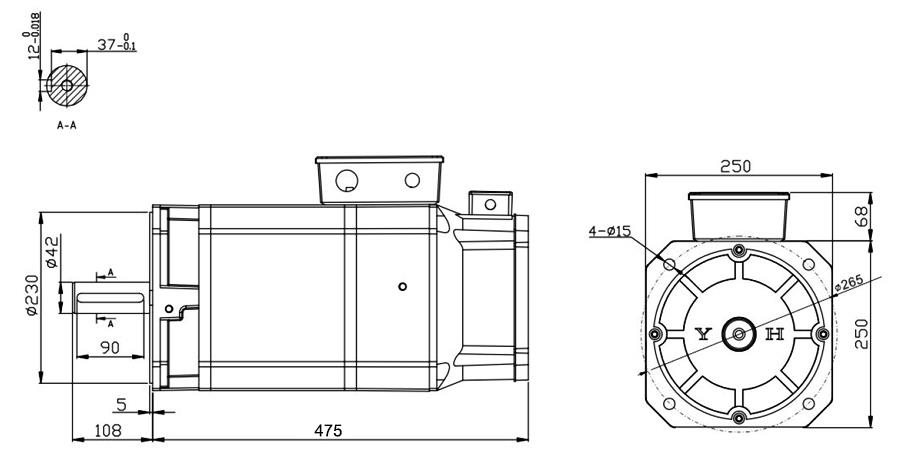
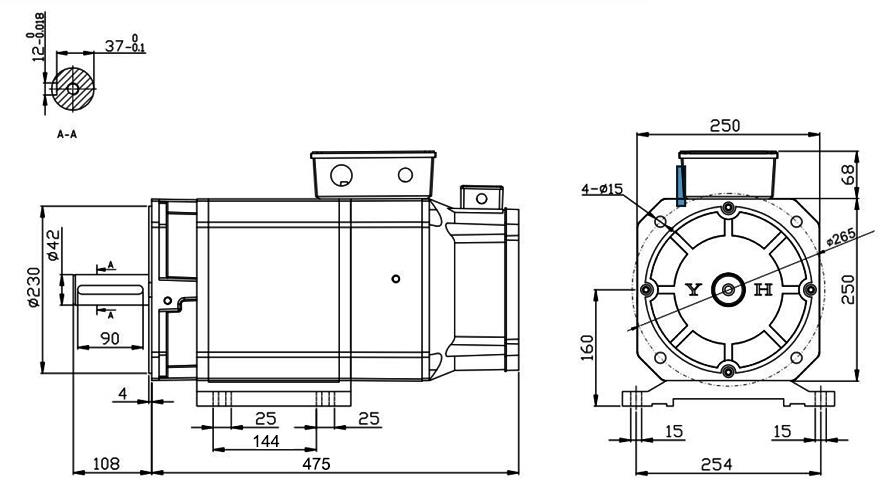
Installation Dimension (Unit: mm)
Vertical Installation:
Horizontal Installation:
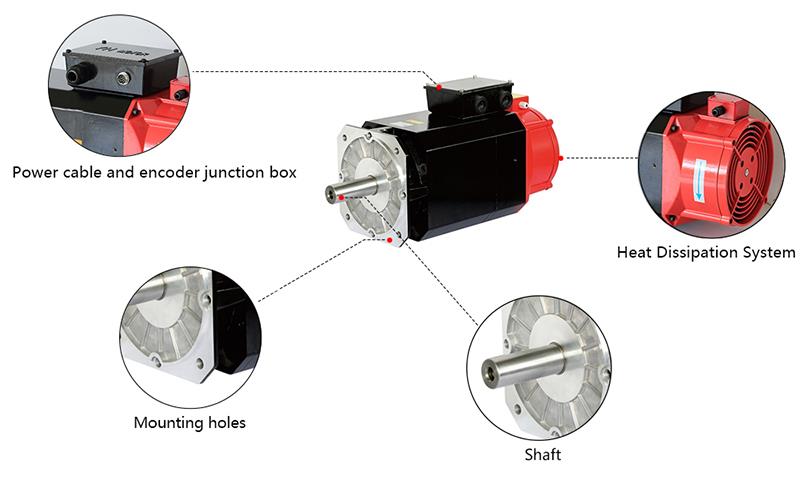
Details
Tips: Precautions for using AC servo spindle motor.
- U, V, and W wiring of the AC servo spindle motor must maintain the corresponding relationship with the U, V, and W terminals of controller respectively.
- It is forbidden to knock the shaft end of AC servo spindle motor or force the motor axially to avoid damaging the encoder and motor bearings.
- Ensure that the ground terminal in junction box of the AC servo spindle motor is effectively grounded.
- When AC servo spindle motor is running, the cooling fan must be ensured to work normally.
- During operation, the surface temperature of AC servo spindle motor is relatively high. Avoid touching it with hands to prevent scald.
- When wiring the fan, ensure that wind direction of the fan is consistent with the indicating plate.
Product reviews
Use time of 9.5kW AC servo spindle motor
Djsclient

7/22/2021 7:34 PM
Is the shelf life of this 9.5W AC servo spindle motor long?
Was this review helpful? (0/0)
Special Requirements
Elena
6/12/2024 12:02 AM
We need the dyno motor top speed to reach at least 500rpm and act like a generator as well. For example in our test, the electric bike motor will output about 100Nm at 70rpm, and 30Nm at 440rpm. We need the dyno motor to provide a load that matches this torque, which means it will act as a generator, converting the mechanical power of the motor under test into electrical power to act as a "brake" or "load" on the motor under test.
Our requirements are as below:
Motoring Mode (quadrant 1 and 3) (For ebike brake testing)
>120Nm at >100rpm for >1 minutes
>60Nm at >500rpm continuously
Summary of how Motoring Mode will work:
The dyno motor output speed will be controlled by a test operator using a dial or programming. In this test, the operator would set the motor speed to about 300rpm. Then the operator will engage the ebike brakes while the motor tries to maintain 300rpm, and measure the output torque/speed using the ATO torque sensor.
Generator Mode (quadrant 2 and 4) (For ebike motor testing)
>120Nm at >100rpm for >1 minutes
>30Nm at >500rpm continuously
Summary of how Generator Mode will work:
The load amount from the dyno motor will be controlled by a test operator using a dial or programming. In this test, the operator would slowly increase the load on the electric bike motor from ~0Nm to ~120Nm and measure the output torque/speed using the ATO torque sensor.
Would the ATO-SERVO-9560 motor be able to meet these requirements?
Was this review helpful? (0/0)
Only registered users can write reviews
Related products

3 hp (2.2 kW) AC Servo Spindle Motor, 14 Nm, 1460 rpm
ATO-SERVO-314
$869.75
AC servo spindle motor for sale, optional controller and brake resistor. Rated power 3 hp (2.2 kW), working voltage 3-phase 220V/380V, speed 1460 rpm (max 6000 rpm), torque 14 Nm. AC asynchronous servo motor with high speed photoelectric encoder, especially for CNC machine spindle control, small size, low price, manufacturer direct sale.

5 hp (3.7 kW) AC Servo Spindle Motor, 24 Nm, 1460 rpm
ATO-SERVO-524
$2,298.46
Buy good price servo spindle motor from manufacturer. Working power 5 hp (3.7 kW), rated voltage 220V/380V, rated speed 1460 rpm, max 6000 rpm, torque 24 Nm. 3-phase AC asynchronous servo motor used in CNC machine spindle control, equipped with photoelectric encoder, matching controller and brake resistor for selection.

5.5 kW AC Servo Spindle Motor, 35 Nm, 1460 rpm
ATO-SERVO-5535
$1,174.77
Powerful AC servo spindle motor works at 5.5 kW rated power. Working voltage three phase 220V/380V, rated speed 1460 rpm (maximum 6000 rpm), high torque 35 Nm, high-speed photoelectric encoder. AC asynchronous servo spindle motor with economical price. Controller and brake resistor for optional configuration.

10 hp (7.5 kW) AC Servo Spindle Motor, 50 Nm, 1460 rpm
ATO-SERVO-1050
$1,546.23
High torque AC servo spindle motor for sale. Rated power 10 hp (7.5 kW), working voltage 220V/380V, operating speed 1460 rpm with max 6000 rpm, torque 50 Nm, built with photoelectric encoder, available matching controller and brake resistor. 3-phase AC asynchronous servo motor for CNC machine spindle control, industrial grade, competitive price.

11 kW AC Servo Spindle Motor, 70 Nm, 1500 rpm
ATO-SERVO-1170
$2,249.69
Competitive price AC servo spindle motor with 70 Nm high torque. Industrial-grade power 11 kW, rated voltage 3-phase 380V, working speed 1500 rpm, max 6000 rpm, equipped with photoelectric encoder. Asynchronous servo motor controls CNC machine spindle, matched controller and brake resistor is provided.