3" Manual Angle Seat Valve

$301.99
Economical price manual angle seat valve is a fluid control valve designed for reliable operation in various industrial applications. Featuring a durable 304 stainless steel body and 3 inch (DN80) thread port, this angle seat piston valve ensures longevity and resistance to corrosion. A manual handwheel allows you can easily adjust flow rates, making it ideal for precise fluid regulation.
SKU: ATO-MANGLE-DN80
Free Shipping
Delivery date: 6-12 days

Factory price DN80 angle seat valve features a manual handwheel for convenient manual operation, providing users with the flexibility to adjust flow rates as needed. Durable construction and reliable PTFE sealing make it suitable for various media, enhancing efficiency in fluid control systems.

Specification

  • Model: ATO-MANGLE-DN80
  • Thread Port Size: 3 inch (DN80)
  • Working Medium: Air, Water, Oil, Gas, Steam
  • Body Material: 304 Stainless Steel
  • Driving Mode: Manual
  • Nominal Pressure: 1.6Mpa
  • Connection type: Internal thread

Manual Angle Seat Valve Dimension
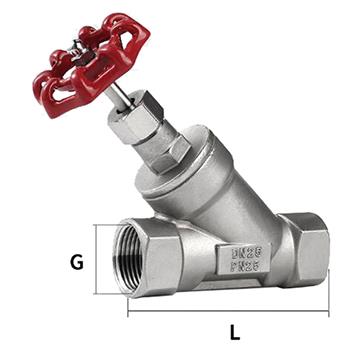
Manual angle seat valve dimension

  • G: 3 inch (DN80)
  • L: 210mm

Tips: Difference between an angle seat valve and a ball valve

Angle seat valves and ball valves are both types of industrial valves used to control the flow of fluids, but they have distinct differences.

Angle seat valves have a body with an angled seat and a linearly moving piston or plug. When the valve is actuated, the piston or plug lifts off the seat to allow flow or seals against it to stop flow. They are suitable for a wide range of applications, including controlling steam, air, and aggressive fluids. Angle seat valves offer precise control and can handle high flow rates.

Ball valves, on the other hand, have a spherical closure element (a ball) with a hole in it. They rotate a quarter turn to open or close the flow passage. Ball valves are known for their fast operation, tight sealing, and minimal pressure drop. They are commonly used in applications where quick shut-off is required, such as in water, gas, or oil systems.

The key difference is in the design and operation: angle seat valves use a linear motion to control flow, while ball valves use a rotational motion, making them suitable for different purposes.

Proposition 65 Warning

*WARNING: This product can expose you to chemicals, including lead, which is known to the State of California to cause birth defects or other reproductive harm. For more information, go to www.P65Warnings.ca.gov.

Product reviews
Reliable and cost-effective valve
4
Liam
Avatar
9/29/2025 8:53 PM
I purchased the 3" manual angle seat valve for my industrial setup, and it has exceeded expectations. The 304 stainless steel body feels solid and durable, and I appreciate the corrosion resistance in daily use. The handwheel makes it very easy to adjust flow rates with precision, and the threaded port fit perfectly without leaks. Overall, it’s a reliable and cost-effective valve for fluid control.
Was this review helpful? Yes No (0/0)
Write your review
  • Only registered users can write reviews
*
*
  • Bad
  • Excellent
*
*
*
*

Factory price DN80 angle seat valve features a manual handwheel for convenient manual operation, providing users with the flexibility to adjust flow rates as needed. Durable construction and reliable PTFE sealing make it suitable for various media, enhancing efficiency in fluid control systems.

Specification

  • Model: ATO-MANGLE-DN80
  • Thread Port Size: 3 inch (DN80)
  • Working Medium: Air, Water, Oil, Gas, Steam
  • Body Material: 304 Stainless Steel
  • Driving Mode: Manual
  • Nominal Pressure: 1.6Mpa
  • Connection type: Internal thread

Manual Angle Seat Valve Dimension

Manual angle seat valve dimension

  • G: 3 inch (DN80)
  • L: 210mm

Tips: Difference between an angle seat valve and a ball valve

Angle seat valves and ball valves are both types of industrial valves used to control the flow of fluids, but they have distinct differences.

Angle seat valves have a body with an angled seat and a linearly moving piston or plug. When the valve is actuated, the piston or plug lifts off the seat to allow flow or seals against it to stop flow. They are suitable for a wide range of applications, including controlling steam, air, and aggressive fluids. Angle seat valves offer precise control and can handle high flow rates.

Ball valves, on the other hand, have a spherical closure element (a ball) with a hole in it. They rotate a quarter turn to open or close the flow passage. Ball valves are known for their fast operation, tight sealing, and minimal pressure drop. They are commonly used in applications where quick shut-off is required, such as in water, gas, or oil systems.

The key difference is in the design and operation: angle seat valves use a linear motion to control flow, while ball valves use a rotational motion, making them suitable for different purposes.

Product reviews
Reliable and cost-effective valve
4
Liam
Avatar
9/29/2025 8:53 PM
I purchased the 3" manual angle seat valve for my industrial setup, and it has exceeded expectations. The 304 stainless steel body feels solid and durable, and I appreciate the corrosion resistance in daily use. The handwheel makes it very easy to adjust flow rates with precision, and the threaded port fit perfectly without leaks. Overall, it’s a reliable and cost-effective valve for fluid control.
Was this review helpful? Yes No (0/0)
Only registered users can write reviews