2240 Nm Drum Gear Coupling, 5900 rpm

$365.89
The 2240 Nm gear coupling has a compact and lightweight design for easy installation and dismantling, reducing downtime and increasing productivity. Drum gear coupling's robust construction and high torque capability make it ideal for use in industries such as mining, construction and manufacturing.
SKU: ATO-GC-GICL3
*
*
*
Free Shipping
Delivery date: 6-12 days

Buy a low priced drum gear coupling online that has a nominal torque of 2240 Nm and a permissible speed of 5900 rpm. ATO drum gear couplings are easy to maintain and repair, allowing your machines to run smoothly and efficiently.

Specification

ModelATO-GC-GICL3
Nominal Torque2240 Nm
Allowable Speed5900 rpm
Shaft Hole Diameterd1, d2, dz30, 32, 35, 3840, 42, 45, 50, 55, 5660
Shaft Hole LengthY,L82112142
J1,Z16084107
DimensionD174
D1140
A106
C3
C124.51717
C2252835
Moment of Inertia0.047 kg*m2
Grease Dosage140mL
Weight17.2kg


Features

  • 2240 Nm drum gear couplings can transmit high levels of torque due to their large contact area and robust construction.
  • Drum couplings can accommodate both angular and parallel misalignments, which can help reduce wear and tear on the connected equipment.
  • Drum gear couplings require minimal maintenance, thanks to their rugged design and few moving parts.
  • Gear couplings operate with low vibration and noise, which helps to ensure smooth and efficient power transmission.
  • These gear couplings operate with low vibration and noise, which helps to ensure smooth and efficient power transmission.

Dimension (Unit: mm)
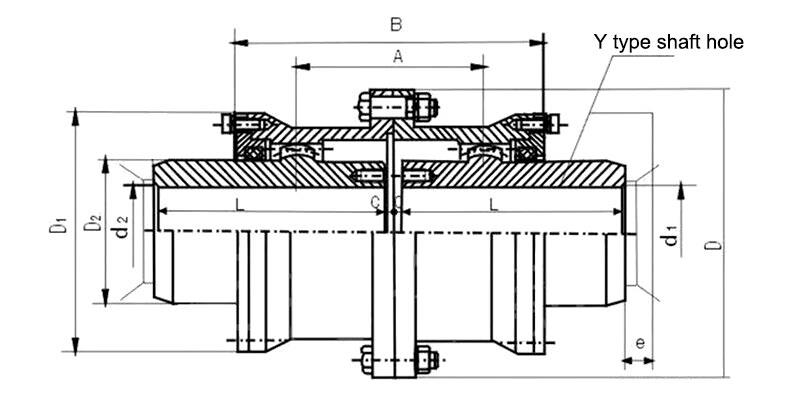
Gear coupling dimension

Drum gear coupling dimension

Applications

Gear couplings are commonly used in heavy machineries such as steel mills, mining equipment, power generation, and paper mills. Additionally, gear couplings are frequently utilized in marine applications, such as propulsion systems and winches, due to their high torque capacity and ability to handle harsh environments.

Gear coupling applications.

Tips: What are the different types of gear couplings?

Gear couplings are a type of flexible coupling used to transmit torque between two shafts that are not aligned perfectly. There are several different
types of gear couplings, including:

  • Full gear coupling: A full gear coupling consists of two hubs with external teeth and a sleeve with internal teeth. The hubs and sleeve are bolted together to form a rigid unit that transmits torque between the two shafts.
  • Half gear coupling: A half gear coupling is similar to a full gear coupling, but it only has teeth on one half of the coupling. The other half is smooth, allowing for some misalignment between the shafts.
  • Floating shaft gear coupling: A floating shaft gear coupling consists of two hubs, each with internal and external teeth, and an intermediate shaft with a set of gears. The intermediate shaft floats between the two hubs, allowing for some misalignment between the shafts.
  • Spacer gear coupling: A spacer gear coupling is similar to a floating shaft gear coupling, but instead of an intermediate shaft, it has a spacer with internal and external teeth. The spacer floats between the two hubs, allowing for some misalignment between the shafts.
  • Sleeve gear coupling: A sleeve gear coupling consists of two hubs with internal teeth and a sleeve with external teeth. The hubs and sleeve are bolted together to form a rigid unit that transmits torque between the two shafts.

Each type of gear coupling has its own advantages and disadvantages, and the choice of coupling will depend on the specific application and requirements.

Proposition 65 Warning

*WARNING: This product can expose you to chemicals, including lead, which is known to the State of California to cause birth defects or other reproductive harm. For more information, go to www.P65Warnings.ca.gov.

Write your review
  • Only registered users can write reviews
*
*
  • Bad
  • Excellent
*
*
*
*

Buy a low priced drum gear coupling online that has a nominal torque of 2240 Nm and a permissible speed of 5900 rpm. ATO drum gear couplings are easy to maintain and repair, allowing your machines to run smoothly and efficiently.

Specification

ModelATO-GC-GICL3
Nominal Torque2240 Nm
Allowable Speed5900 rpm
Shaft Hole Diameterd1, d2, dz30, 32, 35, 3840, 42, 45, 50, 55, 5660
Shaft Hole LengthY,L82112142
J1,Z16084107
DimensionD174
D1140
A106
C3
C124.51717
C2252835
Moment of Inertia0.047 kg*m2
Grease Dosage140mL
Weight17.2kg


Features

  • 2240 Nm drum gear couplings can transmit high levels of torque due to their large contact area and robust construction.
  • Drum couplings can accommodate both angular and parallel misalignments, which can help reduce wear and tear on the connected equipment.
  • Drum gear couplings require minimal maintenance, thanks to their rugged design and few moving parts.
  • Gear couplings operate with low vibration and noise, which helps to ensure smooth and efficient power transmission.
  • These gear couplings operate with low vibration and noise, which helps to ensure smooth and efficient power transmission.

Dimension (Unit: mm)
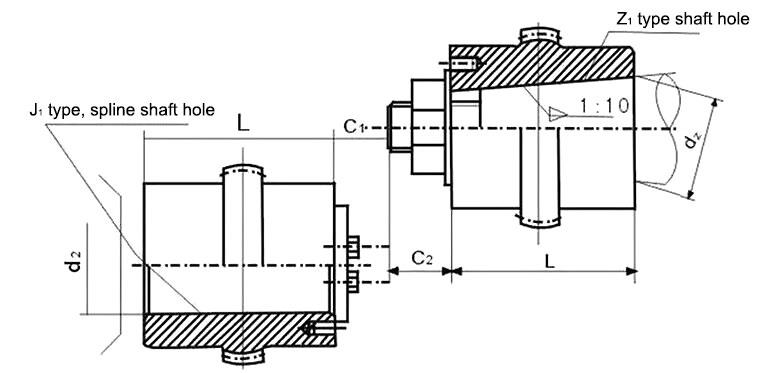
Gear coupling dimension

Drum gear coupling dimension

Applications

Gear couplings are commonly used in heavy machineries such as steel mills, mining equipment, power generation, and paper mills. Additionally, gear couplings are frequently utilized in marine applications, such as propulsion systems and winches, due to their high torque capacity and ability to handle harsh environments.

Gear coupling applications.

Tips: What are the different types of gear couplings?

Gear couplings are a type of flexible coupling used to transmit torque between two shafts that are not aligned perfectly. There are several different
types of gear couplings, including:

  • Full gear coupling: A full gear coupling consists of two hubs with external teeth and a sleeve with internal teeth. The hubs and sleeve are bolted together to form a rigid unit that transmits torque between the two shafts.
  • Half gear coupling: A half gear coupling is similar to a full gear coupling, but it only has teeth on one half of the coupling. The other half is smooth, allowing for some misalignment between the shafts.
  • Floating shaft gear coupling: A floating shaft gear coupling consists of two hubs, each with internal and external teeth, and an intermediate shaft with a set of gears. The intermediate shaft floats between the two hubs, allowing for some misalignment between the shafts.
  • Spacer gear coupling: A spacer gear coupling is similar to a floating shaft gear coupling, but instead of an intermediate shaft, it has a spacer with internal and external teeth. The spacer floats between the two hubs, allowing for some misalignment between the shafts.
  • Sleeve gear coupling: A sleeve gear coupling consists of two hubs with internal teeth and a sleeve with external teeth. The hubs and sleeve are bolted together to form a rigid unit that transmits torque between the two shafts.

Each type of gear coupling has its own advantages and disadvantages, and the choice of coupling will depend on the specific application and requirements.

Only registered users can write reviews