
Fixed type NH3 gas detector is used to monitor the ammonia concentration with optional range of 0 - 50ppm, 0-100ppm, 0-200ppm in different kinds of fields such as refrigerated space, liquid ammonia tank storage area, laboratory, livestock farm, sewage treatment plant, denitrification chemical industry, etc.
Features
- Adopting high precision sensor for accurate gas leak detection.
- Equipped with 3-wire system 4-20mA analog output, relay output, RS485 output (optional).
- Compatible with various controlled alarms, PLC, DCS and other control system, and can be remote monitored.
- Explosion-proof design, fast, relaible and stable.
- Infrared ray controller can remote control the alarm point settings, zero calibration, and address modification.
- Two-stage alarm with sound and light, and the alarm point is settable.
- With self-calibration function, and three standard keys will be used to realize on-site maintenance.
- Can output one or two on-off signals, can drive ventilator, solenoid valve or other external devices.
Specifications
| Model | GD300-NH3 |
| Detection Principle | Electrochemistry |
| Gas | Ammonia (NH3) |
| Range (Optional) | 0 to 50ppm, 0 to 100ppm, 0 to 200ppm, 0 to 500ppm, 0 to 1000ppm, 0 to 2000ppm, 0 to 5000ppm |
| Resolution | 0.01ppm (0-50ppm), 0.1ppm (0-100/200ppm), or 1ppm (0-500/1000/2000/5000ppm) |
| Calibration Kit | Gas pressure regulator (calibration gas cylinder NOT included) |
| Accuracy | ≤±3% F.S. |
| Response Time | ≤10s |
| Repeatability | ≤±1% |
| Recovery Time | ≤10s |
| Linearity Error | ≤±1% |
| Zero Shift | ≤±1% (F.S./year) |
| Signal Output (Optional) | 4-20mA and RS485 Relay output: one group of relay output (1NO+1NC, 5A/30V) for one alarm (default), or two groups of relay output (2NO+2NC, 5A/30V) for high/low alarm (optional). |
| Alarms | Sound, light |
| Display | High light nixie tube display |
| Installation | Wall-mounted, piping type, flow-type (according to the detected environment) |
| Connection | Power connection type: G1/2 male thread explosion-proof flexible pipe Pipe-mounted type: M45*P2.0 |
| Operating Time | 24h |
| Explosion-proof Grade | II 2G Ex db IIC T4 Gb |
| Protection Grade | IP65 |
| Certification | CE, ATEX (Standard: EN IEC 60079-0:2018, EN 60079-1:2014) |
| Working Voltage | 12-36V DC |
| Case Material | Die-casting aluminum housing |
| Operating Temperature | -20℃~50℃ |
| Operating Humidity | 0~95%RH (non-condensing) |
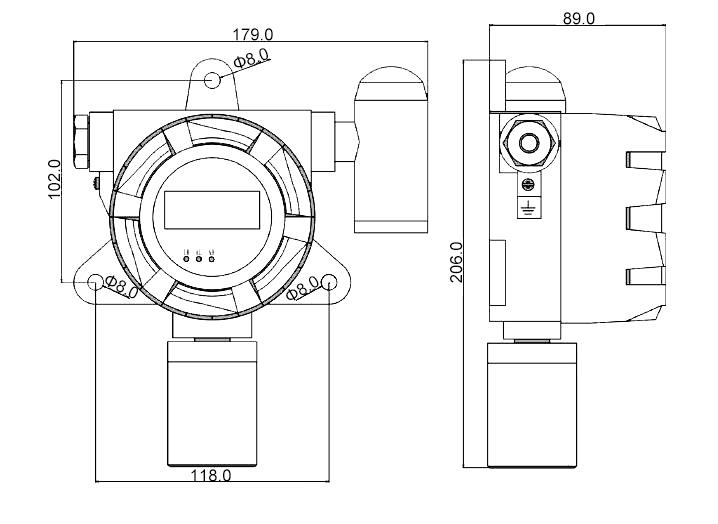
| Dimension | 206*179*90mm |
| Weight | ≤1.6kg |
| Power Adapter | Input 100-240VAC 50/60Hz, Output 24VDC 1A (Optional USA plug, Europe plug, AU plug or UK plug) |
| Accessories (Optional) | Calibration kit - gas pressure regulator (calibration gas cylinder NOT included)
|
Notes
Regarding the flow rate for gas detectors, there are 2 types:
- Pump-Suction Type: Equipped with a built-in pump, with a flow rate of 600 mL/min. (Models: GD200, GD400, GD600)
- Diffusion Type: Not equipped with a built-in pump, with a flow rate of 300 mL/min. (Models: GD300, GD500, GD800)
If you require a customized flow rate, please let us know your specific requirements. We will evaluate whether customization is possible. A flow rate that is too high or too low can affect measurement accuracy, so we recommend using an appropriate flow rate for your application.
Flow rate only needs to be considered when sampling gas from pipelines. For measuring gas concentrations in normal ambient air, you do not need to consider the flow rate. To measure confined spaces such as pipelines, please get in touch with us and provide the detailed conditions of use.
Dimensions (Unit: mm)
Installation Guide
The following precautions apply when connecting the GD300 series fixed gas detector to a pipeline:
- Working pressure should be stable at 1 bar ±10%, and the flow rate should be controlled at 300 mL/min.
- Working temperature is -20°C to +50°C.
- Working humidity is 0–95% RH. When the humidity is above 60% RH, it is recommended to use a dehumidifier or add a filter. When the humidity is above 95% RH, the gas is essentially saturated with water, making measurement impossible.
- The gas detector should be installed indoors. If it is installed outdoors, a rain cover should be added to protect the entire instrument.
- For the second pipeline connection method of the GD300 gas detector, the pipe-mounted installation, the detector mounting thread size is M45 × P2.0. During installation, hold the detector with both hands, keeping the sensor parallel to the mounting thread. Align it with the threaded port, rotate the detector clockwise, and install it in the desired position. To prevent gas leakage at the threaded connection, an appropriate amount of thread seal tape can be wrapped around the sensor head thread before installation.
***Other Common Gases and Ranges Available for Fixed Gas Detectors
| Gas Type | Measure Range | Resolution |
| Ammonia (NH3) | 0-50/100/200/500/1000/2000/5000ppm | 0.01ppm/0.1ppm/1ppm |
| Benzene (C6H6) | 0-1/10/50/100/200/1000/2000/5000/10000ppm | 0.001ppm/0.01ppm/0.1ppm/1ppm |
| Carbon Dioxide (CO2) | 0-1000/2000/5000/9999ppm, 0-2/5/10/20/25/30/50/100%VOL | 0.1ppm/1ppm/0.001%VOL/0.01%VOL/0.1%VOL |
| Carbon Monoxide (CO) | 0-10/20/50/100/500/1000/2000ppm | 0.01ppm/0.1ppm/1ppm |
| Chlorine (Cl2) | 0-5/10/20/50/100ppm | 0.001ppm/0.01ppm/0.1ppm |
| Chlorine Dioxide (ClO2) | 0-1/5/10/20/50/100ppm | 0.001ppm/0.01ppm/0.1ppm |
| Combustible Gas (EX) | 0-100%LEL | 1%LEL |
| Ethylene (C2H4) | 0-10/20/50/100/500/1000/2000ppm | 0.01ppm/0.1ppm/1ppm |
| Formaldehyde (CH2O) | 0-10/20/50/100/500/1000ppm | 0.01ppm/0.1ppm/1ppm |
| Hydrocarbons (HC) | 0-100%LEL | 1%LEL |
| Hydrogen (H2) | 0-10/20/500/1000/2000/5000/9999ppm, 0-2/4% VOL, 0-100% LEL | 0.1ppm/1ppm/0.001%VOL/1%LEL |
| Hydrogen Chloride (HCL) | 0-10/20/50/100/200ppm | 0.01ppm/0.1ppm |
| Hydrogen Cyanide (HCN) | 0-10/20/50/100ppm | 0.01ppm/0.1ppm |
| Hydrogen Sulfide (H2S) | 0-5/20/50/100/200ppm | 0.001ppm/0.01ppm/0.1ppm |
| Methane (CH4) | 0-50/100%VOL, 0-100%LEL | 0.01%VOL/0.1%VOL/1%LEL |
| Nitric Oxide (NO) | 0-1/5/10/20/50/100/250/500/1000ppm | 0.001ppm/0.01ppm/0.1ppm/1ppm |
| Nitrogen (N2) | 0-99.99/0-100%VOL | 0.01%VOL/0.1%VOL |
| Nitrogen Dioxide (NO2) | 0-1/5/10/20/50/100/500/1000ppm | 0.001ppm/0.01ppm/0.1ppm/1ppm |
| Nitrogen Oxides (NOX) | 0-1/5/10/20/50/100/250/500/1000ppm | 0.001ppm/0.01ppm/0.1ppm/1ppm |
| Oxygen (O2) | 0-25/30/100%VOL | 0.01%VOL/0.1%VOL |
| Ozone (O3) | 0-1/5/10/20/50/100ppm | 0.001ppm/0.01ppm/0.1ppm |
| Phosphine (PH3) | 0-10/20/50/100/500/1000/2000/3000ppm | 0.01ppm/0.1ppm/1ppm |
| Sulfur Dioxide (SO2) | 0-1/5/10/20/50/100/500/1000ppm | 0.001ppm/0.01ppm/0.1ppm/1ppm |
| Volatile Organic Compounds (VOC) | 0-1/5/10/20/50/100/200/500/1000/2000/5000/10000ppm | 0.001ppm/0.01ppm/0.1ppm/1ppm |
Note: Some common gases and the measuring ranges are listed in the above table. For more information, please feel free to contact us.
Details
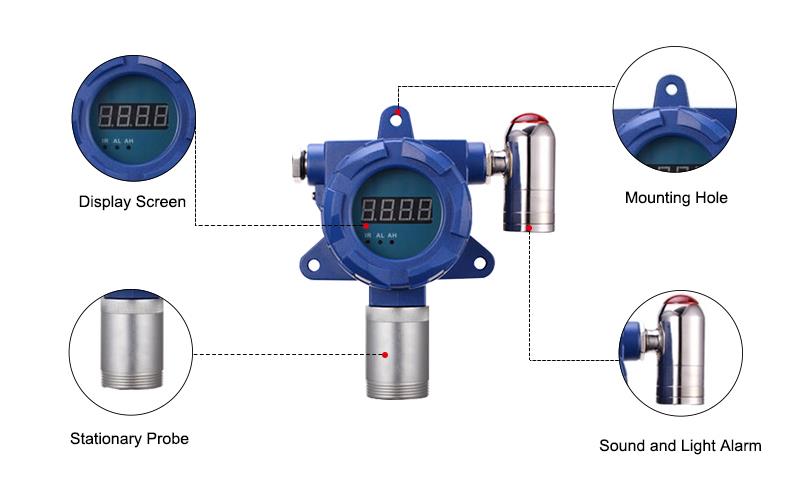
10 Tips for Installing Fixed type Ammonia (NH3) Gas Detector
- The fixed ammonia (NH3) gas detector shall not be installed in the place which has high concentration of smoke, jet-propelled insecticide and combustible solvent (coating), otherwise it may cause an alarm.
- The fixed ammonia gas detector shall not be installed at the place with large wind flow, such as the vent, ventilator and door. It may affect the accuracy of ammonia detector.
- The fixed ammonia detector shall not be installed at the place with much water vapor or water drops (relative humidity is above 90%), otherwise the ammonia sensor may be damaged for being placed in water vapor for a long term.
- The fixed NH3 detector shall not be installed at temperatures below -30℃ or below 50℃.
- The fixed ammonia detector shall not be installed in a strong electromagnetic field.
- As soon as the ammonia detector sends a concentration alarm signal, the output control signal will be locked, even if the gas concentration doesn’t continue to exceed the limit, the controlled device is still unable to restore the pre alarm state automatically, manual reset is required (press the reset button or self-calibration for 3 seconds).
- The fixed NH3 gas detector shall be installed in a higher place of the farm because the concentration of ammonia is lighter than the air.
- If alarm, the ammonia concentration has exceeded the set alarm concentration. After the cause for excessive NH3 concentration is removed, press the reset button to clear the alarm data.
- It’s normal for the alarm sound in the first power-on in case the ammonia detector has been powered off for a long time.
- After the ammonia detector is fixed, do not move its position at will, so as not to damage the accessories.


Fixed Hydrogen Sulfide (H2S) Gas Detector, 0 to 50/100/200 ppm

Fixed Combustible Gas Detector, 0 to 100%LEL

Fixed Formaldehyde Gas Detector, 0 to 10/20/50/100 ppm

Fixed Sulfur Dioxide (SO2) Gas Detector, 0 to 20/50/100 ppm

Fixed Chlorine (Cl2) Gas Detector, 0 to 10/50/100ppm

Portable Chlorine (Cl2) Gas Detector, 0 to 10/50/100 ppm

Fixed Carbon Monoxide (CO) Gas Detector, 0 to 100/500/1000 ppm
Fixed Hydrogen Sulfide (H2S) Gas Detector, 0 to 50/100/200 ppm
