Vibrating Rod Level Switch for Powder/Tanks/Solids

$327.99
Cost-effective vibrating rod level switch for sale online. This is a vibration level sensor for point-level detection, with 250V AC/30V DC 5A SPDT contact capacity, 2.5W power consumption, and optional voltage of 220V AC or 24V DC. Rod level sensor is widely used in manufacturing, agriculture and chemical processing fields to monitor and control the material level in storage tanks, silos or containers, etc.
SKU: ATO-VLS-YN100
*
Free Shipping
Delivery date: 6-12 days

Vibrating rod level switch is a device used for point level detection of solids and liquids in industrial applications. Consisting of a rod that vibrates at its natural frequency, the vibration rod level switch monitors changes in vibration when it comes into contact with the material being measured.  It is suitable for a wide range of materials, including powders, granules, and bulk solids.

Specification

ModelATO-VLS-YN100
Power Supply (Optional)220V AC/ 24V DC
Power Consumption2.5W
Vibration Frequency280Hz
Relay Contact250V AC/ 30V DC 4A
Electrical ConnectionM20 x 1.5 (φ8~φ10 Cable)
Delay Time0.5 Seconds for Detection (Stop Vibration), 1~2 Seconds for Recovery (Stop Vibration)
Working TemperatureProbe Head -30℃~+200℃, Substrate Part -30℃~+70℃
Switch FunctionNormally Open NO, Normally Closed NC, Common COM
Contact Capacity250V AC/30V DC 5A SPDT


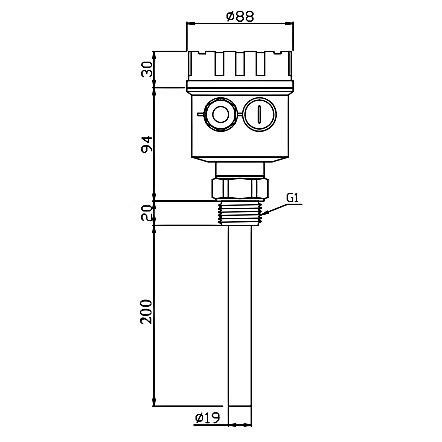
Dimension (Unit: mm)

Vibrating fork level switch dimension

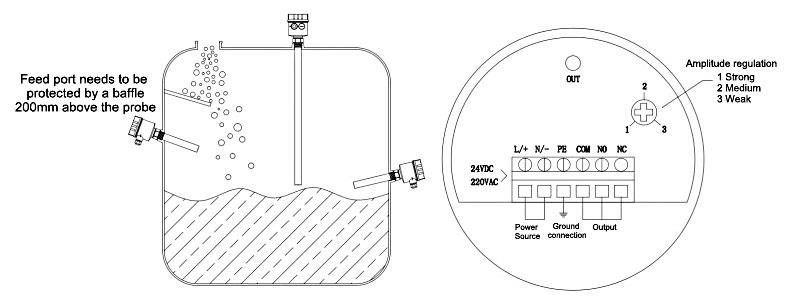
Installation & Wiring

Vibrating rod level switch installation and wiring

Note*

  • Pay attention to the installation position during installation. The outlet of the junction box must be facing downwards, and the cable fixing head must be locked to prevent rainwater from penetrating into the junction box through the outlet and damaging the internal structure and wiring when it rains.
  • When multiple sensor rods are installed at the same time, the distance between switches should be maintained at least 300mm.
  • Avoid installing it close to the feed inlet to reduce impact damage to the sensor rod during feeding. If the switch must be installed close to the material inlet, please install a protective plate 200mm above the vibrating rod level switch.
  • Inclined installation is recommended. It is best to tilt the sensor rod downward and maintain an angle of 20 degrees with the horizontal line. This can increase sensitivity and reduce switch damage caused by blanking impact.
  • The induction rod in the silo cannot be stepped on as a ladder or bent.
  • When cleaning, rinse with water and lightly brush with a brush. Do not knock.
  • When the viscosity of the measuring medium is high, it should be installed vertically from the top of the container or at an angle of 20 degrees from the side wall.

Detail
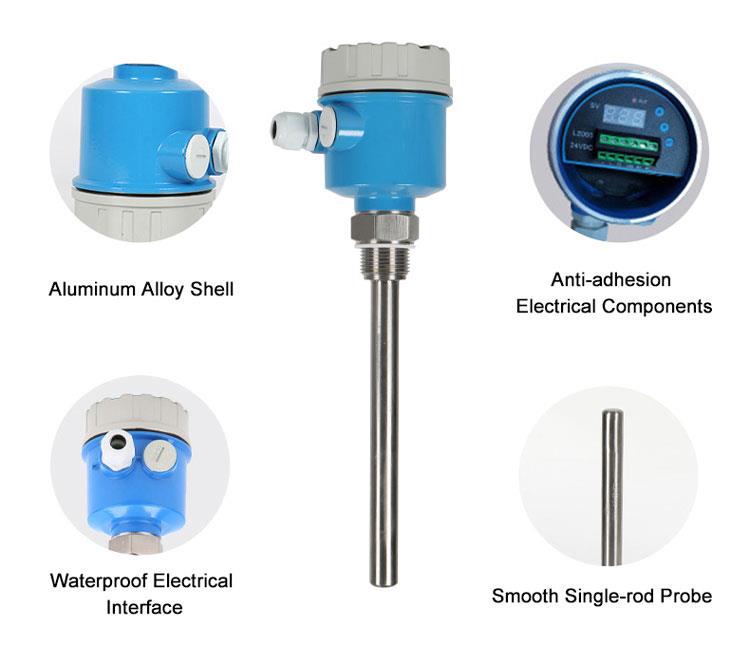
Vibrating rod level switch detail

Tips: Where are vibrating rod level switches used?

Vibrating rod level switches are widely used in industrial applications to monitor and control the level of bulk solids and powders in storage vessels. These devices utilize a vibrating rod that is inserted into the material being monitored. When the material reaches the level of the rod, it dampens the vibration, triggering the switch to signal a high or low level condition. Commonly employed in silos, hoppers, and bins, vibrating rod level switches are preferred for their reliability and ability to handle a variety of materials, including grains, plastics, and minerals. Their versatility makes them suitable for industries such as agriculture, food processing, pharmaceuticals, and manufacturing, where accurate level measurement is crucial for efficient and safe operations.

Product reviews
Level control in a wood chip environment
5
Bethel
Avatar
7/17/2026 12:36 AM
Is this vibrating rod level switch effective for level control in a sawdust/wood chip environment? Is it suitable for point-to-point control in chutes handling wood chips and sawdust?
Was this review helpful? Yes No (0/0)
ATO Responded
We need to know: What is the size and density of the wood chips in your environment?
Write your review
  • Only registered users can write reviews
*
*
  • Bad
  • Excellent
*
*
*
*

Vibrating rod level switch is a device used for point level detection of solids and liquids in industrial applications. Consisting of a rod that vibrates at its natural frequency, the vibration rod level switch monitors changes in vibration when it comes into contact with the material being measured.  It is suitable for a wide range of materials, including powders, granules, and bulk solids.

Specification

ModelATO-VLS-YN100
Power Supply (Optional)220V AC/ 24V DC
Power Consumption2.5W
Vibration Frequency280Hz
Relay Contact250V AC/ 30V DC 4A
Electrical ConnectionM20 x 1.5 (φ8~φ10 Cable)
Delay Time0.5 Seconds for Detection (Stop Vibration), 1~2 Seconds for Recovery (Stop Vibration)
Working TemperatureProbe Head -30℃~+200℃, Substrate Part -30℃~+70℃
Switch FunctionNormally Open NO, Normally Closed NC, Common COM
Contact Capacity250V AC/30V DC 5A SPDT


Dimension (Unit: mm)

Vibrating fork level switch dimension

Installation & Wiring

Vibrating rod level switch installation and wiring

Note*

  • Pay attention to the installation position during installation. The outlet of the junction box must be facing downwards, and the cable fixing head must be locked to prevent rainwater from penetrating into the junction box through the outlet and damaging the internal structure and wiring when it rains.
  • When multiple sensor rods are installed at the same time, the distance between switches should be maintained at least 300mm.
  • Avoid installing it close to the feed inlet to reduce impact damage to the sensor rod during feeding. If the switch must be installed close to the material inlet, please install a protective plate 200mm above the vibrating rod level switch.
  • Inclined installation is recommended. It is best to tilt the sensor rod downward and maintain an angle of 20 degrees with the horizontal line. This can increase sensitivity and reduce switch damage caused by blanking impact.
  • The induction rod in the silo cannot be stepped on as a ladder or bent.
  • When cleaning, rinse with water and lightly brush with a brush. Do not knock.
  • When the viscosity of the measuring medium is high, it should be installed vertically from the top of the container or at an angle of 20 degrees from the side wall.

Detail

Vibrating rod level switch detail

Tips: Where are vibrating rod level switches used?

Vibrating rod level switches are widely used in industrial applications to monitor and control the level of bulk solids and powders in storage vessels. These devices utilize a vibrating rod that is inserted into the material being monitored. When the material reaches the level of the rod, it dampens the vibration, triggering the switch to signal a high or low level condition. Commonly employed in silos, hoppers, and bins, vibrating rod level switches are preferred for their reliability and ability to handle a variety of materials, including grains, plastics, and minerals. Their versatility makes them suitable for industries such as agriculture, food processing, pharmaceuticals, and manufacturing, where accurate level measurement is crucial for efficient and safe operations.

Product reviews
Level control in a wood chip environment
5
Bethel
Avatar
7/17/2026 12:36 AM
Is this vibrating rod level switch effective for level control in a sawdust/wood chip environment? Is it suitable for point-to-point control in chutes handling wood chips and sawdust?
Was this review helpful? Yes No (0/0)
ATO Responded
We need to know: What is the size and density of the wood chips in your environment?
Only registered users can write reviews
Customers who bought this item also bought

Paddle Level Switch for Silo/Tank, SPDT Contact

ATO-PLS-0415
$103.89
Favorable price paddle level switch for sale, with SPDT contact, stainless steel blade, blade speed 1rpm, optional power supply 220V AC, 110V AC, 24V DC. This rotary paddle level switch features low power consumption of just 4W and a stable blade rotation speed of 1 rpm. It is used to detect and monitor the level of material in tanks, bins or silos etc.