Solid state relay SSR-120AA, 120A 70-280V AC to AC

$77.69
Affordable price single phase solid state relay SSR-120AA, load current rating up to 120A, zero cross switching type, AC control AC,70-280V AC input voltage, 24-480V AC load voltage, brand new, high quality and long life time.
SKU: ATO-SSR-DH120AA
Free Shipping
Delivery date: 6-12 days

Features

120A 70-280V AC to 24-480V AC solid state relay (SSR) features high structural strength, good impact resistance, and strong shock resistance. The SSR offers a reliable switching the commercial and industrial loads, such as computer peripheral interface device, printing machine, molding machine, food machine, packaging machine, and so on.

  • Built in RC absorption
  • Photoelectric isolation
  • SCR output
  • LED indicator for operation status
  • Removable protective cover for safety
  • Panel mount
  • Zero-crossing switch type

Specification

ModelATO-SSR-DH120AA
InputControl voltage range70-280V AC
Max. input current15mA
Must operate voltage70V AC
Must release voltage50V AC
OutputLoad voltage range24-480V AC
Peak voltage800V AC
Maximum load current120A
Maximum off-state leakage current2mA
Maximum off-state time10mS
Maximum on-state voltage drop1.5V
GeneralTypeAC to AC, single phase
Dimension L – W – H (mm)57.4х44.8х28
Weight135g
Dielectric strength (input to output)4000V
Dielectric strength (input, output to the base)2500V
Operating temperature-20℃~ 80℃
MountPanel
CertificationCE

Note:

  1. When the load is a resistive load, the maximum load current of the selected SSR should be 2~3 times greater than the actual load current;
  2. When the load is an inductive load, the maximum load current of the selected SSR should be more than 7~8 times the actual load current.
  3. When the maximum load current is higher than 10A, a heat sink must be installed to the solid state relay, or the SSR relay should be mounted on a metal base plate with heat dissipation effect, and the thermal grease is applied between them.

Dimension (Unit: mm)
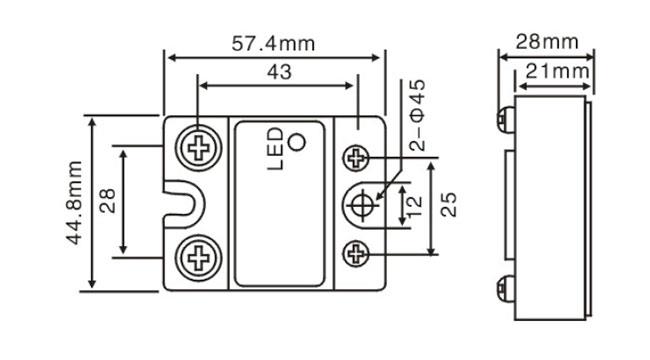
Single Phase SSR Dimensions

Wiring Diagram

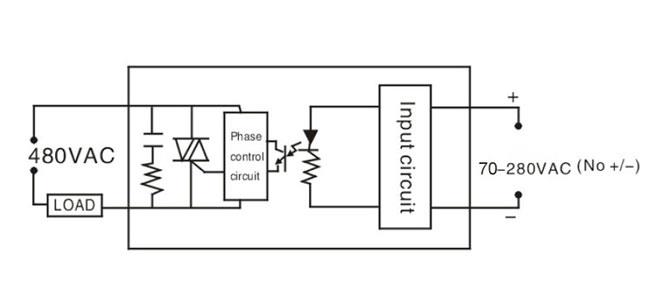
Single Phase AC to AC SSR Wiring

Tips: Overvoltage protection for solid state relays

Transient voltage disturbance is one of the main causes of damage to electronic circuits and equipment. In the process of using solid state relays, instantaneous voltage damage to the solid state relays often occurs.
Common overvoltage protection methods include: RC snubber circuits, metal oxide varistors (MOVs), and built-in transient voltage suppressors (TVS).

  1. The RC snubber circuit absorbs and suppresses the momentary voltage applied to the solid state relay and reduces the rise rate of voltage index (dv/dt).
  2. MOVs are bipolar protection elements that absorb excessive transient voltages. However, with the energy absorption at each time, the performance of MOVs changes, the voltage level decreases and eventually the risk of overheating occurs due to unbearable supply voltage.
  3. TVS (Transient Voltage Suppressors) is efficient silicon PN junction protection device, a new product developed based on the voltage-regulator tube technology. Subjected to a transient high-energy impact at both ends of the TVS tube, it can turn the high impedance at both ends into a low impedance at very high speeds (response time is typically less than a few nS) while absorbing a large current, clamping the voltage between the two poles to a safe value, thus ensuring that the circuit components behind are protected from the impact of transient high energy.

Solid state relay (SSR) is simple but widely used in the automation fields. Thus, it is not complex to wire a solid state relay. In this vedio, ATO takes a 40 Amp SSR (DC - AC) for example to show the wiring of a SSR and then switch on/off a motor with this SSR.

How to Test a Solid State Relay?

Solid state relays are commonly used to control many electronic components, so if a component isn't working because there's no current flowing through it, it's likely a problem with the relay. With some simple troubleshooting steps, it's easy to check if an SSR is working as expected. In this video, we'll show you step-by-step instructions on how to test a solid state relay.

Types of Solid State Relays

There are different types of solid state relays according to various classification standards. In this video, we will introduce a series of different types of SSRs according to the following standards.

DC-AC/AC-AC Single Phase Solid State Relays

In this video we take a quick look at ATO's current single phase SSR models along with their specifications and key features. They are designed to operate high load currents using low control currents, using our advanced opto-isolation technology.

In this video we will try to clear the confusion many people have between relays and contactors by showing you how to tell the difference based on five criteria: Definition, Capacity, Structure, Contacts and Applications.

Write your review
  • Only registered users can write reviews
*
*
  • Bad
  • Excellent
*
*
*
*

Features

120A 70-280V AC to 24-480V AC solid state relay (SSR) features high structural strength, good impact resistance, and strong shock resistance. The SSR offers a reliable switching the commercial and industrial loads, such as computer peripheral interface device, printing machine, molding machine, food machine, packaging machine, and so on.

  • Built in RC absorption
  • Photoelectric isolation
  • SCR output
  • LED indicator for operation status
  • Removable protective cover for safety
  • Panel mount
  • Zero-crossing switch type

Specification

ModelATO-SSR-DH120AA
InputControl voltage range70-280V AC
Max. input current15mA
Must operate voltage70V AC
Must release voltage50V AC
OutputLoad voltage range24-480V AC
Peak voltage800V AC
Maximum load current120A
Maximum off-state leakage current2mA
Maximum off-state time10mS
Maximum on-state voltage drop1.5V
GeneralTypeAC to AC, single phase
Dimension L – W – H (mm)57.4х44.8х28
Weight135g
Dielectric strength (input to output)4000V
Dielectric strength (input, output to the base)2500V
Operating temperature-20℃~ 80℃
MountPanel
CertificationCE

Note:

  1. When the load is a resistive load, the maximum load current of the selected SSR should be 2~3 times greater than the actual load current;
  2. When the load is an inductive load, the maximum load current of the selected SSR should be more than 7~8 times the actual load current.
  3. When the maximum load current is higher than 10A, a heat sink must be installed to the solid state relay, or the SSR relay should be mounted on a metal base plate with heat dissipation effect, and the thermal grease is applied between them.

Dimension (Unit: mm)

Single Phase SSR Dimensions

Wiring Diagram

Single Phase AC to AC SSR Wiring

Tips: Overvoltage protection for solid state relays

Transient voltage disturbance is one of the main causes of damage to electronic circuits and equipment. In the process of using solid state relays, instantaneous voltage damage to the solid state relays often occurs.
Common overvoltage protection methods include: RC snubber circuits, metal oxide varistors (MOVs), and built-in transient voltage suppressors (TVS).

  1. The RC snubber circuit absorbs and suppresses the momentary voltage applied to the solid state relay and reduces the rise rate of voltage index (dv/dt).
  2. MOVs are bipolar protection elements that absorb excessive transient voltages. However, with the energy absorption at each time, the performance of MOVs changes, the voltage level decreases and eventually the risk of overheating occurs due to unbearable supply voltage.
  3. TVS (Transient Voltage Suppressors) is efficient silicon PN junction protection device, a new product developed based on the voltage-regulator tube technology. Subjected to a transient high-energy impact at both ends of the TVS tube, it can turn the high impedance at both ends into a low impedance at very high speeds (response time is typically less than a few nS) while absorbing a large current, clamping the voltage between the two poles to a safe value, thus ensuring that the circuit components behind are protected from the impact of transient high energy.
Only registered users can write reviews