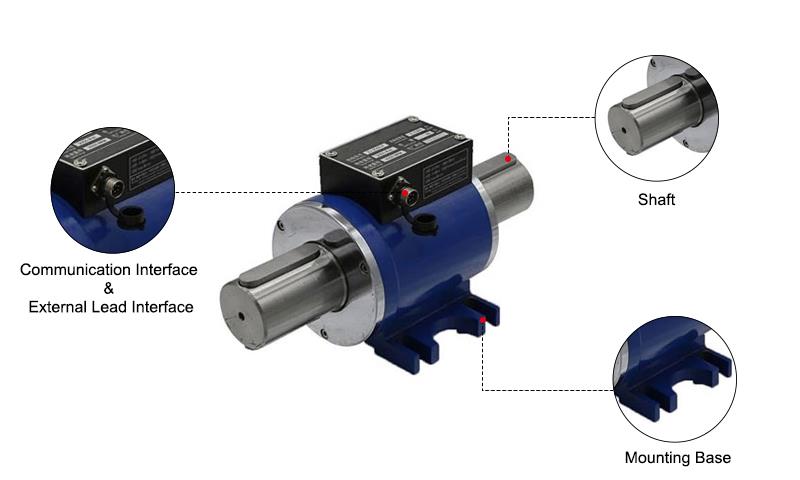
Rotary Shaft Torque Sensor, Non-Contact, 50-50000 Nm

$1,812.68
Rotary torque sensor can measure static torque and dynamic torque, non-contact with two shafts and shaft keys. The electrical signal of elastic shaft under torsion can be measured by providing power for the strain gauge bridge. Shaft torque sensors have a capacity range from 50 Nm, 100 Nm, 500 Nm to 50000 Nm.
SKU: ATO-TQS-ZJ-A
*
*
*
*
*
Free Shipping
Delivery date: 30-40 Days

Rotary shaft torque sensors have capacity range from 50Nm, 100 Nm, 500 Nm to 50000 Nm. Torque sensor capacity can be customized according to customer requirements. You can buy a signal converter with 4-20mA/ 0-5V/ 0-10V output or RS485 communications to use with ATO rotating torque sensor.

Specification

ModelATO-ZJ-A
Rotary Torque SensorShipping Weight5~110kg
Capacity Range *0-50 Nm ~ 0-50000 Nm
Accuracy *0.2%F·S, 0.1%F·S
Power Supply *±15V ±5% DC (≥50mA), 24V DC
Output Signal *10kHz±5kHz, 4-20mA, 0-5V, 1-5V, 0-10V (add signal converter, with a 5m connecting cable), RS485
Max. Speed6000rpm
Speed Range0-1500rpm, 0-3000rpm, 0-4000rpm, maximum speed 6000rpm
Speed Signal60-2000 pulse/turn
Temperature Drift on Zero<0.1%F·S/10°C
Operating Temperature-20°C~+70°C
Humidity≤90%RH
Insulation Resistance>500MΩ
Stability0.3%F·S/year
Safety Overload150%F·S
Breaking Load200%F·S
Sensitivity1±0.2 mv/V
Power Consumption4W
Bridge VoltageDC 10V
MaterialAlloy steel
Protection ClassIP65
Electrical ConnectionCircular connector
Wiring±15V DC: Red: V+, Blue: V-, Green: Speed output, Yellow: Torque output, Black: GND
24V DC: Red: 24V DC, Blue: Signal-, Green: Speed output, Yellow: Torque output, Black: GND
Cable Length2m (Φ5mm), or other customizable lengths
Signal ConverterPower Supply±15V DC, 24V DC (±0.4V)
Power Supply Dissipation PowerLess than 1W
Response Time≥100mS
Conversion Accuracy±0.1%F·S
Signal InputOptoelectronic isolation. It is used with rotary torque sensor.
F/V Signal Output0-5V, 0-10V
F/I Signal Output4-20mA
Operating Temperature-20°C~+60°C
Humidity0-90%RH
Wiring±15V DC: Red: V+, Blue: V-, Green: Speed output, Yellow: Torque output, Black: GND
24V DC: Red: 24V DC, Blue: Signal-, Green: Speed output, Yellow: Torque output, Black: GND
Overall Dimension158*95*55mm (L*W*H)
Istallation Dimension143*43, 4-M3 (mm)


Rotary Torque Sensor Dimensions (Units: mm)

*Single Key (Default)
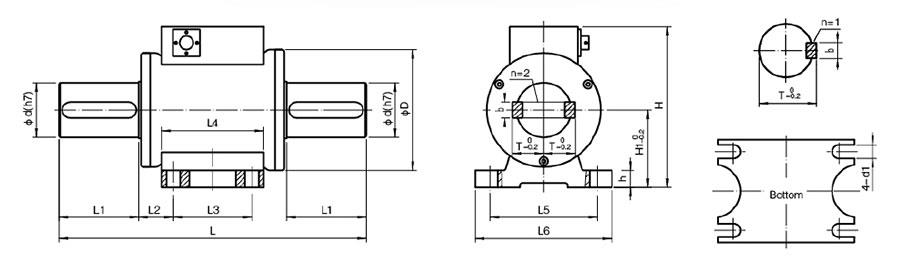
Dimensions of Non-Contact Rotary Torque Sensor 50-50000 Nm

Capacity RangeOverall Dimension (mm)Shaft Couping Size (mm)Base Support Size (mm)Max. Speed (rpm)Weight (kg)
HLDdb(h7)*nTL1L2L3L4L5L6H1d1h
50 Nm11418878186*120.531317290751005581260005
100 Nm11418878186*120.531317290751005581260005
500 Nm135238963810*22255557290751006581240008
1000 Nm1432701064814*227.57070699078120681215300010
3000 Nm1873471447520*24210510569100156180901215200025
5000 Nm1873471447520*24210510569100156180901215200025
10000 Nm2143891589828*255118118801101702001101415200040
20000 Nm22542016810528*228.5125125881251802051151415180060
50000 Nm30148024015040*2841501509012519035015318201500110


Details

Rotary Torque Sensor,Non-Contact Details

Tips: What are different types of torque sensor?

Torque sensor is mainly used for measuring various torque, speed and mechanical efficiency. It converts torque into electrical signals, and its accuracy is related to the accuracy of the test system. The torque sensor can measure static torque, rotary torque and dynamic torque with high detection accuracy, good stability and strong anti-interference. It can continuously measure forward and reverse torque without repeated zero adjustment, which can run for a long time at high speed. It outputs high level frequency signals which can be directly sent to the computer for processing. Here are the different types of torque sensor as follows.

  • Non-contact torque sensor
    Non-contact torque sensor is dynamic torque sensor, also called rotary torque sensor. Its input shaft and output shaft are connected by a torsion bar. Its input shaft and output shaft are connected by a torsion bar. The input shaft has splines on it, and the output shaft is a keyway. When the torsion bar is twisted by the torque, the relative position of the splines and keyway is changed, and the change of their relative displacement is the torsion of the torsion bar. This process causes the magnetic intensity on the spline to change, which is converted into a voltage signal by the coil.
  • Strain gauge torque sensor
    The strain gauge torque sensor uses strain electric measurement technology. Its principle is to make use of the elastic shaft and paste the strain gauge to form a measuring bridge. When the elastic shaft is subjected to small deformation by the torque, the resistance value of the bridge will change, and then the electrical signal will change, so as to realize the measurement of torque.
  • Phase difference torque sensor
    The phase difference torque sensor is the torque angle phase difference sensor. Its principle is the magnetoelectric phase difference torque measurement technology. Two sets of gears with exactly the same number of teeth, shape and installation angle are installed at both ends of the elastic shaft, and the proximity sensor is installed outside the gear. As the elastic shaft rotates, the waveforms of the two sets of sensors create a phase difference to calculate the torque.

In addition, high-performance rotary torque sensor is more commonly used, it combined with wireless communication technology, to achieve the wireless transmission of data.

Product reviews
Seems ok
5
Abby
Avatar
8/6/2021 2:47 AM
Good products and services. I bought it to transform the machine tool. It has good sensitivity. When I received the goods, ATO told me how to install and use them carefully. The enough capacity range and non-contact are the reasons why I chose it. So far, I have a good user experience.
Was this review helpful? Yes No (0/0)
I have a question about the 50-5000Nm rotary torque sensor
5
Olivia
Avatar
10/26/2021 8:40 PM
Hi, I have a question regarding the 50-5000Nm rotary torque sensor. Will there be any changes to torque reading if I apply axial force (tension or compression) on the torque sensor?
Was this review helpful? Yes No (0/0)
ATO Responded
Yes, if you apply an axial force (tension or pressure) on the 50-5000Nm rotary torque sensor, the torque reading will change.
I am interested in your torque sensor.
5
Geiger
Avatar
12/31/2021 2:03 AM
My name is David Towery and I am with Borets US, Inc. in Tulsa. I am working on an application and am interested in your 3000Nm rotary torque sensor. I need dimensional information on the sensor itself and the signal conditioner box that would be required for a 4-20mA signal output. Also, can the signal conditioner box be mounted as much as 200 feet from the sensor? This sensor will be mounted vertically and without the use of the base. Will the unit be alright in this configuration? Can the foot/base be removed? The dimension for this unit is not listed on the chart located on your website. The chart skips from 2000Nm to 5000Nm, therefore I need dimensions for this unit. Can I get CAD files on this unit and the signal conditioner box, preferably in a (. DXF or a. DWG) file format? I am very interested in your products and would like to use them in this application. I am however on standby until I hear from you.
Was this review helpful? Yes No (0/0)
ATO Responded
SKU: ATO-TQS-D01
Capacity: 3000Nm
Output signal: 4-20mA
1. The 4-20mA signal output is usually in the range of 10 meters to 20 meters. Since 200 feet is about 60 meters, this distance does not ensure the normal transmission of the 4-20 mA signal.
2. The sensor can be mounted vertically without fixing the base, but a baffle should be made to prevent the housing from turning.
3. The size of 3000NM sensor is the same as that of 2000NM sensor. You can refer to the size information on the website directly.
4. The signal converter is rail mounted, size is 22.5(W)*99(D)*115mm(H).
Curious about something
5
Aubren
Avatar
7/12/2024 3:20 AM
We will need to remove the keys from the sensor shafts. I don’t want to get too rough with them and was curious if you had a recommended procedure to do that?
Was this review helpful? Yes No (0/0)
ATO Responded
Okay, that's great. Regarding removing the key from the sensor shaft, you can first try to use pliers to hold the key and see if you can remove it. Or you can tilt it from the end of the shaft at an angle and gently tap the key with a brass rod to slowly move it out of the keyway. But be careful: don’t knock it, just hit the sensor.
Sensor not working
4
Jefferson
Avatar
9/26/2024 12:38 AM
I recently ordered a custom static 400Nm torque sensor from your website and received it. I just tried to set it up to the dc power supply (10V) and read output with a multimeter and oscilloscope and am getting no output reading whatsoever from the sensor. Is there anything we are missing with our set up or is the sensor not working? I'd appreciate some support on this issue.
Was this review helpful? Yes No (0/0)
ATO Responded
The static 400Nm torque sensor you purchased has an output signal of mV by default, Not 10V. You can Not directly measure a 10V voltage signal.
If you want to output a 0-10V signal, you need to configure an additional digital load cell amplifier, Output 0-10V, SKU: ATO-LCTR-OAR. This also requires calibration of the torque sensor and transmitter, see spec and price on: https://www.ato.com/digital-load-cell-amplifier-output-4-20ma-0-10v-rs485
Torque Sensor Recommendation
5
Quimby
Avatar
10/29/2025 12:31 AM
I need to measure stall torque up to 230 Nm, speed up to 2000 RPM, and engine speed up to 30 rpm. Can the following torque sensor do this?
Was this review helpful? Yes No (0/0)
ATO Responded
The ATO-TQS-ZJ-A torque sensor can measure this engine speed. We need additional information before making a recommendation: What is the torque? What signal does the engine speed output?
Write your review
  • Only registered users can write reviews
*
*
  • Bad
  • Excellent
*
*
*
*

Rotary shaft torque sensors have capacity range from 50Nm, 100 Nm, 500 Nm to 50000 Nm. Torque sensor capacity can be customized according to customer requirements. You can buy a signal converter with 4-20mA/ 0-5V/ 0-10V output or RS485 communications to use with ATO rotating torque sensor.

Specification

ModelATO-ZJ-A
Rotary Torque SensorShipping Weight5~110kg
Capacity Range *0-50 Nm ~ 0-50000 Nm
Accuracy *0.2%F·S, 0.1%F·S
Power Supply *±15V ±5% DC (≥50mA), 24V DC
Output Signal *10kHz±5kHz, 4-20mA, 0-5V, 1-5V, 0-10V (add signal converter, with a 5m connecting cable), RS485
Max. Speed6000rpm
Speed Range0-1500rpm, 0-3000rpm, 0-4000rpm, maximum speed 6000rpm
Speed Signal60-2000 pulse/turn
Temperature Drift on Zero<0.1%F·S/10°C
Operating Temperature-20°C~+70°C
Humidity≤90%RH
Insulation Resistance>500MΩ
Stability0.3%F·S/year
Safety Overload150%F·S
Breaking Load200%F·S
Sensitivity1±0.2 mv/V
Power Consumption4W
Bridge VoltageDC 10V
MaterialAlloy steel
Protection ClassIP65
Electrical ConnectionCircular connector
Wiring±15V DC: Red: V+, Blue: V-, Green: Speed output, Yellow: Torque output, Black: GND
24V DC: Red: 24V DC, Blue: Signal-, Green: Speed output, Yellow: Torque output, Black: GND
Cable Length2m (Φ5mm), or other customizable lengths
Signal ConverterPower Supply±15V DC, 24V DC (±0.4V)
Power Supply Dissipation PowerLess than 1W
Response Time≥100mS
Conversion Accuracy±0.1%F·S
Signal InputOptoelectronic isolation. It is used with rotary torque sensor.
F/V Signal Output0-5V, 0-10V
F/I Signal Output4-20mA
Operating Temperature-20°C~+60°C
Humidity0-90%RH
Wiring±15V DC: Red: V+, Blue: V-, Green: Speed output, Yellow: Torque output, Black: GND
24V DC: Red: 24V DC, Blue: Signal-, Green: Speed output, Yellow: Torque output, Black: GND
Overall Dimension158*95*55mm (L*W*H)
Istallation Dimension143*43, 4-M3 (mm)


Rotary Torque Sensor Dimensions (Units: mm)

*Single Key (Default)

Dimensions of Non-Contact Rotary Torque Sensor 50-50000 Nm

Capacity RangeOverall Dimension (mm)Shaft Couping Size (mm)Base Support Size (mm)Max. Speed (rpm)Weight (kg)
HLDdb(h7)*nTL1L2L3L4L5L6H1d1h
50 Nm11418878186*120.531317290751005581260005
100 Nm11418878186*120.531317290751005581260005
500 Nm135238963810*22255557290751006581240008
1000 Nm1432701064814*227.57070699078120681215300010
3000 Nm1873471447520*24210510569100156180901215200025
5000 Nm1873471447520*24210510569100156180901215200025
10000 Nm2143891589828*255118118801101702001101415200040
20000 Nm22542016810528*228.5125125881251802051151415180060
50000 Nm30148024015040*2841501509012519035015318201500110


Details

Rotary Torque Sensor,Non-Contact Details

Tips: What are different types of torque sensor?

Torque sensor is mainly used for measuring various torque, speed and mechanical efficiency. It converts torque into electrical signals, and its accuracy is related to the accuracy of the test system. The torque sensor can measure static torque, rotary torque and dynamic torque with high detection accuracy, good stability and strong anti-interference. It can continuously measure forward and reverse torque without repeated zero adjustment, which can run for a long time at high speed. It outputs high level frequency signals which can be directly sent to the computer for processing. Here are the different types of torque sensor as follows.

  • Non-contact torque sensor
    Non-contact torque sensor is dynamic torque sensor, also called rotary torque sensor. Its input shaft and output shaft are connected by a torsion bar. Its input shaft and output shaft are connected by a torsion bar. The input shaft has splines on it, and the output shaft is a keyway. When the torsion bar is twisted by the torque, the relative position of the splines and keyway is changed, and the change of their relative displacement is the torsion of the torsion bar. This process causes the magnetic intensity on the spline to change, which is converted into a voltage signal by the coil.
  • Strain gauge torque sensor
    The strain gauge torque sensor uses strain electric measurement technology. Its principle is to make use of the elastic shaft and paste the strain gauge to form a measuring bridge. When the elastic shaft is subjected to small deformation by the torque, the resistance value of the bridge will change, and then the electrical signal will change, so as to realize the measurement of torque.
  • Phase difference torque sensor
    The phase difference torque sensor is the torque angle phase difference sensor. Its principle is the magnetoelectric phase difference torque measurement technology. Two sets of gears with exactly the same number of teeth, shape and installation angle are installed at both ends of the elastic shaft, and the proximity sensor is installed outside the gear. As the elastic shaft rotates, the waveforms of the two sets of sensors create a phase difference to calculate the torque.

In addition, high-performance rotary torque sensor is more commonly used, it combined with wireless communication technology, to achieve the wireless transmission of data.

Product reviews
Seems ok
5
Abby
Avatar
8/6/2021 2:47 AM
Good products and services. I bought it to transform the machine tool. It has good sensitivity. When I received the goods, ATO told me how to install and use them carefully. The enough capacity range and non-contact are the reasons why I chose it. So far, I have a good user experience.
Was this review helpful? Yes No (0/0)
I have a question about the 50-5000Nm rotary torque sensor
5
Olivia
Avatar
10/26/2021 8:40 PM
Hi, I have a question regarding the 50-5000Nm rotary torque sensor. Will there be any changes to torque reading if I apply axial force (tension or compression) on the torque sensor?
Was this review helpful? Yes No (0/0)
ATO Responded
Yes, if you apply an axial force (tension or pressure) on the 50-5000Nm rotary torque sensor, the torque reading will change.
I am interested in your torque sensor.
5
Geiger
Avatar
12/31/2021 2:03 AM
My name is David Towery and I am with Borets US, Inc. in Tulsa. I am working on an application and am interested in your 3000Nm rotary torque sensor. I need dimensional information on the sensor itself and the signal conditioner box that would be required for a 4-20mA signal output. Also, can the signal conditioner box be mounted as much as 200 feet from the sensor? This sensor will be mounted vertically and without the use of the base. Will the unit be alright in this configuration? Can the foot/base be removed? The dimension for this unit is not listed on the chart located on your website. The chart skips from 2000Nm to 5000Nm, therefore I need dimensions for this unit. Can I get CAD files on this unit and the signal conditioner box, preferably in a (. DXF or a. DWG) file format? I am very interested in your products and would like to use them in this application. I am however on standby until I hear from you.
Was this review helpful? Yes No (0/0)
ATO Responded
SKU: ATO-TQS-D01
Capacity: 3000Nm
Output signal: 4-20mA
1. The 4-20mA signal output is usually in the range of 10 meters to 20 meters. Since 200 feet is about 60 meters, this distance does not ensure the normal transmission of the 4-20 mA signal.
2. The sensor can be mounted vertically without fixing the base, but a baffle should be made to prevent the housing from turning.
3. The size of 3000NM sensor is the same as that of 2000NM sensor. You can refer to the size information on the website directly.
4. The signal converter is rail mounted, size is 22.5(W)*99(D)*115mm(H).
Curious about something
5
Aubren
Avatar
7/12/2024 3:20 AM
We will need to remove the keys from the sensor shafts. I don’t want to get too rough with them and was curious if you had a recommended procedure to do that?
Was this review helpful? Yes No (0/0)
ATO Responded
Okay, that's great. Regarding removing the key from the sensor shaft, you can first try to use pliers to hold the key and see if you can remove it. Or you can tilt it from the end of the shaft at an angle and gently tap the key with a brass rod to slowly move it out of the keyway. But be careful: don’t knock it, just hit the sensor.
Sensor not working
4
Jefferson
Avatar
9/26/2024 12:38 AM
I recently ordered a custom static 400Nm torque sensor from your website and received it. I just tried to set it up to the dc power supply (10V) and read output with a multimeter and oscilloscope and am getting no output reading whatsoever from the sensor. Is there anything we are missing with our set up or is the sensor not working? I'd appreciate some support on this issue.
Was this review helpful? Yes No (0/0)
ATO Responded
The static 400Nm torque sensor you purchased has an output signal of mV by default, Not 10V. You can Not directly measure a 10V voltage signal.
If you want to output a 0-10V signal, you need to configure an additional digital load cell amplifier, Output 0-10V, SKU: ATO-LCTR-OAR. This also requires calibration of the torque sensor and transmitter, see spec and price on: https://www.ato.com/digital-load-cell-amplifier-output-4-20ma-0-10v-rs485
Torque Sensor Recommendation
5
Quimby
Avatar
10/29/2025 12:31 AM
I need to measure stall torque up to 230 Nm, speed up to 2000 RPM, and engine speed up to 30 rpm. Can the following torque sensor do this?
Was this review helpful? Yes No (0/0)
ATO Responded
The ATO-TQS-ZJ-A torque sensor can measure this engine speed. We need additional information before making a recommendation: What is the torque? What signal does the engine speed output?
Only registered users can write reviews