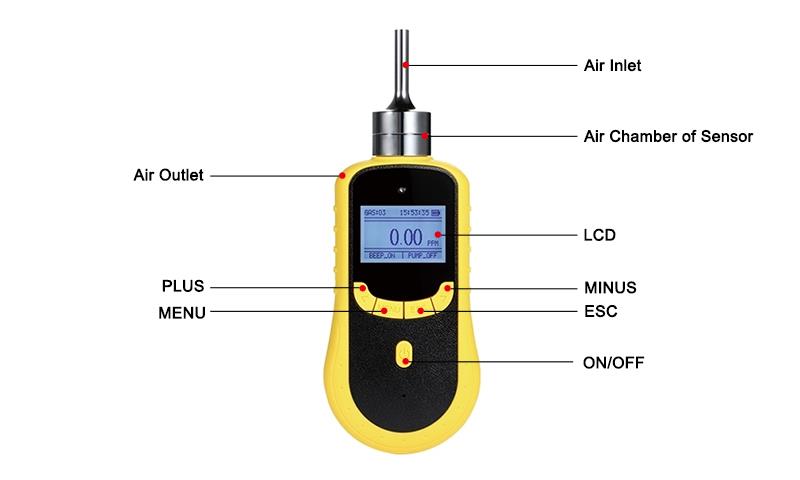
Portable Phosphine (PH3) Gas Detector, 0 to 5/10/20/50/100 ppm

$734.99
ATO low price phosphine PH3 gas detector is kind of mini size and high accuracy portable gas detector. Easy to operate, comprehensive functions, can measure phosphine, measure range from 0 to 5/10/20/50/100 ppm. The handheld PH3 gas detector is with back clip, protected by silicone case, suitable for different kinds of situations.
SKU: GD200-PH3
*
*
*
Free Shipping
Delivery date: 8-12 days

Portable gas detector provides Phosphine PH3 monitoring with high accuracy sensor, LCD display, easy readout, small & portable design, convenient to carry.

Specification

ModelGD200-PH3
Sampling MethodPumping suction, flow rate can be up to 750ml/min
Detection PrincipleElectrochemistry
GasPhosphine (PH3)
Range (Optional)*0 to 5ppm, 0 to 10ppm, 0 to 20ppm, 0 to 50ppm, 0 to 100ppm, 0 to 500ppm, 0 to 1000ppm, 0 to 2000ppm, 0-3000ppm
Resolution0.01ppm (0-5/10/20/50ppm), 0.1ppm (0-100ppm), 1ppm (0-500/1000/2000/3000ppm)
Accuracy≤±3% F.S.
Response Time≤10s
Repeatability≤±1%
Recovery Time≤10s
Linearity Error≤±1%
Zero Shift≤±1% (F.S./year)
Data Logging (Optional Function)High speed data transmission by USB, available for data downloading and printing (The built-in IC card has about 2G memory, which can record 100,000 sets of data.)
AlarmsSound, light and vibration
DisplayLCD dot matrix display
LanguageChinese/English
Battery3.7V rechargeable lithium battery, 3.7 Watt (Charger included: Input AC 100-240V 50/60Hz with optional USA, Europe or UK plug)
Operating Time100h (Pump off)
Explosion-proof GradeII 1G Ex da ia IIC T4 Ga
Case MaterialABS+PC
Protection GradeIP66
CertificationCE, ATEX (Standard: EN IEC 60079-0:2018, EN 60079-1:2014)
Operating Temperature-20℃~50℃
Operating Humidity0~95%RH (non-condensing)
Operating Pressure0.8~1.2bar
Dimension205*75*32mm
Weight300g
Warranty12 months
Extension ProbeAbout 480mm (Total Length), About 300mm (Probe Head)
Accessories (Optional)Calibration kit - gas pressure regulator (calibration gas cylinder NOT included)
  • Body Material: Stainless steel
  • Input Range of Pressure Gauge: 0-25MPa
  • Output Range of Pressure Gauge: 0-0.6Mpa
  • Gauge Class: 2.5
  • Input Pressure: ≤15MPa
  • Output Pressure: ≤0.45MPa
  • Rated Flow: 0.6 m3/h
  • Connection: Inlet: W21.8-14 teeth/inch (levorotation, dextrorotation); Outlet: Ф6 flexible tube

Note 1:

  • If you require a PH3 gas detector with a measuring range not listed in the table above, please contact us with details about your operating environment. We can help you choose the right detector for your application.

  • We also offer gas detectors for other common gases. Please refer to the ATO Gas Detector Catalog for available gas types and measuring ranges.

Note 2:

Regarding the flow rate for gas detectors, there are 2 types:

  • Pump-Suction Type: Equipped with a built-in pump, with a flow rate of 600 mL/min. (Models: GD200, GD400, GD600)
  • Diffusion Type: Not equipped with a built-in pump, with a flow rate of 300 mL/min. (Models: GD300, GD500, GD800)

If you require a customized flow rate, please let us know your specific requirements. We will evaluate whether customization is possible. A flow rate that is too high or too low can affect measurement accuracy, so we recommend using an appropriate flow rate for your application.

Flow rate only needs to be considered when sampling gas from pipelines. For measuring gas concentrations in normal ambient air, you do not need to consider the flow rate. To measure confined spaces such as pipelines, please get in touch with us and provide the detailed conditions of use.

*** Other Common Gases and Ranges Available for Portable Gas Detectors

Gas TypeMeasure RangeResolution
Ammonia (NH3)0-10/20/50/100/200/500/1000/2000/5000ppm0.01ppm/0.1ppm/1ppm
Benzene (C6H6)0-1/5/10/20/50/100/200/500/1000/2000/5000/10000ppm0.001ppm/0.01ppm/0.1ppm/1ppm
Carbon Dioxide (CO2)0-1000/2000/5000/10000/20000/50000ppm, 0-10%/20%/30%/50%/100% VOL1ppm, 0.01% VOL
Carbon Monoxide (CO)0-10/20/50/100/500/1000/2000ppm0.001ppm/0.01ppm/1ppm
Chlorine (Cl2)0-5/10/20/50/100/200ppm0.001ppm/0.01ppm/0.1ppm
Chlorine Dioxide (ClO2)0-1/5/10/20/50/100ppm0.001ppm/0.01ppm/0.1ppm
Ethylene (C2H4)0-10/20/50/100/500/1000/2000ppm0.001ppm/0.01ppm/0.1ppm/1ppm
Flammable0-100% LEL1% LEL
Formaldehyde (CH2O)0-10/20/50/100/500/1000ppm0.01ppm/0.1ppm/1ppm
Hydrocarbons (HC)0-100% LEL1% LEL
Hydrogen (H2)0-10/20/100/500/1000/2000/3000/5000/10000/20000/40000ppm, 0-4% VOL0.001ppm/0.01ppm/0.1ppm/1ppm, 0.001% VOL
Hydrogen Chloride (HCl)0-10/20/50/100/200/500/1000/2000ppm0.01ppm/0.1ppm/1ppm
Hydrogen Cyanide (HCN)0-10/20/50/100ppm0.01ppm/0.1ppm
Hydrogen Fluoride (HF)0-1/5/10/50ppm0.001ppm/0.01ppm
Hydrogen Sulfide (H2S)0-5/10/20/50/100/200/500/1000/2000ppm0.001ppm/0.01ppm/0.1ppm/1ppm
Methane (CH4)0-100% LEL, 0-50%/100% VOL1% LEL, 0.01%VOL
Methyl Bromide (CH3Br)0-50/100/200/500/1000/2000/3000ppm0.1ppm/1ppm
Nitric Oxide (NO)0-20/50/100/250/500/1000ppm0.01ppm/0.1ppm/1ppm
Nitrogen (N2)0-99.99%/100% VOL0.01% VOL
Nitrogen Dioxide (NO2)0-20/50/100/500/1000ppm0.01ppm/0.1ppm/1ppm
Oxygen (O2)0-25%/30%/100% VOL0.01% VOL
Ozone (O3)0-1/5/10/20/50/100/200/500/1000/2000ppm0.001ppm/0.01ppm/0.1ppm/1ppm
Phosgene (COCl2)0-1/5/10ppm0.001ppm
Phosphine (PH3)0-10/20/50/100/500/1000/2000/3000ppm0.01ppm/0.1ppm/1ppm
Sulfur Dioxide (SO2)0-20/50/100/500/1000ppm0.01ppm/0.1ppm/1ppm
Sulfur Hexafluoride (SF6)0-1000/2000/3000ppm1ppm
Volatile Organic Compounds (VOC)0-1/5/10/20/100ppm0.01ppm/0.1ppm


Details

Portable Phosphine (PH3) Gas Detector Details

Application

Applications of Portable Multi Gas Detector

Tips: ATO gas detector advantages

  • Small size, easy to carry, good quality and low price Portable gas detectors are usually small in size, so they are very convenient to carry and can be used at any time. In addition, high-quality portable gas detectors mainly use high-performance sensors, and high sensitivity is its most significant feature. This portable gas detector can visually display the gas concentration on site, and the standby time is longer than other products of the same type.
  • Start-up detection, no need to set parameters. Before the factory leaves the factory, the parameters and values in the portable gas detector have been set, and the customer only needs to start the detection.
  • Strong adaptability and wide range of applications. Portable gas detectors can also be used in places that people cannot enter or cannot reach. Equipped with an external pump, this avoids the danger of letting the staff go to the detection first. The design of the pump extension pipe can be used in places such as cold rooms, refrigeration workshops, tunnels and other closed places where toxic gas leaks. In addition, the portable gas detector also adopts a waterproof, dustproof and explosion-proof design, and cooperates with a replaceable in-line gas sensing module, making it an ideal tool for safety detection on the job site today.
  • Simple calibration steps General professional portable gas detectors have the characteristics of simple calibration steps. During the detection process, technicians only need to use the magnetic programming tool to start the calibration process. The detector will automatically start calibration as soon as the gas is supplied, and if the signal has started to be in a relatively stable state, the combustible gas detector will record the initial data and prompt the technician to disconnect the gas source.
Write your review
  • Only registered users can write reviews
*
*
  • Bad
  • Excellent
*
*
*
*

Portable gas detector provides Phosphine PH3 monitoring with high accuracy sensor, LCD display, easy readout, small & portable design, convenient to carry.

Specification

ModelGD200-PH3
Sampling MethodPumping suction, flow rate can be up to 750ml/min
Detection PrincipleElectrochemistry
GasPhosphine (PH3)
Range (Optional)*0 to 5ppm, 0 to 10ppm, 0 to 20ppm, 0 to 50ppm, 0 to 100ppm, 0 to 500ppm, 0 to 1000ppm, 0 to 2000ppm, 0-3000ppm
Resolution0.01ppm (0-5/10/20/50ppm), 0.1ppm (0-100ppm), 1ppm (0-500/1000/2000/3000ppm)
Accuracy≤±3% F.S.
Response Time≤10s
Repeatability≤±1%
Recovery Time≤10s
Linearity Error≤±1%
Zero Shift≤±1% (F.S./year)
Data Logging (Optional Function)High speed data transmission by USB, available for data downloading and printing (The built-in IC card has about 2G memory, which can record 100,000 sets of data.)
AlarmsSound, light and vibration
DisplayLCD dot matrix display
LanguageChinese/English
Battery3.7V rechargeable lithium battery, 3.7 Watt (Charger included: Input AC 100-240V 50/60Hz with optional USA, Europe or UK plug)
Operating Time100h (Pump off)
Explosion-proof GradeII 1G Ex da ia IIC T4 Ga
Case MaterialABS+PC
Protection GradeIP66
CertificationCE, ATEX (Standard: EN IEC 60079-0:2018, EN 60079-1:2014)
Operating Temperature-20℃~50℃
Operating Humidity0~95%RH (non-condensing)
Operating Pressure0.8~1.2bar
Dimension205*75*32mm
Weight300g
Warranty12 months
Extension ProbeAbout 480mm (Total Length), About 300mm (Probe Head)
Accessories (Optional)Calibration kit - gas pressure regulator (calibration gas cylinder NOT included)
  • Body Material: Stainless steel
  • Input Range of Pressure Gauge: 0-25MPa
  • Output Range of Pressure Gauge: 0-0.6Mpa
  • Gauge Class: 2.5
  • Input Pressure: ≤15MPa
  • Output Pressure: ≤0.45MPa
  • Rated Flow: 0.6 m3/h
  • Connection: Inlet: W21.8-14 teeth/inch (levorotation, dextrorotation); Outlet: Ф6 flexible tube

Note 1:

  • If you require a PH3 gas detector with a measuring range not listed in the table above, please contact us with details about your operating environment. We can help you choose the right detector for your application.

  • We also offer gas detectors for other common gases. Please refer to the ATO Gas Detector Catalog for available gas types and measuring ranges.

Note 2:

Regarding the flow rate for gas detectors, there are 2 types:

  • Pump-Suction Type: Equipped with a built-in pump, with a flow rate of 600 mL/min. (Models: GD200, GD400, GD600)
  • Diffusion Type: Not equipped with a built-in pump, with a flow rate of 300 mL/min. (Models: GD300, GD500, GD800)

If you require a customized flow rate, please let us know your specific requirements. We will evaluate whether customization is possible. A flow rate that is too high or too low can affect measurement accuracy, so we recommend using an appropriate flow rate for your application.

Flow rate only needs to be considered when sampling gas from pipelines. For measuring gas concentrations in normal ambient air, you do not need to consider the flow rate. To measure confined spaces such as pipelines, please get in touch with us and provide the detailed conditions of use.

*** Other Common Gases and Ranges Available for Portable Gas Detectors

Gas TypeMeasure RangeResolution
Ammonia (NH3)0-10/20/50/100/200/500/1000/2000/5000ppm0.01ppm/0.1ppm/1ppm
Benzene (C6H6)0-1/5/10/20/50/100/200/500/1000/2000/5000/10000ppm0.001ppm/0.01ppm/0.1ppm/1ppm
Carbon Dioxide (CO2)0-1000/2000/5000/10000/20000/50000ppm, 0-10%/20%/30%/50%/100% VOL1ppm, 0.01% VOL
Carbon Monoxide (CO)0-10/20/50/100/500/1000/2000ppm0.001ppm/0.01ppm/1ppm
Chlorine (Cl2)0-5/10/20/50/100/200ppm0.001ppm/0.01ppm/0.1ppm
Chlorine Dioxide (ClO2)0-1/5/10/20/50/100ppm0.001ppm/0.01ppm/0.1ppm
Ethylene (C2H4)0-10/20/50/100/500/1000/2000ppm0.001ppm/0.01ppm/0.1ppm/1ppm
Flammable0-100% LEL1% LEL
Formaldehyde (CH2O)0-10/20/50/100/500/1000ppm0.01ppm/0.1ppm/1ppm
Hydrocarbons (HC)0-100% LEL1% LEL
Hydrogen (H2)0-10/20/100/500/1000/2000/3000/5000/10000/20000/40000ppm, 0-4% VOL0.001ppm/0.01ppm/0.1ppm/1ppm, 0.001% VOL
Hydrogen Chloride (HCl)0-10/20/50/100/200/500/1000/2000ppm0.01ppm/0.1ppm/1ppm
Hydrogen Cyanide (HCN)0-10/20/50/100ppm0.01ppm/0.1ppm
Hydrogen Fluoride (HF)0-1/5/10/50ppm0.001ppm/0.01ppm
Hydrogen Sulfide (H2S)0-5/10/20/50/100/200/500/1000/2000ppm0.001ppm/0.01ppm/0.1ppm/1ppm
Methane (CH4)0-100% LEL, 0-50%/100% VOL1% LEL, 0.01%VOL
Methyl Bromide (CH3Br)0-50/100/200/500/1000/2000/3000ppm0.1ppm/1ppm
Nitric Oxide (NO)0-20/50/100/250/500/1000ppm0.01ppm/0.1ppm/1ppm
Nitrogen (N2)0-99.99%/100% VOL0.01% VOL
Nitrogen Dioxide (NO2)0-20/50/100/500/1000ppm0.01ppm/0.1ppm/1ppm
Oxygen (O2)0-25%/30%/100% VOL0.01% VOL
Ozone (O3)0-1/5/10/20/50/100/200/500/1000/2000ppm0.001ppm/0.01ppm/0.1ppm/1ppm
Phosgene (COCl2)0-1/5/10ppm0.001ppm
Phosphine (PH3)0-10/20/50/100/500/1000/2000/3000ppm0.01ppm/0.1ppm/1ppm
Sulfur Dioxide (SO2)0-20/50/100/500/1000ppm0.01ppm/0.1ppm/1ppm
Sulfur Hexafluoride (SF6)0-1000/2000/3000ppm1ppm
Volatile Organic Compounds (VOC)0-1/5/10/20/100ppm0.01ppm/0.1ppm


Details

Portable Phosphine (PH3) Gas Detector Details

Application

Applications of Portable Multi Gas Detector

Tips: ATO gas detector advantages

  • Small size, easy to carry, good quality and low price Portable gas detectors are usually small in size, so they are very convenient to carry and can be used at any time. In addition, high-quality portable gas detectors mainly use high-performance sensors, and high sensitivity is its most significant feature. This portable gas detector can visually display the gas concentration on site, and the standby time is longer than other products of the same type.
  • Start-up detection, no need to set parameters. Before the factory leaves the factory, the parameters and values in the portable gas detector have been set, and the customer only needs to start the detection.
  • Strong adaptability and wide range of applications. Portable gas detectors can also be used in places that people cannot enter or cannot reach. Equipped with an external pump, this avoids the danger of letting the staff go to the detection first. The design of the pump extension pipe can be used in places such as cold rooms, refrigeration workshops, tunnels and other closed places where toxic gas leaks. In addition, the portable gas detector also adopts a waterproof, dustproof and explosion-proof design, and cooperates with a replaceable in-line gas sensing module, making it an ideal tool for safety detection on the job site today.
  • Simple calibration steps General professional portable gas detectors have the characteristics of simple calibration steps. During the detection process, technicians only need to use the magnetic programming tool to start the calibration process. The detector will automatically start calibration as soon as the gas is supplied, and if the signal has started to be in a relatively stable state, the combustible gas detector will record the initial data and prompt the technician to disconnect the gas source.
Only registered users can write reviews