
High-precision Prani compound vacuum gauge sensor is equipped with a piezoelectric differential pressure unit and Pirani composite wide range, built-in temperature compensation, dual control point setting switch, one-button atmosphere/vacuum calibration, and voltage analog output.
Specifications
| Model | ATO-CX-PRN11-A000 |
| Measuring Range | 5.0x10⁻² ~1.5x10+5 Pa |
| Accuracy | 3.0x10³ ~ 1.5x10+5 Pa: ±1% Reading (MEMS Piezoresistive Section) |
| 1.0x10+0 ~ 3.0x10+3 Pa: ±15% Reading (Pirani Section) | |
| 5.0x10⁻² ~ 1.0x10+0 Pa: ± 20% Reading (Pirani Section) | |
| Repeatability | ±1% Full Scale |
| Withstand Pressure (Absolute Pressure) | 2.0x10+5 Pa |
| Response Time | 100ms |
| Working Environment | Temperature 0℃~+50℃; Humidity 5... 85% (non-condensing) |
| Signal Output | (Default) Analog Output 0.0V ~ +10.3V DC, Minimum Impedance 10Ω |
| If you need RS485, switch output, or other outputs, please contact us. | |
| Power Supply | +16V DC to +30V DC/0.5A, Maximum Power Consumption 1.5W |
| Vacuum System Connection | DN 16 ISO-KF (Default); Others (Contact Us). |
| Protection Level | IP40, IEC529 |
| Vacuum System Connection | DN 16 ISO-KF (Default); Others (Contact Us) |
| Material In Contact With Vacuum | SS304, SS316L, Kovar, Tungsten Filament, Glass |
Dimension (Unit: mm)
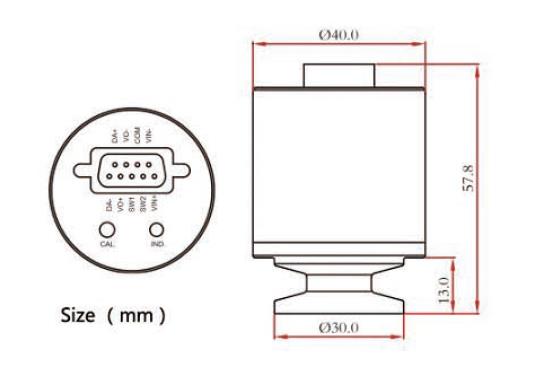
Pin Definition
Lectric Connection D-SUB 9 Needle (Male ) Plug
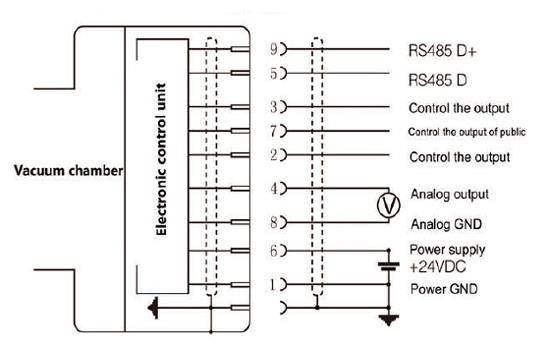
Pirani Sensor Analog Signal Output Diagram
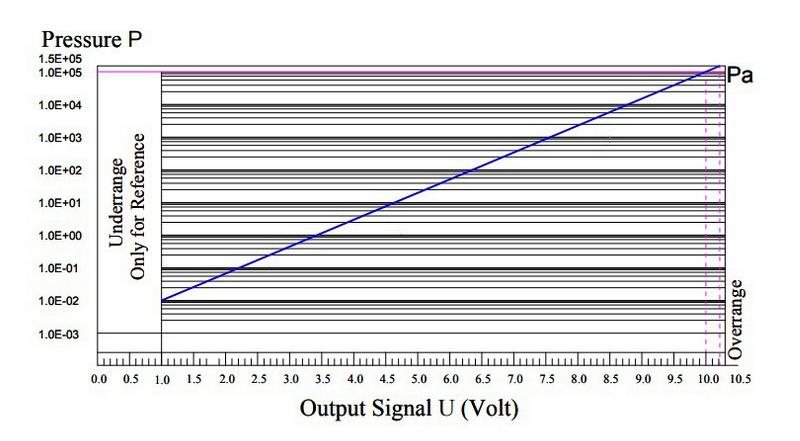
Pin 4/Pin 8 of the D-Sub 9 connector provides the analog voltage value of the real-time vacuum degree.
Measurement signal range: +0.0V~+10.3VDC, 2.5mV resolution.
Applications

Tips: Types of Vacuum Gauges
- Capacitance Manometers: These gauges measure pressure by detecting changes in capacitance between two conductive plates. They are highly accurate and can measure a wide range of pressures, from high to ultra-high vacuum.
- Pirani Gauges: These gauges measure pressure based on the thermal conductivity of the gas. A heated filament's temperature changes with pressure, and this temperature change is used to determine the pressure. They are suitable for medium to low vacuum ranges.
- Thermocouple Gauges: Similar to Pirani gauges, they measure pressure by detecting temperature changes in a heated filament, but they use a thermocouple for the temperature measurement. They are effective for medium vacuum applications.
- Cold Cathode Ionization Gauges: These gauges use an electric field to ionize gas molecules. The resulting ion current is measured to determine pressure. They are suitable for high to ultra-high vacuum applications.
- Hot Cathode Ionization Gauges: These gauges use a heated filament (cathode) to produce electrons that ionize gas molecules. The resulting ion current is used to measure pressure. They are used for high and ultra-high vacuum applications.
Only registered users can write reviews
Related products

Digital Vacuum Pressure Gauge, Pa/mBar/mmHg/Micron
ATO-VG-VG90
$203.84
Portable digital vacuum gauge is an instrument to measure vacuum pressure within a wide range of 0~10kPa, 0~100.00mBar, 0~75.000mmHg, and 0~75000Micron, suitable for refrigerator air conditioners, cold storage, automobiles, chemical industry, and pipelines.

Digital Vacuum Pressure Meter, Pa/mBar/mmHg/Micron
ATO-VG-VMV-1
$231.53
Buy a digital vacuum pressure meter with 720P LCD display and alarm. It is a portable vacuum test gauge used for measuring vacuum pressure in the range of 0~10kPa, 0~100.00mBar, 0~75.000mmHg and 0~75000Micron.

Pirani Vacuum Gauge Sensor, Analog Output
ATO-VG-PRN10
$670.22
High accuracy Pirani vacuum gauge sensor adopts a KF16 standard flange and RJ45 electrical plug, analog voltage output, and can automatically identify atmosphere and high vacuum within 1.0x10^-1 ~ 1.0x10^5 Pa. Micro Pirani vacuum pressure gauge is suitable for front vacuum pressure monitoring, safety circuits in vacuum systems, and vacuum measurement and control in the medium and low vacuum range.

Wireless Pirani Vacuum Gauge, Pa/mBar/Torr, Analog Output
ATO-VG-PRN12
$895.38
Digital Pirani gauge is a vacuum measurement instrument that integrates vacuum sensing, display, control, analog voltage or other output, wireless data transmission and other functions. It can display Pa/mBar/Torr values at the same time.