
Built with laser‑welded stainless steel housing and advanced shielding technology, this accelerometer sensor provides excellent durability and interference protection. Featuring high shock resistance up to 2000g, it is suitable for predictive maintenance, vibration testing, and industrial automation systems. Get your accelerometer sensor today for efficient analysis.
Specification
| Model | ATO-KT19 | ATO-KT20 | |
| Dynamic Performance Specifications | Sensitivity | ~50 mV/g | ~500 mV/g |
| Measurement Range | ±100 g | ±10 g | |
| Mounted Resonant Frequency | 10 kHz | 8 kHz | |
| Frequency Response ±3dB | 1‑2000 Hz | ||
| Non‑linearity | ≤1 % | ||
| Transverse Sensitivity | ≤5 % | ||
| Output | ±5 V | ||
| Environmental Specifications | Shock Limit | ±2000 g | ±1000 g |
| Sealing Performance | Laser Welded | ||
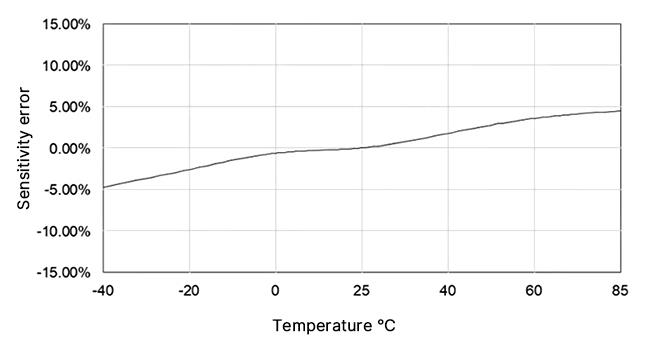
| Operating Temperature | -40~85℃ | ||
| Electrical Parameters | Supply Voltage | 18‑36 VDC | |
| Mount‑to‑Ground Insulation Resistance | ≥10⁸Ω | ||
| Structure | Output Connector | C5015 4‑core | M12 4‑core |
| Weight | 82 g | 130 g | |
| Housing Material | Stainless Steel | ||
| Sensing Element | Piezoelectric Ceramic | ||
| Element Structure | Shear | ||
| Mounting Base | M5 | ||
Features
- High Sensitivity & Accuracy: The piezo accelerometer sensor offers 50mV/g or 500mV/g sensitivity with ±5V output for precise vibration measurement and analysis.
- Long-Term Monitoring Stability: The accelerometer sensor features a sealed stainless steel structure and reliable electronics for continuous industrial vibration monitoring.
- Excellent Protection Performance: Laser-welded sealing protects the piezo accelerometer sensor against dust, water, and oil, extending service life in harsh environments.
- Strong Anti-Interference Capability: The industrial accelerometer sensor uses dual shielding isolation technology to maintain stable signals in electrically noisy conditions.
- Wide Measurement Range: This accelerometer is available with two measurement ranges of ±10g and ±100g, meeting different vibration detection requirements.
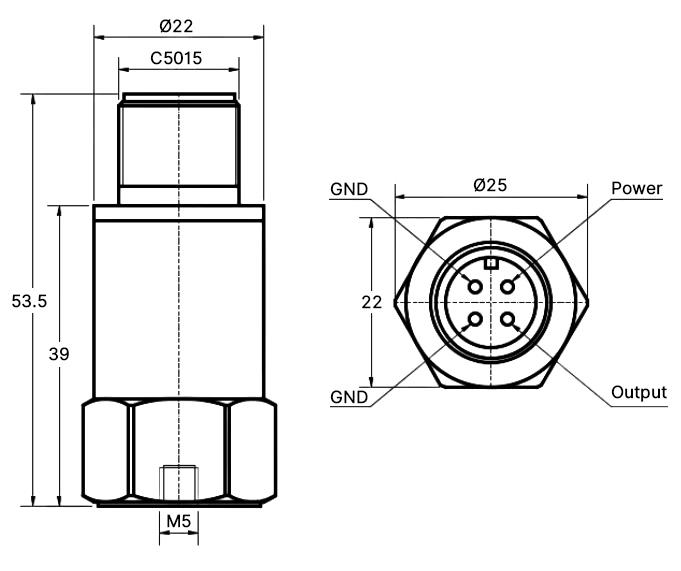
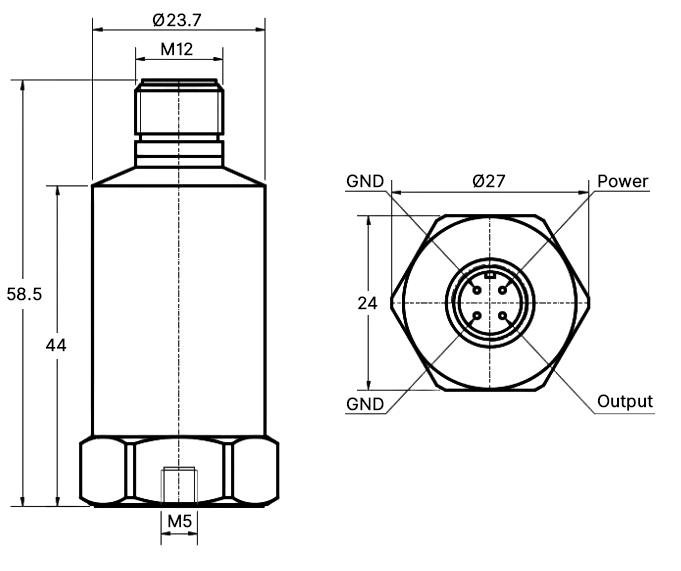
Dimension (unit: mm)
ATO-KT19 (±100g)
ATO-KT20 (±10g)
Typical Temperature Curve
Tips: How does a piezo accelerometer sensor work?
A piezo accelerometer sensor works based on the piezoelectric effect, where certain materials generate an electrical charge when subjected to mechanical stress. When vibration or acceleration occurs, the internal mass applies force to the piezoelectric element, causing it to produce a charge signal proportional to the applied acceleration. The sensor then converts this signal into an electrical output for vibration, shock, and dynamic acceleration measurement.

Piezo Accelerometer Sensor, 1-5V Output, 0-1g/0-10g

Industrial Piezoelectric Accelerometer Sensor, ±50g
Piezo Accelerometer Sensor, 1-5V Output, 0-1g/0-10g

Piezoelectric Accelerometer Sensor, 0-200g/0-500g/0-1000g
