Optical Dust Sensor, 0–1000 μm/m3

$59.96
Optical dust sensor with laser scattering technology for accurate particulate measurement (0–1000 μg/m3), 0.3 μm resolution, and laser auto-calibration, featuring standard PWM and UART output and full metal shielded housing for strong anti-interference performance. Operating voltage 4.75–5.25 VDC, working temperature -10–50 °C.
SKU: ATO-DS-APM10
*
Free Shipping
Delivery date: 6-12 days

This optical dust sensor uses laser scattering to accurately detect 0.3–10 μm particles, designed for HVAC systems and air quality monitoring manufacturers to enable reliable, high-precision dust detection in smart ventilation, cleanroom, and environmental monitoring applications.

Specification

ModelATO-APM10
Measured Particle Size Range0.3–10 μm
Particle Concentration Range0–1000 μg/m3
Accuracy±15 μg/m3(0–100 μg/m3)
±15% of reading (100–1000 μg/m3)
Supply Voltage4.75–5.25 VDC
Operating Current50 mA
Data Refresh Rate1 s
Power-on Stabilization Time60 s
Operating Temperature-10–50 ℃
Storage Temperature-30–70 ℃
Service Life>3 years
Dimensions49 × 31.5 × 10.8 mm


Feature

  • High-Precision Laser Scattering Technology: Optical dust sensor delivers reliable and accurate real-time dust detection for professional air quality monitoring applications
  • Ultra-Fine Particle Detection Capability: Measures particles from 0.3–10 μm, ensuring superior sensitivity for cleanroom and indoor air quality systems
  • Advanced Laser Self-Calibration: Optical particle sensor maintains long-term measurement stability with reduced drift and consistent accuracy over time
  • Standard Digital Output Interface: Enables seamless integration with HVAC systems, smart ventilation, and IoT-based environmental monitoring platforms
  • Industrial-Grade Full Metal Shielding: Laser dust sensor provides strong anti-interference performance and enhanced durability in complex electromagnetic environments
  • Wide Measurement Range: Supports 0–1000 μg/m3 particulate concentration for both low and high pollution monitoring scenarios
  • Real-Time Fast Response: 1-second data refresh rate ensures instant air quality feedback for dynamic control systems
  • Rugged Wide-Temperature Operation: Reliable performance from -10–50°C, with storage capability from -30–70°C for harsh environments

Size (Unit:mm)
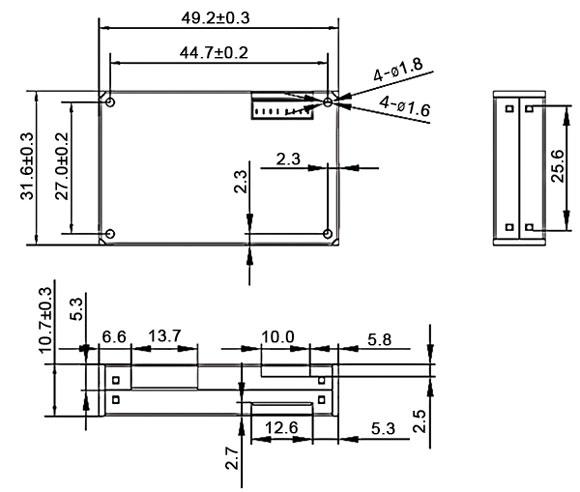
Optical dust sensor size

Interface Definitions

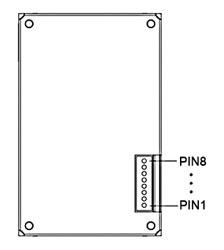
Optical dust sensor interface definitions

PINNameDescription
PIN 1VCCPower supply
PIN 2GNDGround
PIN 3SETConfiguration: 1 or floating ~ UART
PIN 4RX/SDAUART receive
PIN 5TX/SCLUART transmit
PIN 6NC-
PIN 7NC-
PIN 8PWMPWM output


Tips: What does the optical dust sensor work?
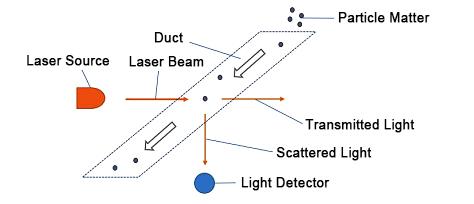
Optical dust sensor principle

The small optical dust sensor integrates a laser source and a light detector to measure airborne particles in real time. As air flows through the internal duct, particle matter passing through the laser beam causes light scattering. The light detector captures changes in both transmitted light and scattered light intensity. Based on Mie scattering theory, the sensor processes these signals to calculate the equivalent particle size and the concentration of particles per unit volume, enabling accurate particulate matter monitoring.

Product reviews
Consistent Air Quality Monitoring
5
Olivi
Avatar
8/2/2026 7:27 PM
We integrated this dust sensor into our indoor air quality monitoring system, and the data has been stable and reliable from the start. The UART interface was easy to work with, and the sensor responds quickly to changes in particle concentration. Its metal housing also performs well in an electrically noisy environment, giving us confidence in long-term operation.
Was this review helpful? Yes No (0/0)
Write your review
  • Only registered users can write reviews
*
*
  • Bad
  • Excellent
*
*
*
*

This optical dust sensor uses laser scattering to accurately detect 0.3–10 μm particles, designed for HVAC systems and air quality monitoring manufacturers to enable reliable, high-precision dust detection in smart ventilation, cleanroom, and environmental monitoring applications.

Specification

ModelATO-APM10
Measured Particle Size Range0.3–10 μm
Particle Concentration Range0–1000 μg/m3
Accuracy±15 μg/m3(0–100 μg/m3)
±15% of reading (100–1000 μg/m3)
Supply Voltage4.75–5.25 VDC
Operating Current50 mA
Data Refresh Rate1 s
Power-on Stabilization Time60 s
Operating Temperature-10–50 ℃
Storage Temperature-30–70 ℃
Service Life>3 years
Dimensions49 × 31.5 × 10.8 mm


Feature

  • High-Precision Laser Scattering Technology: Optical dust sensor delivers reliable and accurate real-time dust detection for professional air quality monitoring applications
  • Ultra-Fine Particle Detection Capability: Measures particles from 0.3–10 μm, ensuring superior sensitivity for cleanroom and indoor air quality systems
  • Advanced Laser Self-Calibration: Optical particle sensor maintains long-term measurement stability with reduced drift and consistent accuracy over time
  • Standard Digital Output Interface: Enables seamless integration with HVAC systems, smart ventilation, and IoT-based environmental monitoring platforms
  • Industrial-Grade Full Metal Shielding: Laser dust sensor provides strong anti-interference performance and enhanced durability in complex electromagnetic environments
  • Wide Measurement Range: Supports 0–1000 μg/m3 particulate concentration for both low and high pollution monitoring scenarios
  • Real-Time Fast Response: 1-second data refresh rate ensures instant air quality feedback for dynamic control systems
  • Rugged Wide-Temperature Operation: Reliable performance from -10–50°C, with storage capability from -30–70°C for harsh environments

Size (Unit:mm)

Optical dust sensor size

Interface Definitions

Optical dust sensor interface definitions

PINNameDescription
PIN 1VCCPower supply
PIN 2GNDGround
PIN 3SETConfiguration: 1 or floating ~ UART
PIN 4RX/SDAUART receive
PIN 5TX/SCLUART transmit
PIN 6NC-
PIN 7NC-
PIN 8PWMPWM output


Tips: What does the optical dust sensor work?

Optical dust sensor principle

The small optical dust sensor integrates a laser source and a light detector to measure airborne particles in real time. As air flows through the internal duct, particle matter passing through the laser beam causes light scattering. The light detector captures changes in both transmitted light and scattered light intensity. Based on Mie scattering theory, the sensor processes these signals to calculate the equivalent particle size and the concentration of particles per unit volume, enabling accurate particulate matter monitoring.

Product reviews
Consistent Air Quality Monitoring
5
Olivi
Avatar
8/2/2026 7:27 PM
We integrated this dust sensor into our indoor air quality monitoring system, and the data has been stable and reliable from the start. The UART interface was easy to work with, and the sensor responds quickly to changes in particle concentration. Its metal housing also performs well in an electrically noisy environment, giving us confidence in long-term operation.
Was this review helpful? Yes No (0/0)
Only registered users can write reviews