
Magnetic Stirrer
The magnetic stirrer is a laboratory instrument that is used for liquid mixing, mainly for stirring or simultaneously heating and stirring liquids or solid-liquid mixtures with a certain viscosity. ATO hot plate magnetic stirrers are available with 1 litre, 3 litre, and 5 litre, and comes with adjustable heating temperature up to 380℃ and stepless speed control 0-1600 rpm, convenient operation, fast heating, uniform stirring and high durability.
The heating mantle is a kind of general heating instrument in the laboratory. It is composed of a hemispherical heating inner cover made of alkali free glass fiber and metal heating wire and control circuit. The heating mantles feature fast heating, simple use and high durability and it has magnetic stirring function to ensure the heating evenly. There is a wide selection of capacities, 100ml, 500ml, 1000ml...5L for meeting different heating requirements. These heating mantles with magnetic stirrer are ideal instrument for accurate temperature control and heating test.
What is a magnetic stirrer?
A magnetic stirrer also known as magnetic mixer is a kind of laboratory equipment which is mainly used for stirring or heating stirring in low-viscosity liquid or solid-liquid mixing experiments. A rotating magnetic field is generated under the container plate, and the principle of homosexual repulsion and heterosexual attraction is used to push the magnetic stirring rod in the container to rotate rapidly, thereby achieving the purpose of stirring. The plate usually has a heating function to meet more experimental needs
The lab magnetic stirrer is usually used in the chemical and biological fields, and it is suitable for airtight containers or closed systems. It doesn’t need a complicated rotating seal structure like an electric mixer, and there is no need to maintain the rotating motor frequently or replace easily worn parts. It is quieter, more efficient, more wear-resistant than electric stirrers, and is not easily damaged (except for the simple bar magnet itself). The magnetic stirrer is more suitable for glass containers, because glass does not significantly affect the magnetic field, and it is easy to observe the stirring.
Features of magnetic stirrer
Just now, you learn the functions and characters of magnetic stirrer. Now let’s move to the features of magnetic stirrer.
- The top of the control panel is designed with an anti-corrosion liquid guiding groove. Even if the liquid overflows during the stirring process, it will not cause damage to the electronic components inside the agitator.
- It has large output torque. It is suitable for stirring low-viscosity large-capacity or high-viscosity small-capacity solutions.
- The table top is made of die-casting aluminum alloy material, and the exterior is sprayed with enamel material. The oil has good thermal conductivity and corrosion resistance. The smooth mixing table is easy to clean and has no residual pollutants.
- Aluminum alloy die-casting shell has the characteristics of high temperature resistance, corrosion resistance and easy cleaning.
- The bottom of the heating plate adopts double melting heat device, which can fully improve the efficiency. And it can avoid heat conduction to the case.
In addition to these features, magnetic stirrers have other features. Magnetic stirrers are mainly used for liquid dissolution, heating and batching in pharmaceutical, food and other industries in actual life and work. The role played by the magnetic stirrer is incomparable to that of the ordinary stirrer. The magnetic stirrer can basically liberate the hands in the process of liquid stirring. And for some liquids that need temperature control, the stirring temperature can also be changed at will for better liquid mixing. For some liquids (like oil), the viscosity will change during the stirring process, and the viscosity gear needs to be adjusted to keep the speed constant.
How to use a magnetic stirrer?
Turn on the power, the cup is ready, open the lid of the stainless steel container, place the cup in the middle of the stainless steel container, add heat transfer oil or silicone oil to the stainless steel container to the appropriate height, and put the stirrer into the cup solution. Turn on the power switch, the indicator light is on, turn the speed regulating potentiometer clockwise, and the stirring speed is from slow to fast. Adjust to the required speed.
When heating, connect the temperature sensor probe, clamp the probe on the bracket, move the bracket so that the temperature sensor probe is inserted into the solution not less than 5 cm, but can not affect the stirring, turn on the temperature control switch, set the desired temperature, press On the temperature controller +, - set the temperature to be constant temperature, the digital display value on the meter head is the actual temperature in the cup, the heating stops, the automatic constant temperature, the heating magnetic stirrer can continuously heat the constant temperature for a long time.
If there is a jumping phenomenon in the stirrer during work, please turn off the power and then turn it on again. The speed is from slow to fast, and it can be adjusted to resume normal work.
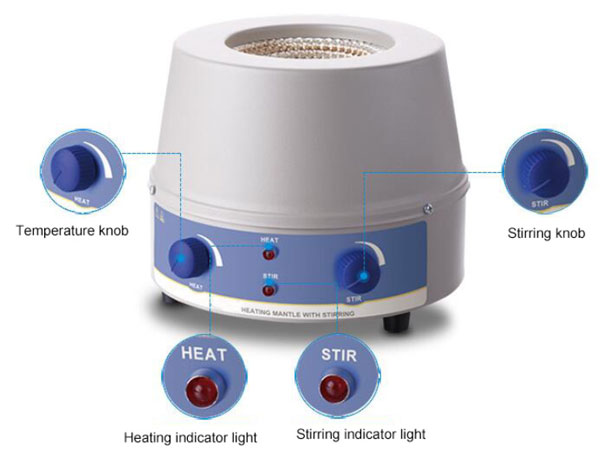
The common faults of heating magnetic stirrers are as follows:
- The magnetic stirrer does not start after power on: check the connection of the power cord and the power fuse.
- The magnetic stirrert can be started, but the self-test cannot be performed or the self-test is abnormal after power-on: turn off the power of the instrument and try again. If it still does not work, check whether the rotor cannot reach the proper speed due to the high viscosity of the solution.
- Excessive noise when the instrument is working: It may be caused by the excessive clearance of the inner shaft sleeve and bearing of the agitator, and the mismatch between the bearing and the shaft sleeve. It is recommended to replace the original parts according to the model of the instrument.
- The heating magnetic stirrer does not heat up: Check whether the heating fuse is burnt, the heating ring is short-circuited, or the heating meter is damaged.
- The rotor does not rotate or rotates abnormally: Check whether the viscosity of the solution is too high. If it is not a viscous solution, consider the electrical or mechanical failure of the rotor or the instrument itself. Check whether the instrument impeller rotates normally, and check whether the drive device is installed normally. If the reason is still unclear, it is recommended to contact the manufacturer's after-sales service personnel.

Laboratory Hot Plate Magnetic Stirrer, 1L, 0-1600 RPM

Laboratory Hot Plate Magnetic Stirrer, 3L, 0-1600 RPM

Laboratory Hot Plate Magnetic Stirrer, 5L, 200-2000 RPM

Heating Mantle with Magnetic Stirrer, 100ml/500ml/1000ml/2000ml


