
This photoelectric LED color sensor is engineered for high-accuracy color discrimination and mark detection in industrial settings. Colour identification sensor employs RGB tri-color LEDs to support two operational modes—color mode and mark mode—enabling flexible and reliable performance across different applications. With features such as long detection range, adjustable hysteresis, and a compact rectangular light spot, this sensor ensures precision and stability even under challenging conditions.
Specification
| Model | ATO-FGS-22N (NPN Output) | ATO-FGS-22P (PNP Output) |
| Sensing Distance | 18–28 mm | |
| Supply Voltage | 12–24 V DC | |
| Light Source Type | RGB Three-color Light | |
| Spot Size | Approx. 1.5×7 mm (at 23 mm) | |
| Residual Voltage | Below 1.5 V | |
| Max. Input Current | Power below 850 mW Below 35 mA at 24 V | |
| Current Consumption | 50 mA | |
| Response Time | < 100 μs | |
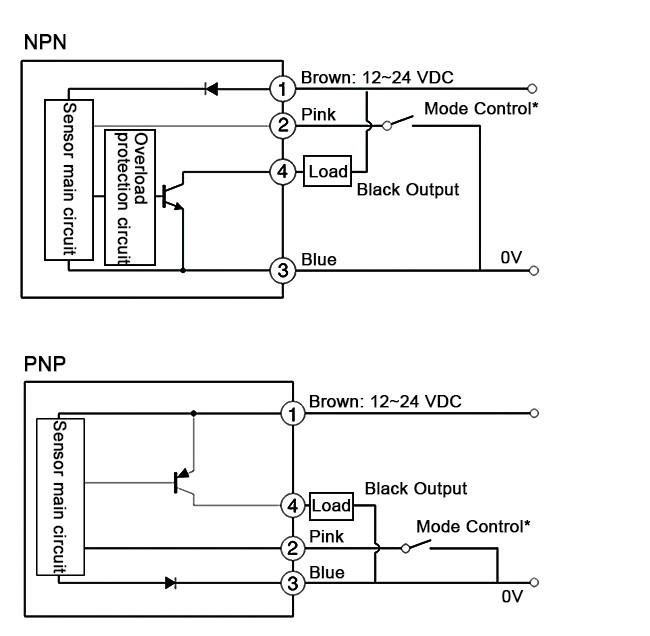
| Mode Switching | Mark Mode: Low (ON) 0–0.6 V DC; Sink current below 0.5 mA; Input impedance approx. 10 kΩ | |
| Color Mode: High (OFF) 12 to +V DC or open | ||
| Output Action | Mark Mode: ON when mark detected Color Mode: ON when match | |
| Light Projection Element | Composite LED; Red/Green/Blue (Peak Wavelength: 640 nm / 525 nm / 470 nm) | |
| Operating Temperature | –10 ℃ to 55 ℃; 35% to 85% RH | |
| Short-circuit Protection | Built-in | |
| Weight | Approx. 104 g | |
| Housing Material | ABS Engineering Plastic | |
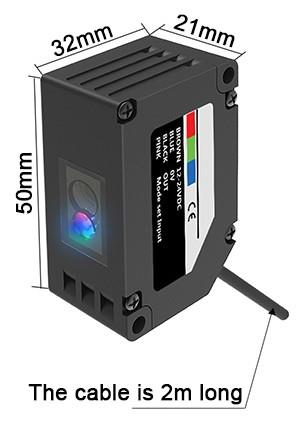
| Cable | 4-core rubber cable, standard length 2 m | |
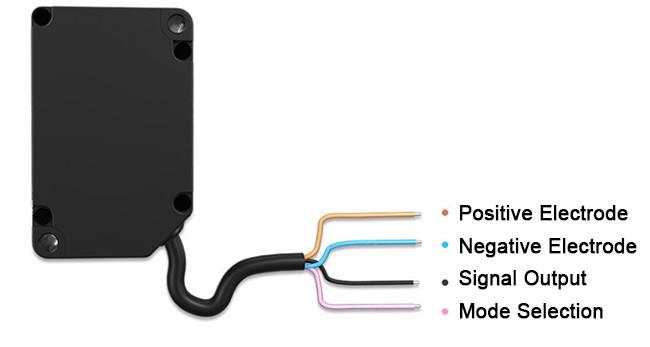
| Wiring | 4-wire Brown: +V; Blue: 0V; Black: Signal Output; Pink: Mode Switch | |
Feature
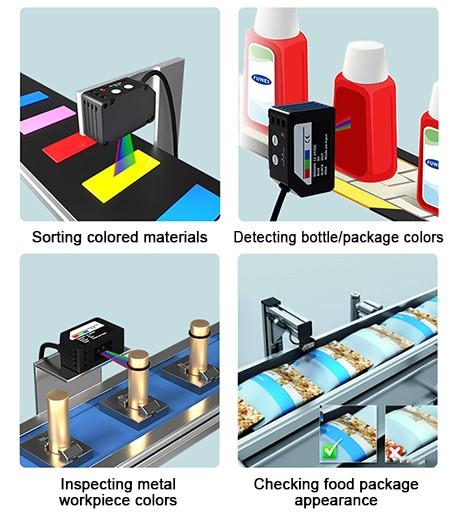
- Dual Detection Modes: The photoelectric LED color sensor supports both color mode and mark mode. In color mode, it uses RGB tri-color LEDs to identify colors based on the reflected RGB ratio. In mark mode, it automatically selects the optimal single-color LED for high-speed mark detection.
- Long Detection Range: Thanks to advanced optical and circuit design, the photoelectric LED color sensor achieves a reliable detection distance of 18–28 mm.
- Anti-Jitter Performance: Equipped with adjustable hysteresis, the color identification sensor minimizes the impact of object vibration, ensuring stable operation.
- Rectangular Light Spot: The color recognition sensor projects a rectangular light spot (approximately 1.5 mm × 7 mm at 23 mm), enabling precise detection on small or narrow targets.
Dimension (Unit: mm)
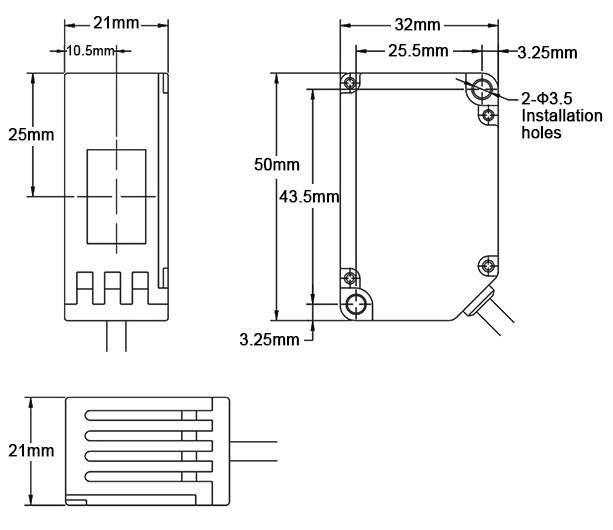
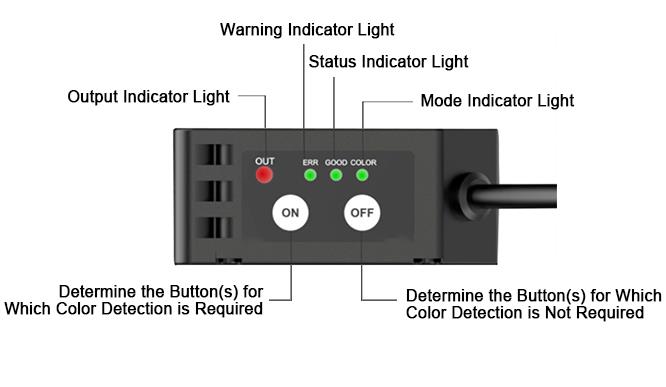
Detail
Wiring Diagram
Application
3 Tips for Photoelectric LED Color Sensor Operation
- Before teaching the photoelectric LED color sensor, confirm whether it is set to color mode or mark mode. The "COLOR" indicator light will be steadily lit in color mode and off in mark mode.
- To teach the color sensor, first position it over the target color and press the ON button until the GOOD indicator flashes. Then, position it over the background color and press the OFF button to complete the setup.
- Adjust the hysteresis setting to reduce the effects of object vibration. Press and hold the ON button for about 5 seconds until the hysteresis indicator flashes, then use the OFF button to select the desired hysteresis level (small, medium, or large).
Only registered users can write reviews
Related products

Color Detection Sensor, Red/Green/Blue/White
ATO-COLS
$85.24
Color sensor can be used with the instrument of automatic control system to detect the color, color patches and lines, and objects existence, can realize automatic positioning, color identification, correction, register, counting and other functions, with high sensitivity, fast response, strong anti-background light interference, compact structure, easy to use and low price.

Color Light Sensor with RGB Photodiode, 5-50mm
ATO-COLS-21N
$161.76
This color light sensor with an RGB photodiode offers high-precision color recognition for a wide range of targets (5-50mm). It features three distinct detection modes to handle various object characteristics, utilizes a combination of RGB light source, fiber optic probe, and focusing lens for stable performance, and provides rapid response times.

Color Recognition Sensor, NPN/PNP Output
ATO-COLS-CPES
$735.62
Discount color recognition sensors for sale, support NPN/PNP output, provide 4-channel open collector interface, suitable for a variety of industrial automation applications, with a high-speed response time of 200μs, suitable for the detection of extremely sensitive to color changes in the demand.

Industrial Color Sensor, 30-70mm/50-500mm Long Range
ATO-COLS-70NP
$339.94
This industrial color sensor utilizes a high-brightness white LED light source to enable stable and accurate detection over a long range of 30–70mm or 50–500mm. It excels at distinguishing subtle color and brightness differences on various workpieces, even under challenging conditions like surface tilt or distance variations. This industrial color sensor offers reliable performance for diverse industrial automation applications.