
Single axis laser diameter gauges are highly accurate and precise, often capable of measuring diameter sizes with micrometer-level tolerances. These laser measuring devices are widely utilized in various industries, including wire and cable manufacturing, metalworking, plastics extrusion, and textile production.
Features
- Laser diameter gauge is a measurement of diameter value, with a multi-angle display of the operation panel.
- This laser diameter measuring equipment adopts fully automatic closed-loop control technology and advanced DSP processing technology.
- The measurement process is not affected by speed and vibration.
- It comes with an over-tolerance alarm function.
- It adopts high-quality stainless steel fasteners, an aluminum die-casting shell, a plastic spraying surface, and good corrosion resistance.
- RS232/485/MODBUS protocol communication interface.
Specification
| Model | ATO-CJY-100A |
| Measuring Range | 1-100mm |
| Measuring Accuracy | ±10μm±0.008%Dz mm (Dz is the actual diameter of the measured object) |
| Resolution Ratio | 0.001mm |
| Scanning Speed | 1400 Times Scanning Cycle/Second |
| Power Supply | 100~240V AC, 1A |
| Working Frequency | 50/60Hz |
| Display Method | Two-Row 5-Digit Pipe Display |
| Light Source | Second Generation Visible Laser, Wavelength 650nm |
| Working Principle | Non-Contact Laser Scanning |
| Data Collection and Analysis | Support (Need to connect to an external computer and install related software) |
| Out-of-Tolerance Alarm Function | Dual relay contact output, upper and lower deviation signals are output separately (External sound and light alarm 24V DC and below) |
| Working Temperature | 0~45℃ |
| Relative Humidity | ≤85%RH (No Condensation Water) |
| Other Environmental Requirements | The air does not contain corrosive gases, serious volatile oils, water vapor and dust. |
| Power Consumption | ≤15W (with Adapter + 40W) |
| Communication Mode | Communication Method: Use RS485 interface, MODBUS RTU protocol/TCP protocol (Ethernet) to communicate with other devices |
| Protection Grade | IP65 |
| Dimension | 575*64*378mm (L*W*H) |
| Weight | 27.8kg |
Dimension (Unit: mm)
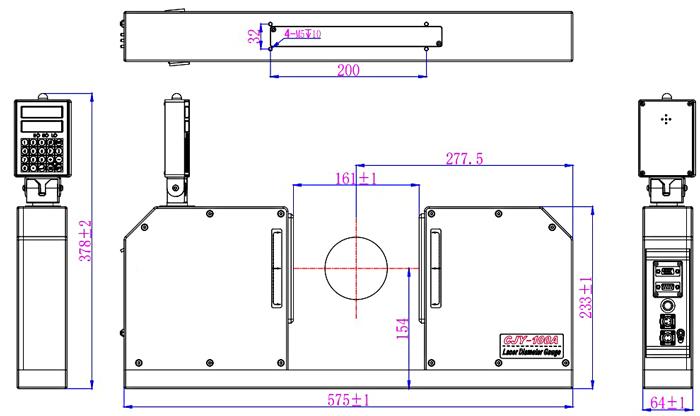
Tips: How to choose a suitable laser diameter gauge?
There are several key factors to consider when choosing a suitable laser diameter gauge:
- Measuring range: Make sure the measuring range of the instrument covers your actual needs, including both the minimum and maximum diameters.
- Measuring accuracy: Choose a laser diameter measuring instrument with suitable measuring accuracy based on the specific requirements of the application. High-precision measuring instruments are usually more expensive, but they are necessary in demanding applications.
- Response speed: In dynamic measurements, the response speed is an important factor to ensure that the instrument can capture rapidly changing diameters in real time.
- Environmental adaptability: Consider the adaptability of the instrument in different working environments, such as temperature, humidity, vibration, etc.
- Data output and processing: Check the data output options and interfaces of the instrument to ensure that it is compatible with your data acquisition and processing system.
Only registered users can write reviews
Related products

Laser Diameter Gauge, Dual Axis, 0.1-25mm
ATO-LDG-25B
$4,648.10
Laser diameter gauge is a non-contact measurement device, with a measuring range from 0.1mm to 25mm, used to precisely determine the diameter of cylindrical objects such as wires, cables, tubes, and rods. Dual axis laser diameter gauge is non-destructive and non-contact, which can measure delicate or sensitive materials without causing damage.

Laser Diameter Gauge, Dual Axis, 0.1-40mm
ATO-LDG-40B
$5,327.94
Daul axis laser diameter gauge for sale online, with a measuring range from 0.1mm to 40mm. This diameter measuring equipment is crafted for non-contact measurements to gauge the diameter of cylindrical items such as wires, cables, tubes, and rods.

Laser Diameter Gauge, Single Axis, 0.1-10mm
ATO-LDG-10A
$2,537.62
ATO laser diameter gauge, a non-contact measurement tool, precisely determines cylindrical object diameters, ranging from 0.1mm to 10mm. This single axis diameter gauge is ideal for measuring wires, cables, tubes, and rods.

Laser Diameter Gauge, Single Axis, 1-60mm
ATO-LDG-60A
$4,664.48
Factory price laser diameter gauge with a measuring range of 1-60mm, is used for precise measurement of the diameter of cylindrical objects such as wires, cables, tubes, and rods. Single axis laser diameter gauge employs laser technology to ensure high accuracy and reliability in diameter measurement.

Laser Diameter Gauge, Single Axis, 1-70mm
ATO-LDG-70A
$4,823.21
Economical price single axis laser diameter gauge is a precision measuring instrument designed for non-contact measurement, specifically tailored for determining the diameter of cylindrical objects like wires, cables, tubes, and rods. With a measurement range from 1mm to 70mm, it offers versatility across various industrial applications.