Industrial Linear Actuator, 12V/24V, 7000N, 450mm Stroke

$451.15
High load linear actuator is 12/24V rated voltage, 150W output power, max load up to 7000N, 450mm stroke (other strokes are available), built-in a not adjustable clutch, used in a wide range of industries, projects and applications.
SKU: ATO-LACTU-7000
*
*
*
*
Free Shipping
Delivery date: 10-20 days

The provided industrial linear actuator is a very powerful actuator, due to its 7000N large load capacity, compact design, and IP65 rated protection, is ideal for various applications such as agricultural machinery, construction machinery, and industrial machinery.

Electric Linear Actuator Specifications

ModelATOHTW10
Voltage12V DC, 24V DC (Optional)
Note: The fluctuation of voltage is +/-2V.
Maximum Load7000N in pull/push
Self Locking Force9000N
Power150W
Rated Speed at Full Load4mm/s at 7500N
Output Speed at No Load5.5mm/s
Rated Load Current16.2A
Stroke (Optional)*50/ 100/ 150/ 200/ 250/ 300/ 350/ 400/ 450mm (Can be customized)
Limit Type (Optional)*1. With clutch, no limit switch (stroke + 200 mm)
2. Built-in limit switch, not adjustable (stroke + 240 mm)
IP RatingIP65
Operational Temperature Range-20°C~+45°C
CertificationISO, CE, RoHS
Noise<60db
Upper End TypeCylindrical, aperture 8.1mm
Line Length750mm
Weight8 kg

Linear Actuator Load and Speed Selection

Rated Load CapacitySelf Locking Force (N)Rated Load Current (A)Output Speed at No load (mm/s)Rated Speed at Full Load (mm/s)
Pull (N)Push (N)
70007000900016.25.54
60006000600016.28.57
50005000500016.8119.5
40004000300015.81714

Linear Actuator Standard Dimension (mm)
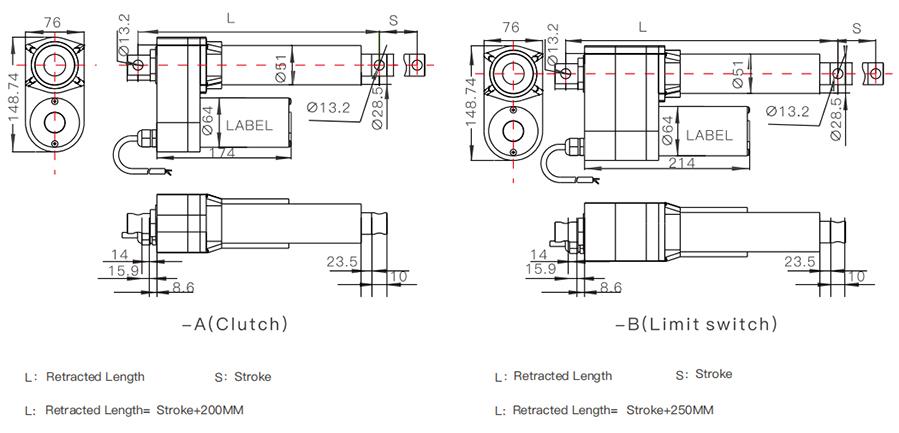
7000N industrial 12v/ 24v linear actuator size

Linear Actuator Stroke and Retracted Length (L) Selection

Stroke±2 (mm), Mounting Dimension±2 (mm)
Stroke50100150200250300350400450
L for Actuator with Clutch250300350400450500550600650
L for Actuator with Limit Switch300350400450500550600650700

Tips: What is the self-lock condition of the linear actuator?

First, it is the static self-lock. The self-lock coefficient is less than 0.35. When it is static, and free of any vibration, the rod can maintain static when there is an external pressure. When the self-lock is less than 0.3, and the force of the rod goes against the movement direction, the motor has no movement in power off. When the self-lock is less than 0.25, and the force of the rod is the same as the movement direction, the motor has no movement in power off. When the self-lock coefficient is between 0.35 and 0.55, the rod will move up and down when the external force increases constantly. When the self-lock is higher than 0.55, the rod can move up and down when the external force is very small. Therefore, we should pay attention to the problem of self-lock in linear actuator model selection.

Proposition 65 Warning

*WARNING: This product can expose you to chemicals, including lead, which is known to the State of California to cause birth defects or other reproductive harm. For more information, go to www.P65Warnings.ca.gov.

Product reviews
Questions for your linear actuator
5
Hunter Hershey
Avatar
1/5/2020 7:05 PM
For your high speed linear actuator, and just to make sure I understand fully: This actuator has a built in servo motor. That motor takes a signal (either + /- 12, 24 V) which makes the servo turn and the actuator extend at a constant rate. A hall sensor built into the servo reports the position of the actuator. If yes, then can I adjust its speed?
Was this review helpful? Yes No (0/0)
ATO Responded
1. Yes, this drive has a built-in servo motor and is equipped with a small gearbox. The motor receives signals (+/ -12, 24v).
2. The rated load and operating speed of the actuator are usually fixed when customized. Therefore, when the rated voltage is lowered, the load and speed will decrease simultaneously, so, the electric actuator does not have different speeds under different loads. Because the input voltage drops, the speed will drop, and the load will drop.
This linear actuator was perfect for what I needed
5
Michael Goald
Avatar
5/12/2020 7:11 PM
This linear actuator (24V, 7500N, 400mm stroke) was perfect for what I needed. The only thing is the ram with a little lose when close to fully or fully extended but it still works very well.
Was this review helpful? Yes No (0/0)
Does the Hall sensor option for your linear actuator allow you to set limits for adjusting stroke length?
5
Leet
Avatar
11/11/2021 10:43 PM
Does the Hall sensor option for your linear actuator allow you to set limits for adjusting stroke length?
Was this review helpful? Yes No (0/0)
ATO Responded
The Hall sensor of the linear actuator can be used as a position signal output. This signal can be used to determine the position of the push rod for the synchronous expansion and contraction of the two push rods. But the stroke of our product itself is not controlled by Hall sensors.
Have some trouble reading the linear actuator HAL signal
5
rabbie
Avatar
6/7/2023 2:33 AM
We are having trouble reading the HAL signal with the PLC. We have it connected as an encoder to an input that can do 100Khz. We can only get a few pulses detected by the PLC.
Do you have any more information that could help? How many pulses per revolution and rpm is our motor?
Was this review helpful? Yes No (0/0)
ATO Responded
The motor inside the actuator has 2 pairs of poles, and the number of pulses corresponding to 1mm stroke is 4 pulses.
The motor is 4000 rpm, and each revolution has 4 pulse signals.
What the load rating is in amps for this actuator at 24V DC?
5
yuri
Avatar
7/24/2023 7:22 PM
Thank you for your help so far with this linear actuator. It has been running properly for some time.
We are only now having a situation happen where the fuse is sometimes blown as the actuator reaches the end of the stroke.
We think it is working hard at the endpoint compared to in the middle of the stroke.
The linear actuator is on a 10A fuse and 24V.
The website says that this linear actuator is 150W, so I believe 10A should be enough.
Could you please help by confirming what the load rating is in amps for this actuator at 24V DC?  
Can you think of why we might be blowing a 10A GMA-style fuse?
Was this review helpful? Yes No (0/0)
ATO Responded
If the actuator is overloaded, the current increase will burn the 10A GMA-style fuse.
The rated current corresponding to the 24V voltage of this actuator is about 15A, so we recommend that you use a fuse above 15A, and test again.
Write your review
  • Only registered users can write reviews
*
*
  • Bad
  • Excellent
*
*
*
*

The provided industrial linear actuator is a very powerful actuator, due to its 7000N large load capacity, compact design, and IP65 rated protection, is ideal for various applications such as agricultural machinery, construction machinery, and industrial machinery.

Electric Linear Actuator Specifications

ModelATOHTW10
Voltage12V DC, 24V DC (Optional)
Note: The fluctuation of voltage is +/-2V.
Maximum Load7000N in pull/push
Self Locking Force9000N
Power150W
Rated Speed at Full Load4mm/s at 7500N
Output Speed at No Load5.5mm/s
Rated Load Current16.2A
Stroke (Optional)*50/ 100/ 150/ 200/ 250/ 300/ 350/ 400/ 450mm (Can be customized)
Limit Type (Optional)*1. With clutch, no limit switch (stroke + 200 mm)
2. Built-in limit switch, not adjustable (stroke + 240 mm)
IP RatingIP65
Operational Temperature Range-20°C~+45°C
CertificationISO, CE, RoHS
Noise<60db
Upper End TypeCylindrical, aperture 8.1mm
Line Length750mm
Weight8 kg

Linear Actuator Load and Speed Selection

Rated Load CapacitySelf Locking Force (N)Rated Load Current (A)Output Speed at No load (mm/s)Rated Speed at Full Load (mm/s)
Pull (N)Push (N)
70007000900016.25.54
60006000600016.28.57
50005000500016.8119.5
40004000300015.81714

Linear Actuator Standard Dimension (mm)

7000N industrial 12v/ 24v linear actuator size

Linear Actuator Stroke and Retracted Length (L) Selection

Stroke±2 (mm), Mounting Dimension±2 (mm)
Stroke50100150200250300350400450
L for Actuator with Clutch250300350400450500550600650
L for Actuator with Limit Switch300350400450500550600650700

Tips: What is the self-lock condition of the linear actuator?

First, it is the static self-lock. The self-lock coefficient is less than 0.35. When it is static, and free of any vibration, the rod can maintain static when there is an external pressure. When the self-lock is less than 0.3, and the force of the rod goes against the movement direction, the motor has no movement in power off. When the self-lock is less than 0.25, and the force of the rod is the same as the movement direction, the motor has no movement in power off. When the self-lock coefficient is between 0.35 and 0.55, the rod will move up and down when the external force increases constantly. When the self-lock is higher than 0.55, the rod can move up and down when the external force is very small. Therefore, we should pay attention to the problem of self-lock in linear actuator model selection.

Product reviews
Questions for your linear actuator
5
Hunter Hershey
Avatar
1/5/2020 7:05 PM
For your high speed linear actuator, and just to make sure I understand fully: This actuator has a built in servo motor. That motor takes a signal (either + /- 12, 24 V) which makes the servo turn and the actuator extend at a constant rate. A hall sensor built into the servo reports the position of the actuator. If yes, then can I adjust its speed?
Was this review helpful? Yes No (0/0)
ATO Responded
1. Yes, this drive has a built-in servo motor and is equipped with a small gearbox. The motor receives signals (+/ -12, 24v).
2. The rated load and operating speed of the actuator are usually fixed when customized. Therefore, when the rated voltage is lowered, the load and speed will decrease simultaneously, so, the electric actuator does not have different speeds under different loads. Because the input voltage drops, the speed will drop, and the load will drop.
This linear actuator was perfect for what I needed
5
Michael Goald
Avatar
5/12/2020 7:11 PM
This linear actuator (24V, 7500N, 400mm stroke) was perfect for what I needed. The only thing is the ram with a little lose when close to fully or fully extended but it still works very well.
Was this review helpful? Yes No (0/0)
Does the Hall sensor option for your linear actuator allow you to set limits for adjusting stroke length?
5
Leet
Avatar
11/11/2021 10:43 PM
Does the Hall sensor option for your linear actuator allow you to set limits for adjusting stroke length?
Was this review helpful? Yes No (0/0)
ATO Responded
The Hall sensor of the linear actuator can be used as a position signal output. This signal can be used to determine the position of the push rod for the synchronous expansion and contraction of the two push rods. But the stroke of our product itself is not controlled by Hall sensors.
Have some trouble reading the linear actuator HAL signal
5
rabbie
Avatar
6/7/2023 2:33 AM
We are having trouble reading the HAL signal with the PLC. We have it connected as an encoder to an input that can do 100Khz. We can only get a few pulses detected by the PLC.
Do you have any more information that could help? How many pulses per revolution and rpm is our motor?
Was this review helpful? Yes No (0/0)
ATO Responded
The motor inside the actuator has 2 pairs of poles, and the number of pulses corresponding to 1mm stroke is 4 pulses.
The motor is 4000 rpm, and each revolution has 4 pulse signals.
What the load rating is in amps for this actuator at 24V DC?
5
yuri
Avatar
7/24/2023 7:22 PM
Thank you for your help so far with this linear actuator. It has been running properly for some time.
We are only now having a situation happen where the fuse is sometimes blown as the actuator reaches the end of the stroke.
We think it is working hard at the endpoint compared to in the middle of the stroke.
The linear actuator is on a 10A fuse and 24V.
The website says that this linear actuator is 150W, so I believe 10A should be enough.
Could you please help by confirming what the load rating is in amps for this actuator at 24V DC?  
Can you think of why we might be blowing a 10A GMA-style fuse?
Was this review helpful? Yes No (0/0)
ATO Responded
If the actuator is overloaded, the current increase will burn the 10A GMA-style fuse.
The rated current corresponding to the 24V voltage of this actuator is about 15A, so we recommend that you use a fuse above 15A, and test again.
Only registered users can write reviews