
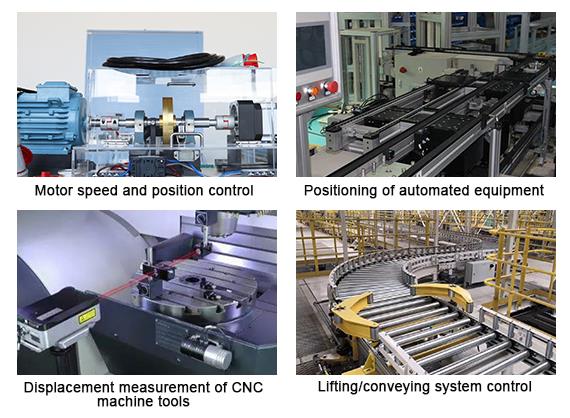
Incremental optical rotary encoders with 5000 ppr can be used for robots, workbenches, injection molding machines, electronic equipment, printing and packaging machinery, non-standard equipment and CNC machine, a variety of office automation systems, industrial automation control and measurement fields.
Specification
| Basics | Model | ATO-S5808G-5000BM | |||||||||||||||||||
| Weight | 100 g | ||||||||||||||||||||
| Wiring | Color | Red | Black | Green | White | Yellow | Brown | Gray | Orange | ||||||||||||
| Signal | Vcc | GND | A | B | Z | A- | B- | Z- | |||||||||||||
| Mechanical properties | Maximum shaft speed (r/min) | 5000 | |||||||||||||||||||
| Starting torque | <0.03Nm (25℃) | ||||||||||||||||||||
| Maximum shaft load | Radial load: 50N, axial load: 20N | ||||||||||||||||||||
| Shock resistance | 50G/11ms | ||||||||||||||||||||
| Anti-vibration | 10G (10~2000Hz) | ||||||||||||||||||||
| Rotational inertia | 4X10⁻⁸kgm2 | ||||||||||||||||||||
| Operating temperature | -30~+85℃ (-22~+185℉) | ||||||||||||||||||||
| Storage temperature | -35~+95℃ (-31~+203℉) | ||||||||||||||||||||
| Protection Level | IP51 | ||||||||||||||||||||
| Electrical characteristics | Output circuit | Open-collector output | Voltage output | Push-pull output | Line driver output | ||||||||||||||||
| Supply voltage Vcc | DC 5V±0.2 | DC 5~24V | DC 5V±0.2 | DC 5~24V | DC 5V±0.2 | DC 5~24V | DC5V±0.2 | DC 5~24V | |||||||||||||
| Current consumption | ≤60mA | ≤60mA | ≤60mA | ≤100mA | |||||||||||||||||
| Output high level | ≥3.5V | ≥Vcc-2.5V | - | - | ≥2.5V | ≥Vcc-2.5V | |||||||||||||||
| Output low level | ≤0.5V | ≤0.5V | - | - | ≤0.5V | ≤1.0V | |||||||||||||||
| Rise time Tr | ≤500ns | ≤1500ns | - | - | ≤200ns | ≤500ns | |||||||||||||||
| Fall time Tf | ≤100ns | ≤300ns | - | - | ≤200ns | ≤200ns | |||||||||||||||
| Maximum frequency response | 0~100kHz | 0~100kHz | 0~100kHz | 0~100kHz | 0~100kHz | 0~100kHz | |||||||||||||||
Model Selection
| Shaft type | Diameter of shell | Diameter of shaft | Connection type | Cable length * | Resolution | Production identifier | Z signal | Z signal wavelength | Output mode * | Voltage * |
| S: Shaft | 58: 58mm | 8: 8mm | G: Cable edge output | 1: 1m 2: 2m 3: 3m 4: 4m | 5000: 5000 ppr | B | M: Output 1 if receiving Z signal | Default: 1T | C: Open-collector NPN CP: Open-collector PNP T: Voltage output NPN+R P: Push-pull output NPN+PNP L: Line driver 26LS31 K: Line driver 7272 | 5: +5VDC 830: +8~30VDC |
Note: * denotes optional parameters, you can select parameters in drop-down lists to finish your order. Some customizable parameters can't be selected from the lists directly, please contact customer service staff for further communication.
Features
- The optical shaft encoder adopts a special ASIC chip inside, which is stable and reliable in signal processing and ensures accurate output pulse.
- The overall structure is durable, long life, suitable for long time high frequency operation of industrial occasions.
- Incremental encoder has excellent anti-interference performance, can work stably in complex electromagnetic environment.
- Compact and lightweight, suitable for automation equipment with limited installation space.
- Modular design, easy installation, fast and efficient commissioning.
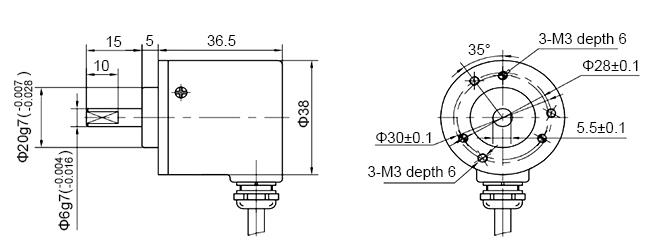
Dimension (unit: mm)
Application
Tips: How to use rotary encoder to detect linear displacement?
- Use a flexible coupling to connect the rotary encoder directly to the main shaft of the power unit that drives the linear displacement.
- Use a small gear (spur gears, bevel gears or worm gear) box to connect with the power unit.
- Use a gear rotating on a spur rack to transfer linear displacement information.
- Get linear displacement information on the drive chain sprocket.
- Obtain linear displacement information on the timing belt of the timing belt pulley.
- Use rotary encoders that are equipped with magnetic rollers to obtain displacement information on linear displaced flat steel surfaces (avoid slip).
- Use retractable wire assembly like a steel tape to connect the rotary encoder to detect linear displacement information (data processing need to overcome the stack winding error).
- Similar to 7, use retractable wire assembly with a small torque motor to connect a rotary encoder to detect linear displacement information (there are similar products in Germany at the moment, with a complex structure and almost no stack winding error).
Product reviews
I need to buy a new module
Rubin

2/20/2025 1:33 AM
Rockwell PLC does have a high-speed counter module, however we would have to buy, install, and configure a new module. We were hoping to do this with the existing infrastructure. Does the incremental encoder on the motor create a load so you can see the current draw on the motor increase/decrease? Please elaborate on this.
Was this review helpful? (0/0)
Only registered users can write reviews
Related products

Incremental Rotary Encoder, Shaft, 100 ppr
ATO-IRE-100PS
$155.24
Cheap optical rotary encoder adopts stainless steel shaft, high resolution, high quality, line interface with waterproof protection, several output modes to choose, manufacturer direct sale. 100 ppr incremental rotary encoder has 38mm shell diameter and 6mm shaft diameter.

Incremental Rotary Encoder, Shaft, 500 ppr
ATO-IRE-500PS
$142.22
Favourable price optical encoder has 6mm diameter stainless steel shaft, 38mm shell diameter, 500 ppr resolution, high reliability, high quality, several output modes to choose, manufacturer direct sale.

Incremental Rotary Encoder, Hollow Shaft, 4096 ppr
ATO-IRE-4096PH
$269.28
Low priced optical rotary encoder adopts hollow shaft, can sleeve-jointed on motor output shaft, high resolution 4096 ppr, high reliability, high quality, several output modes to choose. 1800 ppr incremental rotaty encoder has optional voltage 5VDC/8-30VDC, optional 6 output modes, Φ80mm shell, Φ25mm shaft and cable edge output connection mode.

Incremental Rotary Encoder, Hollow Shaft, 5400 ppr
ATO-IRE-5400PH
$491.43
Favourable price optical incremental encoder adopts Φ30mm hollow shaft and Φ100mm shell, can sleeve-jointed on motor output shaft, high resolution 5400 ppr, high reliability, high quality, 6 output modes to choose, manufacturer direct sale.