
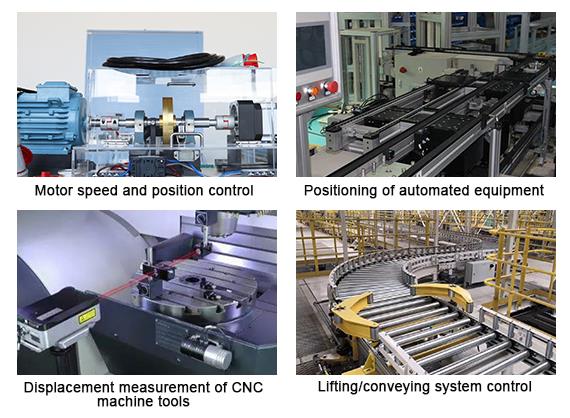
Incremental rotary encoders with 1800 ppr can be used for robots, workbenches, injection molding machines, electronic equipment, printing and packaging machinery, non-standard equipment and CNC machine, a variety of office automation systems, industrial automation control and measurement fields.
Specification
| Basics | Model | ATO-K8030G-1800BM | |||||||||||||||||||
| Weight | 100 g | ||||||||||||||||||||
| Wiring | Color | Red | Black | Green | White | Yellow | Brown | Gray | Orange | ||||||||||||
| Signal | Vcc | GND | A | B | Z | A- | B- | Z- | |||||||||||||
| Mechanical properties | Maximum shaft speed (r/min) | 5000 | |||||||||||||||||||
| Starting torque | <0.03Nm (25℃) | ||||||||||||||||||||
| Maximum shaft load | Radial load: 20N, axial load: 10N | ||||||||||||||||||||
| Shock resistance | 50G/11ms | ||||||||||||||||||||
| Anti-vibration | 10G (10~2000Hz) | ||||||||||||||||||||
| Rotational inertia | 4X10⁻⁸kgm2 | ||||||||||||||||||||
| Operating temperature | -30~+85℃ (-22~+185℉) | ||||||||||||||||||||
| Storage temperature | -35~+95℃ (-31~+203℉) | ||||||||||||||||||||
| Protection Level | IP51 | ||||||||||||||||||||
| Electrical characteristics | Output circuit | Open-collector output | Voltage output | Push-pull output | Line driver output | ||||||||||||||||
| Supply voltage Vcc | DC 5V±0.2 | DC 5~24V | DC 5V±0.2 | DC 5~24V | DC 5V±0.2 | DC 5~24V | DC5V±0.2 | DC 5~24V | |||||||||||||
| Current consumption | ≤60mA | ≤60mA | ≤60mA | ≤100mA | |||||||||||||||||
| Output high level | ≥3.5V | ≥Vcc-2.5V | - | - | ≥2.5V | ≥Vcc-2.5V | |||||||||||||||
| Output low level | ≤0.5V | ≤0.5V | - | - | ≤0.5V | ≤1.0V | |||||||||||||||
| Rise time Tr | ≤500ns | ≤1500ns | - | - | ≤200ns | ≤500ns | |||||||||||||||
| Fall time Tf | ≤100ns | ≤300ns | - | - | ≤200ns | ≤200ns | |||||||||||||||
| Maximum frequency response | 0~150kHz | 0~150kHz | 0~150kHz | 0~150kHz | 0~150kHz | 0~150kHz | |||||||||||||||
Model Selection
| Shaft type | Diameter of shell | Diameter of shaft | Connection type | Cable length * | Resolution | Production identifier | Z signal | Z signal wavelength | Output mode * | Voltage * |
| K: Hollow shaft | 80: 80mm | 30: 30mm | G: Cable edge output | 1: 1m 2: 2m 3: 3m 4: 4m | 1800: 1800 ppr | B | M: Output 1 if receiving Z signal | Default: 1T | C: Open-collector NPN CP: Open-collector PNP T: Voltage output NPN+R P: Push-pull output NPN+PNP L: Line driver 26LS31 K: Line driver 7272 | 5: +5VDC 830: +8~30VDC |
Note: * denotes optional parameters, you can select parameters in drop-down lists to finish your order. Some customizable parameters can't be selected from the lists directly, please contact customer service staff for further communication.
Features
- The encoder adopts a special ASIC chip inside, which is stable and reliable in signal processing and ensures accurate output pulse.
- The overall structure is durable, long life, suitable for long time high frequency operation of industrial occasions.
- Incremental encoder has excellent anti-interference performance, can work stably in complex electromagnetic environment.
- Compact and lightweight, suitable for automation equipment with limited installation space.
- Modular design, easy installation, fast and efficient commissioning.
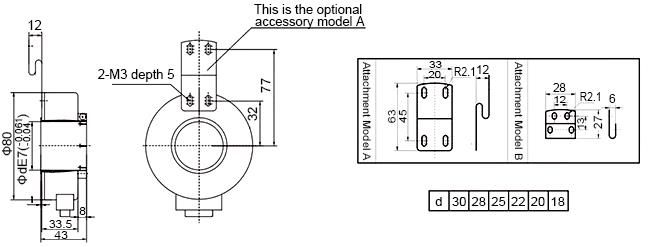
Dimension (unit: mm)
Application
Tips: How far can the distance between rotary encoder and system be?
The biggest problem with using long cables is that the cables become more susceptible to noise. This is due to the capacitance of the cable that makes the cable behave like an antenna, meanwhile the power will be wastage through the cable. To get the maximum cable distance, must follow some basic wiring guidelines:
Keep the cables away from objects that generate a significant amount of electrical noise. This includes AC motors, arc welders, AC power cords and transformers.
Use twisted pair when using signals with complementary signals, use shielded cables when using any type of signal. The output voltage use maximum voltage allowed. For example, if the rotary encoder can output 5 to 24V, then use 24V. Use open-collector output, or differential line driver output with differential receiver chip, to get the maximum drain and source current.
If the encoder is used as input to more than one controller, use a signal amplifier. This is also a good way to increase the distance the signal is transmitted. When using differential inputs, the typical differential line driver has a maximum distance of about 100 feet and the open collector distance is about 35 feet.


Reaction Torque Sensor, Dual Flange, 20 Nm/100 Nm/5000 Nm to 10000 Nm

Incremental Rotary Encoder, Shaft, 1600 ppr

Incremental Rotary Encoder, Shaft, 2000 ppr

Incremental Rotary Encoder, Hollow Shaft, 2048 ppr
