
Incremental non-contact linear encoder provides precise position feedback for your equipment, optimizing production processes and enhancing product quality. Whether you require high-precision machining or precise positioning, ATO provides useful solutions for your needs.
Features
- Multi-color indicator lights indicate signal strength, simplifying installation.
- It includes a built-in reference zero position for precise calibration.
- The encoder utilizes a high flexibility, bending-resistant braided shielding wire.
- Despite its compact size, it offers high resolution for detailed measurements.
- The optical linear encoder provides a standard AB quadrature digital signal output for compatibility with various systems.
- The incremental position encoder features an open non-contact optical system to ensure reliable performance.
- Encased in a stainless steel shell, it boasts strong anti-interference properties.
- The incremental encoder incorporates a high-precision measurement system for accurate readings.
Specification
| Model | ATO-LGD64 |
| Power supply | 5V±-10% |
| Current consumption | Less than 120mA |
| Resolution | 0.1μm, 0.5μm, 1μm (choosable) |
| Accuracy level of grating ruler | ±5μm/m |
| Repeatability | ±1μm |
| Maximum output frequency | 4MHz |
| Output signal | Differential TTL |
| Mode of connection | Direct outlet, DB9 or DB15 |
| LED status | Red, green and blue |
| Reading head size | 32mm*14mm*9mm |
| Grating scale size | 6mm wide (We can provide grating scale, please contact us) |
| Operating temperature | -10℃~70℃ |
| Storage temperature | -20℃~85℃ |
| Outside diameter of cable | 4.0±0.1mm |
| Number of bending | 50 million times, Bending radius greater than 24mm |
Dimension (mm)
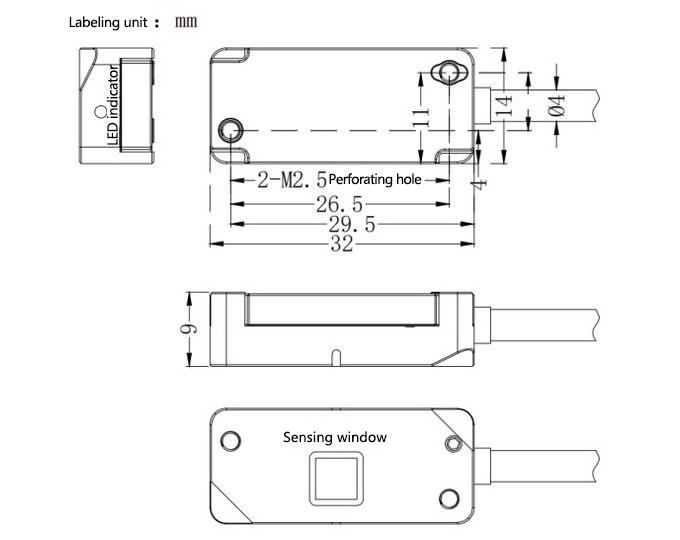
Tips: How to choose an incremental optical linear encoder?
- Resolution: Choose the resolution (e.g., 0.1 µm, 0.5 µm, 1 µm) based on your required precision.
- Signal Output: Decide between digital (e.g., AB quadrature) or analog signals based on your system’s needs.
- Installation and Size: Ensure the encoder fits your mounting requirements.
- Environmental Conditions: Select one that can operate reliably in your environment (e.g., temperature, humidity).
- Additional Features: Consider features like built-in reference points or robust shielding for interference resistance.
- Cost vs Performance: Balance your budget with the required performance specifications.
Only registered users can write reviews
Related products

Incremental Rotary Encoder, Blind Shaft, 800 ppr
ATO-IRE-800PB
$237.46
Low priced optical incremental encoder adopts blind shaft and cable edge output mode. Rotay encoder with 800 rrp resolution, 8mm shaft diameter, 52mm shell diameter, has small installation dimension, high reliability, high quality, 6 output modes to choose, manufacturer direct sale.

Incremental Rotary Encoder, Hollow Shaft, 1000 ppr
ATO-IRE-1000PH
$167.94
1000 ppr optical rotary encoder adopts hollow shaft, can sleeve-jointed on motor output shaft. Incremental rotary encoder has 38mm shell diameter, 8mm shaft diameter, high reliability, high resolution, high quality, 6 output modes to choose and optional 5V/8-30V DC working voltage.

Absolute Magnetic Linear Encoder, Non-Contact, 2+2mm
ATO-IMLE-AMG2000
$292.89
Buy an absolute magnetic linear encoder online, with 2+2 magnetic spacing. This magnetic scale encoder is a position sensor used to measure linear displacement. It can be connected to various connection options such as external drives, motion control cards, PLCs, etc.

Incremental Magnetic Linear Encoder, Non-Contact, 2+2mm/5+5mm
ATO-IMLE-LMH
$340.49
Incremental magnetic linear encoder for sale at factory price, optional magnetic spacing 2+2mm or 5+5mm, supply voltage 5V or 7~28V, output frequency 100 KHz. This non-contact magnetic scale encoder is a displacement sensor that uses the magnetic action of the magnetic strip and magnetic resistance to measure, forming an open, rugged, and durable magnetic measurement system.