
The high-pressure oxygen sensor (0.8~7.0 bar) measures 0100% oxygen with 8.5~14mV output. Designed for high-pressure systems, it’s ideal for oxygen chambers, tankers, and testing ships.
Specification
| Model | ATO-AOD1000 |
| Working Principle | Voltage Divider Electrochemical |
| Output Voltage | 8.5~14mV (in air) |
| Measurement Range | 0~100% |
| Response Time (T) | <10s full range |
| Linearity | <2% of full scale |
| Temperature Compensation | 0 (Equivalent, 0~50°C) |
| Load Resistance | >10kΩ |
| Interface | Molex 3-pin connector (2.54mm) |
| Housing Material | Gray ABS |
| Weight | Approx. 25g |
| Operating Temperature Range | 0~45°C |
| Operating Pressure Range | 0.8~7.0 bar |
| Operating Humidity Range | 0~99% RH (non-condensing) |
| Recommended Storage Temperature | 0~25°C |
| Expected Lifetime | 42 months |
Feature
- Operates in High-Pressure Environments: Designed to function reliably within a pressure range of 0.8 to 7 bar.
- Fast Response: Delivers quick and accurate oxygen measurements with a response time of less than 10 seconds.
- Temperature Compensation: Ensures consistent performance across a wide temperature range, enhancing measurement accuracy.
- Outstanding Long-Term Stability: Maintains reliable performance over extended periods, minimizing the need for frequent recalibration.
- Full-Scale Linear Output: Provides precise and proportional output across the entire measurement range of 0-100%.
Size (Unit:mm)
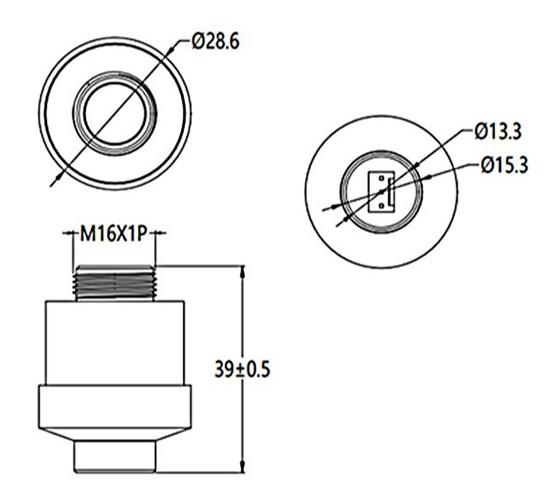
Interface Definition
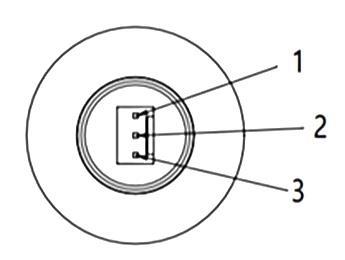
1. Negative pin 2. Negative pin 3. Positive pin
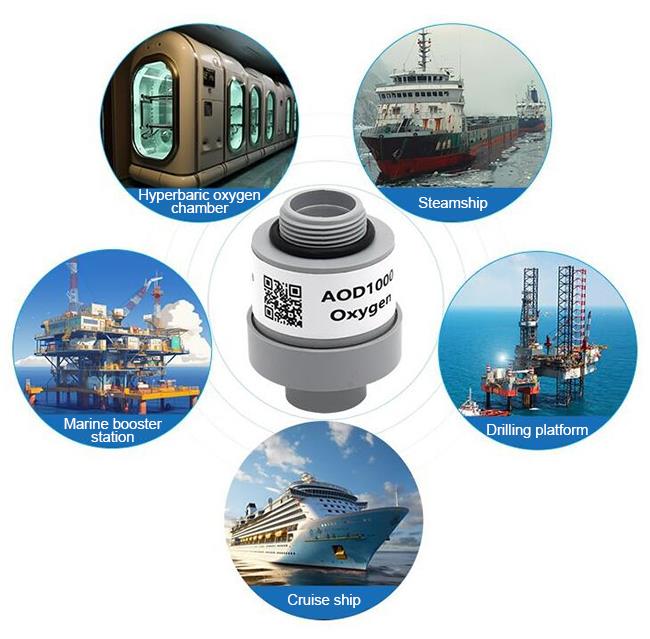
Application
Tips: How is the sensor integrated into existing systems?
The sensor is easy to set up with its Molex 3-pin connector (2.54mm), which provides a strong and reliable connection. It has an output voltage of 8.5~14mV (in air), making it work well with many monitoring systems. Its small size makes it simple to install in both new and existing setups. The clear interface and straightforward wiring make it a great choice for improving current systems without major changes.
Product reviews
Operating Pressure Range
Moriram

11/16/2025 11:21 PM
We are working on an oxygen generator project with an operating pressure range of 0.3 bar to 3 bar. Could you provide a detailed specification sheet for a "high-pressure oxygen sensor, 0.8-7 bar, 0-100%"? We mainly want to understand the sensor's operating principle under pressure fluctuations.
Was this review helpful?
(0/0)
Looking for an Oxygen sensor
Samo
3/6/2026 12:30 AM
I'm looking for a more suitable oxygen sensor that measures oxygen levels from approximately 20% to 90%, with a flow rate up to about 30 liters per minute, and is not very sensitive to pressure fluctuations or is completely insensitive. Do you have experience in this area? Or could you recommend a sensor more suitable for this application?
Was this review helpful?
(0/0)
Some questions
Elsali
10/16/2026 1:29 AM
We are interested in the ATO-GS-O2-D1000 high-pressure oxygen sensor. Could you please provide the following information?
1. Pressure and Differential Pressure: Is the ATO-GS-O2-D1000 suitable for continuous operation under conditions where the absolute pressure on the sensing side is approximately 2.0 bar and the other side is atmospheric pressure? What is the maximum differential pressure that the sensor body and its sealed interface can withstand?
2. Gas Compatibility: Is this sensor suitable for continuous exposure to a gas mixture containing approximately 85% oxygen and carbon dioxide? Are there any limitations regarding carbon dioxide concentration or long-term exposure?
Was this review helpful?
(0/0)
Only registered users can write reviews
Related products

COD (Chemical Oxygen Demand) Sensor, 0~500 mg/L, 0~200 NTU
ATO-WQS-COD
$1,507.93
The COD sensor uses a dual-wavelength ultraviolet absorption method with a range of 0~500 mg/L (COD) and 0~200 NTU (turbidity) and a resolution of 0.1. It offers high accuracy ±5%, a fast response time (<10s). The water quality sensor has two-point calibration, automatic cleaning with a scraper. With RS485 outputs, built with 316L stainless steel, suitable for wastewater treatment, drinking water testing, industrial water treatment, environmental monitoring, etc.

Oxygen (O2) Gas Sensor, 0~100%
ATO-GS-O2-236
$66.82
Buy an O2 sensor for Oxygen gas detection. Electrochemical working principle, 0~100% measurement range, strong anti-interference ability, fast response speed. 3 types of Oxygen (O2) gas sensors can work without an external power supply and are available to choose from according to your application area.

Ultrasonic Oxygen Sensor, 0-10L/min, 21-95.6%
ATO-GS-O2-F1000
$51.74
The ultrasonic oxygen sensor detects concentrations from 21%~95.6% with 0.10% resolution and ±1.5% FS accuracy. It measures flow rates from 0~10 L/min with 0.1 L/min resolution and ±0.2 L/min accuracy. Featuring a 500 ms detection cycle, <10-second preheat time, and UART 9600 bps communication, it operates at 5°C~55°C with a DC12V power supply. Made from durable PBT plastic. Used in medical, industrial, chemical, mining and food applications.

Ultrasonic Oxygen Sensor, 0-15L/min, 21-95.6%
ATO-GS-O2-F2000
$49.87
The ultrasonic oxygen sensor offers a concentration detection range of 21%~95.6%, a flow detection range of 0~15 L/min, a resolution of 0.1 L/min, and an accuracy of ±0.2 L/min. With a detection cycle of 500 ms and a preheat time of less than 10 seconds. It requires a DC voltage supply of 5V~12V (±0.25V), with a current of ≤40 mA and power consumption of ≤200 mW. widely used in medical, industrial, chemical, mining and food applications, especially in medical oxygen generators, industrial oxygen equipment, mining and food storage production.