
This 360 degree glass glaze ceramic potentiometer delivers smooth adjustment through high-quality ceramic material, silver-plated contacts, and corrosion-resistant housing. Supporting DC 12V operation with low rotational noise and excellent insulation performance, it provides dependable control for automotive electronics, smart devices, energy equipment, and industrial applications.
Specification
| Model | ATO-357-22E | |
| Electrical Characteristics | Total Resistance | B10KΩ |
| Total Resistance Tolerance | ±10% | |
| Resistance Taper | B | |
| Rated Power | Linear taper 0.025 W | |
| Max. Operation Voltage | AC 5V, DC 12V | |
| Residual Resistance | Between terminal (1-2)/(2-3): 20 Ω Max. | |
| Gang Error | -40dB~0dB | |
| Insulation Resistance | 100MΩ min at 100 VDC. | |
| Withstand Voltage | 1 minute at AC 300 V | |
| Rotational Noise | Less than 100 mV. | |
| Mechanical Characteristics | Total Rotation Angle | 360° unlimited |
| Rotation Stopper Strength | 0 kgf.cm Max. | |
| Operation Torque | 20 gf.cm ~ 50 gf.cm | |
| Push-pull Strength | Push: 0.5 kgf.cm Max; pull: 0.2 kgm.cm Max | |
| Switch Rotational Angle | Less than 340° | |
| Switch Action | 50 gf.cm ~ 100 gf.cm | |
| Resistance to Soldering Heat | Less than 270℃ and quicker than 3 seconds | |
| Durability | Rotation Life | 1000000 Cycles |
| Switch Load Life | 1000000 Cycles | |
Features
- 360° Continuous Rotation Control: Featuring an unlimited 360 degree rotation mechanism, this glass glaze ceramic potentiometer allows smooth and precise resistance adjustment in any position, providing greater flexibility for control panels, automation equipment, and electronic devices.
- Durable Glass Glaze Ceramic Structure: The ceramic resistance body combined with glass glaze technology delivers excellent insulation, heat resistance, and mechanical stability, helping the potentiometer perform reliably in demanding working conditions.
- Designed for 1 Million Adjustments: A rotation life of up to 1,000,000 cycles makes this rotary potentiometer suitable for high-frequency operation, extending equipment uptime while minimizing maintenance and replacement requirements.
- Optimized for 12V DC Applications: With DC 12V operating capability, B10KΩ resistance value, and ±10% tolerance, the potentiometer provides consistent electrical adjustment for low-voltage control circuits and electronic systems.
- Enhanced Conductivity with Silver-Plated Contacts: Silver-plated copper contact components improve current transmission efficiency and reduce contact instability, ensuring sensitive operation and dependable performance for this potentiometer.
- Stable Output with Low Rotational Noise: Achieving less than 100mV rotational noise and ≥100MΩ insulation resistance, this precision potentiometer supports accurate signal adjustment in industrial controls, measurement devices, and smart electronics.
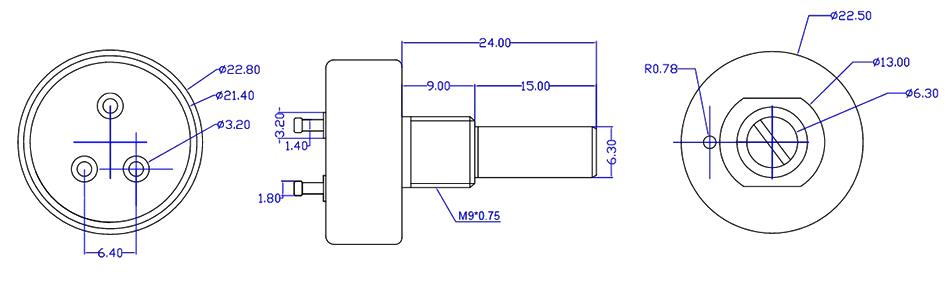
Diemnsion (unit: mm)
Tips: What is the difference between glass glaze ceramic potentiometers and conductive plastic potentiometers?
Glass glaze ceramic potentiometers and conductive plastic potentiometers mainly differ in their resistance materials, electrical performance, and application advantages.
- A glass glaze ceramic potentiometer uses a glass glaze ceramic resistance element, which provides excellent insulation, high durability, strong environmental resistance, and stable performance over long-term operation. It is commonly used in industrial control systems, automation equipment, and electronic devices that require reliable performance in demanding environments.
- A conductive plastic potentiometer uses a conductive plastic resistance track, offering smoother adjustment, lower rotational noise, higher resolution, and better linearity. It is widely used in precision control applications, such as servo systems, measuring instruments, and equipment requiring accurate position feedback.
The key difference is that glass glaze ceramic potentiometers are designed for durability and stable operation, while conductive plastic potentiometers are designed for higher precision and smoother electrical response. The choice between them depends on application requirements, including accuracy, operating environment, adjustment frequency, and expected service life. For industrial applications requiring long-term reliability, a glass glaze ceramic potentiometer is often a suitable choice, for precision control applications, a conductive plastic potentiometer may provide better performance.

Conductive Plastic Potentiometer, 1k/2k/5k/10k Ohm

360 Degree Continuous Rotation Potentiometer, 1k/2k/5k/10k Ohm

Multi Gang Potentiometer, Dual Gang/Triple Gang/Quad Gang

Rotary Potentiometer with Wire, 1K/2K/5K/10K/20K Ohm
