GigE Vision Industrial Camera, 5.3MP, 1" CMOS, Mono/Color

$1,609.05
Industrial camera, 2592x2048 (5.3 Megapixel), is a best choice for machine vision applications, with format 1" CMOS, 20fps maximum frame rate, Gigabit Ethernet interface, C mount for lens, and available 8 or 10 bit depth, black and white or color selectable according to your requirements. High resolution, high speed and favorable price.
SKU: ATO-CAMERA-500020
*
*
Free Shipping
Delivery date: 6-12 days

GigE vision industrial camera is a best choice for machine vision system with a resolution of 2592x2048 (5.3 Megapixel), suitable for various visual applications such as mobile phone screen detection, defect detection, electronic components manufacturing, wafer positioning applications and so on.

Note: For lens products, no returns or exchanges will be accepted unless there is a quality issue.

Features

  • Support GenICam ™ and GigE Vision® Standard
  • Compact design, to save installation space
  • Rugged industrial housing design
  • Built-in temperature, power supply real-time monitoring sensor
  • Provide professional SDK for GigE machine vision camera

Specification

Model5000-20gm5000-20gc
Resolution2592x2048 (5.3 Mega Pixel)
Sensor TypeCMOS
Sensor ModelPYTHON 5000
Format1"
Pixel Size4.8μm x 4.8μm
Maximum Frame Rate20fps
Bit Depth8-bit or 10-bit
Mono/ColorMonochromeColor
Exposure Time16μs~1s
SNR>38dB
Dynamic Range60dB
Shutter TypeGlobal Shutter
InterfaceGigabit Ethernet (100m Transmission Distance)
Lens MountStandard C-Mount
Power SupplyDC 6-24V, PoE
Power ComsumptionApprox. 3.1W@12V DC, Approx. 3.4W@PoE
Hardware ControlI/O input (external trigger), I/O output, Opto-couplers Isolation
Programmable ControlImage Resolution, RGB gain, Exposure Time, Contrast, Gamma Chart, Image Rollover, Raw, LUT, Black Level Correction
Opearting SystemSupport Windows XP/7/8/10
Support 32-bit and 64-bit operating system/Arm/Linux (Software can be provided for free)
Operating Tempearture-30~+60℃
Storage Temperature-30℃~+80℃
Mass88g
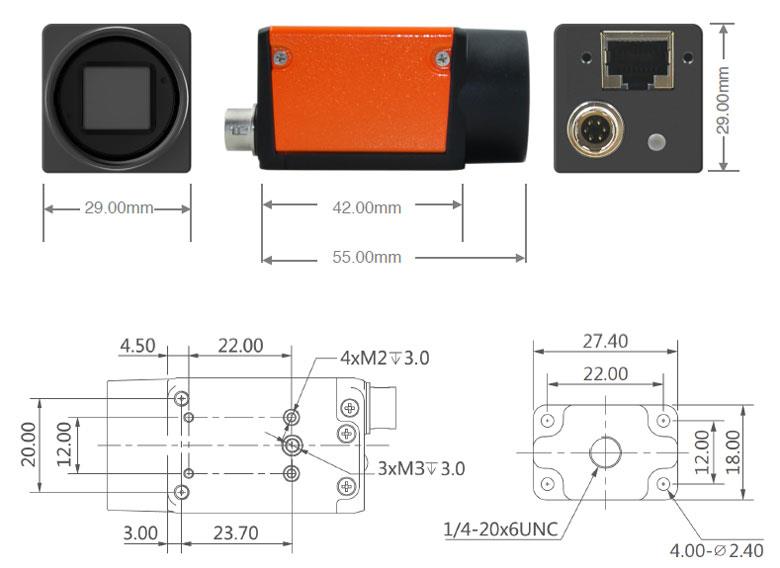
Dimension42x29x29mm

GigE Camera Dimensions

GigE vision industrial camera dimensions

Tips: Differences between the Industrial Camera and Ordinary Digital Camera
1. Industrial camera has stable and reliable performance, and it’s easy to install, has compact structure and uneasy to damage. It can also work in a poor environment for a long time. However, an ordinary camera can’t play as it. For example, it’s impossible for a civil digital camera to work 24 hours a day or to work for several days in a row.
2. The shutter time of an industrial camera is rather short, so it can get the object moving at a high speed.
3. The imaging sensor of an industrial camera belongs to a progressive scanning while that of an ordinary camera is the interlaced scan. The manufacture process of an imaging sensor with progressive scanning is rather complex and expensive.
4. The frame rate of industrial cameras is far higher than that of ordinary cameras. An industrial camera can shoot ten to hundreds of pictures per second, while an ordinary camera can only shot 2-3 pictures per second.
5. The industrial camera output raw data whose spectral range is rather wide. So it’s suitable for the high quality image processing algorithm, such as the Machine Vision. However, the spectral range of images taken by an ordinary camera is only suitable for human vision. The image quality is rather poor after mjpeg compress, so it’s not detrimental to analysis.
6. Industrial Camera is more expensive than the ordinary camera (DSC).

Product reviews
Practical and reliable
5
Imanol
Avatar
12/14/2025 7:35 PM
Image quality is very clear and stable. Setup was straightforward, runs smoothly all day, and works well for our routine inspection jobs. Overall very practical and reliable.
Was this review helpful? Yes No (0/0)
Write your review
  • Only registered users can write reviews
*
*
  • Bad
  • Excellent
*
*
*
*

GigE vision industrial camera is a best choice for machine vision system with a resolution of 2592x2048 (5.3 Megapixel), suitable for various visual applications such as mobile phone screen detection, defect detection, electronic components manufacturing, wafer positioning applications and so on.

Note: For lens products, no returns or exchanges will be accepted unless there is a quality issue.

Features

  • Support GenICam ™ and GigE Vision® Standard
  • Compact design, to save installation space
  • Rugged industrial housing design
  • Built-in temperature, power supply real-time monitoring sensor
  • Provide professional SDK for GigE machine vision camera

Specification

Model5000-20gm5000-20gc
Resolution2592x2048 (5.3 Mega Pixel)
Sensor TypeCMOS
Sensor ModelPYTHON 5000
Format1"
Pixel Size4.8μm x 4.8μm
Maximum Frame Rate20fps
Bit Depth8-bit or 10-bit
Mono/ColorMonochromeColor
Exposure Time16μs~1s
SNR>38dB
Dynamic Range60dB
Shutter TypeGlobal Shutter
InterfaceGigabit Ethernet (100m Transmission Distance)
Lens MountStandard C-Mount
Power SupplyDC 6-24V, PoE
Power ComsumptionApprox. 3.1W@12V DC, Approx. 3.4W@PoE
Hardware ControlI/O input (external trigger), I/O output, Opto-couplers Isolation
Programmable ControlImage Resolution, RGB gain, Exposure Time, Contrast, Gamma Chart, Image Rollover, Raw, LUT, Black Level Correction
Opearting SystemSupport Windows XP/7/8/10
Support 32-bit and 64-bit operating system/Arm/Linux (Software can be provided for free)
Operating Tempearture-30~+60℃
Storage Temperature-30℃~+80℃
Mass88g
Dimension42x29x29mm

GigE Camera Dimensions

GigE vision industrial camera dimensions

Tips: Differences between the Industrial Camera and Ordinary Digital Camera
1. Industrial camera has stable and reliable performance, and it’s easy to install, has compact structure and uneasy to damage. It can also work in a poor environment for a long time. However, an ordinary camera can’t play as it. For example, it’s impossible for a civil digital camera to work 24 hours a day or to work for several days in a row.
2. The shutter time of an industrial camera is rather short, so it can get the object moving at a high speed.
3. The imaging sensor of an industrial camera belongs to a progressive scanning while that of an ordinary camera is the interlaced scan. The manufacture process of an imaging sensor with progressive scanning is rather complex and expensive.
4. The frame rate of industrial cameras is far higher than that of ordinary cameras. An industrial camera can shoot ten to hundreds of pictures per second, while an ordinary camera can only shot 2-3 pictures per second.
5. The industrial camera output raw data whose spectral range is rather wide. So it’s suitable for the high quality image processing algorithm, such as the Machine Vision. However, the spectral range of images taken by an ordinary camera is only suitable for human vision. The image quality is rather poor after mjpeg compress, so it’s not detrimental to analysis.
6. Industrial Camera is more expensive than the ordinary camera (DSC).

Product reviews
Practical and reliable
5
Imanol
Avatar
12/14/2025 7:35 PM
Image quality is very clear and stable. Setup was straightforward, runs smoothly all day, and works well for our routine inspection jobs. Overall very practical and reliable.
Was this review helpful? Yes No (0/0)
Only registered users can write reviews