
The double sphere rubber expansion joint is a flanged flexible expansion joint, available with 2 inch/3 inch/4 inch/6 inch flange diameter, NR, EPDM, or Neoprene material, carbon steel galvanized flange material, and the pressure and flange material can be customized.
Features
- The double sphere flanged rubber expansion joint is compact in size and lightweight, featuring good elasticity and facilitating easy installation and maintenance. It can reduce the structure-transmitted noise during operation and has a strong shock absorption ability.
- It can produce lateral, axial and angular displacement during installation, and is not restricted by the pipe's non-concentricity and the flange's non-parallelism.
- Twin sphere rubber joints can more effectively prevent corrosion in high-temperature, acid-alkali and oil-resistant pipelines, and the medium's erosion of the rubber joint increases its service life.
- 2 inch/3 inch/4 inch/6 inch flexible rubber joints are available, with good comprehensive performance, and are widely used in various industries and pipeline matching.
Specifications
| Model | ATO-KST-16 |
| Working Pressure (MPa) | PN16, Contact us if you need PN10/PN25. |
| Burst Pressure (MPa) | 3.0 (30) |
| Kpa Vacuum | 86.7 (650) |
| Flange Diameter | DN40-DN300, Contact us if you need a 150LB flange. |
| Flange Material | Carbon Steel Galvanized (Default), Stainless Steel 304/316L or Other Materials (Contact Us) |
| Rubber Material | NR (Default), Nitrile, Neoprene, EPDM, and Other Materials (Contact Us) |
| Applicable Temperature | -20℃~+115℃ (-30℃~+250℃ Under Special Conditions) |
| Applicable Medium | Air, Compressed Air, Water, Sea Water, Oil, Acid, Alkali, etc. |
Dimension (Unit: mm)
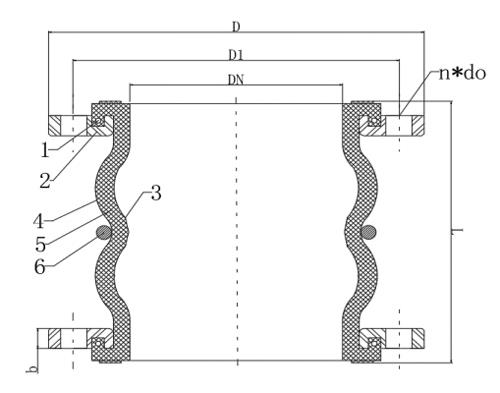
| DN | Mpa | L | D | D1 | n | b | Elongation | Compression | Lateral displacement | Deflection displacement | |
| DN40 | 1.6 | 165 | 150 | 110 | 18 | 4 | 16 | 10 | 20 | 20 | 30 |
| DN50 | 1.6 | 165 | 165 | 125 | 18 | 4 | 18 | 10 | 20 | 20 | 30 |
| DN65 | 1.6 | 175 | 185 | 145 | 18 | 4 | 18 | 10 | 20 | 20 | 30 |
| DN80 | 1.6 | 175 | 200 | 160 | 18 | 8 | 20 | 10 | 20 | 20 | 30 |
| DN100 | 1.6 | 225 | 220 | 180 | 18 | 8 | 20 | 15 | 30 | 25 | 30 |
| DN125 | 1.6 | 225 | 250 | 210 | 18 | 8 | 22 | 15 | 30 | 25 | 30 |
| DN150 | 1.6 | 225 | 285 | 240 | 22 | 8 | 22 | 15 | 30 | 25 | 30 |
| DN200 | 1.6 | 325 | 340 | 295 | 22 | 12 | 23 | 20 | 40 | 30 | 30 |
| DN250 | 1.6 | 325 | 405 | 355 | 26 | 12 | 26 | 20 | 40 | 30 | 30 |
| DN300 | 1.6 | 325 | 460 | 410 | 26 | 12 | 28 | 20 | 40 | 30 | 30 |
| No. | Code | Name | Quantity | Material |
| 1 | KST-01 | Reinforcement Ring | 2 | Multi-strand Steel Wire |
| 2 | KST-02 | Flange | 2 | Q235 |
| 3 | KST-03 | Inner Rubber Lining | 1 | Natural Rubber |
| 4 | KST-04 | Outer Rubber Lining | 1 | Natural Rubber |
| 5 | KST-05 | Frame Layer | - | Nylon Cord |
| 6 | KST-06 | Explosion-proof Ring | - | Q235 |
Applications
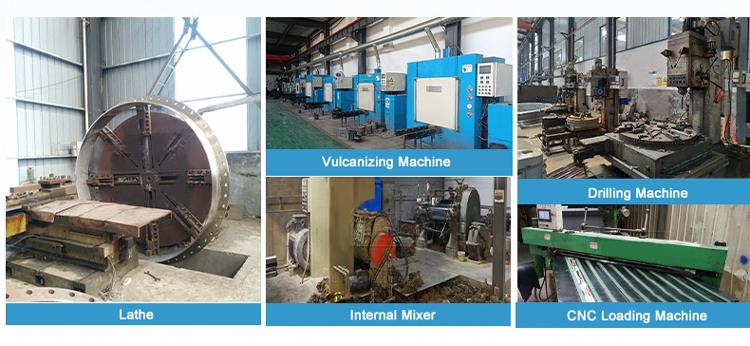
Tips: What are the materials of rubber expansion joints
Rubber expansion joints can be made from a variety of materials, depending on the application, fluid type, temperature, and pressure conditions. Below is a summary of common rubber materials used in expansion joints, along with their characteristics and typical applications:
- Natural Rubber (NR):
Excellent abrasion resistance and flexibility. Ideal for water and slurry.
Not suitable for oil or chemicals. - Nitrile Rubber (NBR):
Good resistance to oils, fuels, and grease.
Poor weather and ozone resistance. - Neoprene (CR):
Resistant to moderate oil, weather, and ozone.
Used in marine and industrial applications. - EPDM (Ethylene Propylene Diene Monomer):
Excellent for water, steam, acids, and weather.
Not suitable for oil or hydrocarbons.

Related products

Single Sphere Flexible Rubber Expansion Joint, 2/3/4/6 inch
ATO-REJ-KXT
$147.11
2 inch/3 inch/4 inch/6 inch flexible rubber expansion joint for sale online. This flanged single sphere expansion joint is equipped with NR, EPDM, or Neoprene material, especially suitable for pipelines with large vibration and frequent hot and cold changes. The pressure and flange material can be customized.