
The level sensor has high adjustment accuracy and can easily detect liquids and colloids. Its output indicator is a yellow LED and is suitable for 12-26mm pipes. Capacitive level sensor is widely used in industrial, agricultural, and residential setting.
Features
- The liquid level sensor adopts a curved appearance design, which makes installation and inspection more flexible and reliable.
- It can directly detect non-metallic media in the container through the non-metallic pipe wall.
- Capacitance level sensors are widely used in liquid level detection and alarm of various containers.
Specification
| Model | ATO-CE15 |
| Mounting | non-flush |
| Adjustable Pipeline | 12-26 mm; wall thickness ≤1.0 mm |
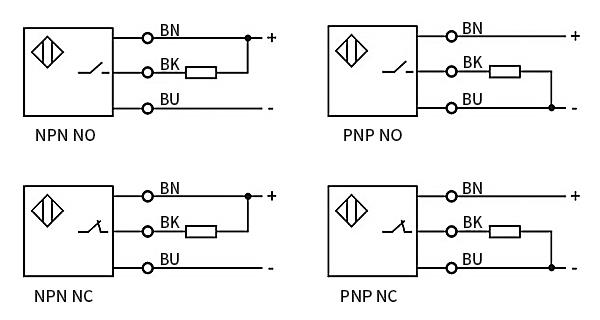
| Output | PNP NO, PNP NC, NPN NO, NPN NC |
| Detection Distance | PNP (2mm), NPN (4mm) |
| Switching Frequency | 60 Hz |
| Switch-point Drift | ≤±20% |
| Load Current | ≤200 mA |
| Residual Voltage | ≤2.5V |
| Current Consumption | ≤15 mA |
| Output Indicator | yellow LED |
| Circuit Protection | short circuit, overload and reverse polarity |
| Ambient Temperature | -10℃~55℃ |
| Ambient Humidity | 35-95%RH |
| Degree of Protection | IP67 |
| Connection Type | 2m PVC cable |
| Housing Material | PBT |
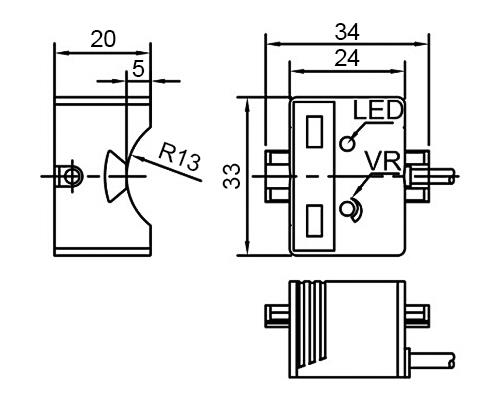
Dimension (Unit: mm)
Wiring Diagram
Tips: What are the Advantages of Capacitive Level Sensor?
- Contactless Operation. Capacitive sensors can detect the water level without direct contact with the liquid. This non-contact feature reduces the risk of sensor contamination or corrosion.
- High Sensitivity. Capacitive sensors are highly sensitive to changes in the dielectric constant of the surrounding medium, such as water. This allows for precise and accurate detection of water levels.
- Low Maintenance. Since there is no direct contact with the liquid, capacitive sensors typically have lower maintenance requirements. This makes them suitable for long-term and continuous monitoring without frequent calibrations or replacements.
- Fast Response Time. Capacitive sensors can provide quick responses to changes in water levels. This is beneficial in applications where rapid detection and response are crucial.
Product reviews
About capacitive level sensor
Alden

9/27/2024 12:16 AM
We are measuring 30 wt% KOH in the pipe, and the wall thickness is somewhere between 2.87 mm to 4.55 mm (depending on 3/4” vs. 1” and schedule 40 vs. 80). 30 wt% KOH has a conductivity of~1.2-1.3 S/cm. The sensor I’m interested in is SKU: ATO-CLS-CE15. Can it be used?
Was this review helpful? (0/0)
Only registered users can write reviews
Related products

Capacitive Liquid Level Sensor for 8-11 mm Pipeline Level Detection
ATO-LEVS-CE10
$179.12
High quality and good price capacitive liquid sensor for sale online. This liquid level sensor with short circuit protection, overload protection and reverse polarity protection. The applicable temperature of capacitive fluid level sensor between -10 ℃ and 55 ℃. Capacitive type level sensor often used in capacitive liquid level detection in pipe diameters.

Electrode Level Sensor for Conductive Liquid, SPDT Contact
ATO-ELS-040
$173.69
Economical price electrode level sensor for sale, with 240VAC/24VDC 5A, SPDT contact, optional power supply 220V AC or 24V AC. The wetted material can be stainless steel or other materials. Conductive liquid level sensor is a switch used to measure the level of liquids in a container by utilizing the principles of conductivity. As the liquid or material rises or falls, it comes into contact with the electrodes, creating electrical connections.

Float Liquid Level Sensor, Stainless Steel/ Plastic
ATO-MR1045-PS
$59.86
Float liquid level sensor for sale, it is a floating switch composed of magnetic spring switch and floating ball. The floating ball will trigger the magnetic spring switch as the level of the liquid tested moves up and down, thus detecting the position of the liquid level. Contact form SPST 1NO/ 1NC, contact power rating 50W, selectable stainless steel or plastic.

High Temperature Level Sensor, 4-20mA/0-5V/0-10V, 0-20M
ATO-LEVS-HT20M
$306.89
High temperature level sensor adopts separated structure and consist of 316L stainless steel gas collector, 316L stainless steel capillary tube and protection head. Water/oil/fuel tank level sensor can be used in high temperature (-20~+85℃ (-4~+185℉)) or corrosive liquid. The measuring range can be 0-1m/0-3m/0-5m/0-7m/0-10m/0-12m ~ 0-20m. High temperature liquid level sensor has optional output signal 0-20mA/4-20mA/0-5V/1-5V/0-10V, optional accuracy 0.5%FS or 0.3%FS and power supply DC 24V/12V.

Magnetic Float Level Sensor for Alarm Switch
ATO-FS-MRDZ3
$256.62
Magnetic float level sensor for alarm switch is a float switch composed of magnetic spring switch and floating ball, which is used for detecting the position of the liquid level, stainless steel, contact power rating 10W.