Three Axis Capacitive Accelerometer Sensor, ±1g/±50g

$1,039.23
A three-axis accelerometer sensor can be used to measure dynamic and static acceleration, such as vibration, shock, gravity acceleration or inclination within the range of ±1g, ±50g. Small triaxial capacitive accelerometer sensor frequency response ranges up to 2000Hz, comes with high sensitivity, low voltage, current & power consumption, easy installation, and strong anti-interference ability.
SKU: ATO-AS-SADR
*
Free Shipping
Delivery date: 8-12 days

Small 3-axis capacitive accelerometer sensor for sale. It is widely used in vibration, shock, rotation acceleration and inclination measurement, calibration, industrial monitoring and other measurements. ±1/±50g measurement range, up to 2000Hz frequency response, nonlinear error less than 0.5%.

Specifications

ModelATO-SADR301ATO-SADR305
Sensitivity1000 mV/g (±10%)38 mV/g (±10%)
Measuring Range±1g±50g
AxisThree Axis
Vibration Nonlinearity0.50%
Maximum Lateral Sensitivity<5%
Frequency Response0~1000Hz (±10%)0~400Hz (±10%)
Resonant Frequency5500Hz20000Hz
Noise~1 mV (rms)~1.5 mV (rms)
Zero G Bias Voltage2.5±0.1V DC
Operating Voltage+5~+16V DC
Operating Temperature-40~+120℃-40~+100℃
Shock Resistance (No Power Supply)2000g3000g
Sensitivity Temperature Coefficient0.3%/℃0.8%/℃
Weight16g
Case MaterialAluminum alloy
Output MethodFive-core overall shielded cable (2m)
Installation Method4-Φ2.8 or adhesive


Features

  • This SADR series axial capacitive accelerometer sensor has three-axis output.
  • Can measure static acceleration, such as gravity acceleration and inclination, and other physical measurements; high sensitivity, stable performance.
  • Low voltage and current, low power consumption, strong anti-interference ability.
  • Acceleration sensor total weight <20g, small size and light weight, more convenient installation.

Dimensions (unit: mm)
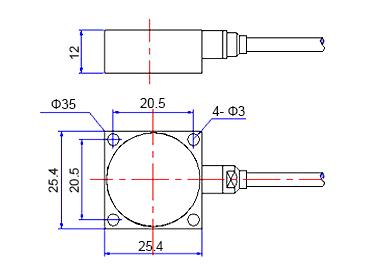
capacitive accelerometer sensor dimension

Working Principle

Capacitive accelerometer sensor working principle

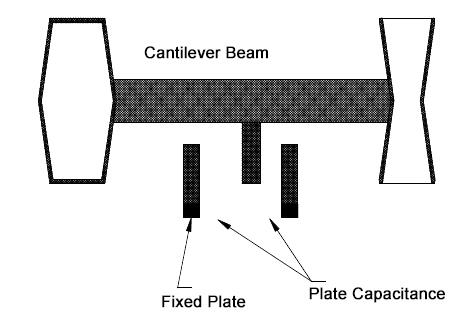
Capacitive accelerometer sensors use micromachining technology to machine a variable gap differential capacitive sensitive element on a silicon wafer. As shown in the figure below, the differential capacitance is composed of two fixed pole plates and one movable pole plate, where the movable pole plate is connected to the inertial mass block, i.e. the cantilever beam shown in the figure. The motion of the cantilever beam causes a change in the differential capacitance, which is then amplified, converted and detected by a circuit integrated on the same silicon wafer to output a voltage signal proportional to the acceleration.

The SADR series of single-axis/triaxial capacitive accelerometer sensors require at least a single +5V or +3V DC power supply to interface with standard data acquisition systems. The sensitivity and 0g DC bias voltage values are proportional to the supply voltage. The output voltage increases from the 0g output value for positive acceleration and decreases for negative acceleration.

When subjected to acceleration, the DC output voltage value is: Vout=Vs/2+ (sensitivity x a x Vs/5)

where Vs is the supply voltage in V and a is the acceleration value in g.

The AC output voltage value is: Vout= Sensitivity x a

Wiring Diagram
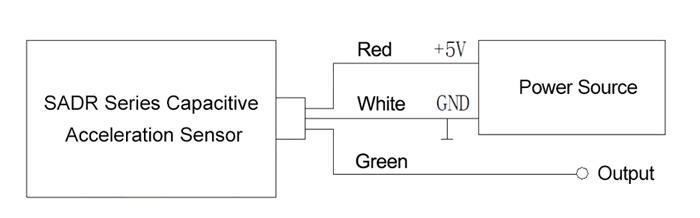
capacitive accelerometer sensor wiring

Tips: What is capacitive accelerometer sensor?

The capacitive accelerometer is a type of sensor used to measure acceleration by detecting changes in capacitance. It operates on the principle that when an object experiences acceleration, there is a relative movement between the sensor's internal components, typically a fixed electrode and a movable electrode (mass). This movement alters the distance between these electrodes, thereby changing the capacitance.

The sensor consists of a proof mass suspended between a set of fixed electrodes. When the accelerometer experiences acceleration, the proof mass shifts slightly from its equilibrium position. This shift causes a change in the capacitance between the proof mass and the fixed electrodes. The sensor's electronics then convert this capacitance change into a voltage signal, which is proportional to the acceleration.

Capacitive accelerometers are favored for their high sensitivity, low noise, and ability to measure both static (e.g., gravity) and dynamic (e.g., vibration) accelerations. They are commonly used in applications such as vibration monitoring, structural health monitoring, consumer electronics (like smartphones), automotive systems (e.g., airbags), and inertial navigation systems.

Their advantages include low power consumption, high resolution, and good stability over a wide temperature range, making them suitable for both industrial and consumer applications.

Product reviews
Awesome accelerometer sensor
5
Avra
Avatar
9/1/2025 8:09 PM
I needed a sensor that could handle precise vibration measurement on my robotic arm project, and this triaxial capacitive accelerometer sensor did not disappoint. The fact that it’s so lightweight and compact made installation super easy—I just used adhesive and it held firm. The three-axis output is super convenient; it saves me from mounting three separate sensors!
Was this review helpful? Yes No (0/0)
Write your review
  • Only registered users can write reviews
*
*
  • Bad
  • Excellent
*
*
*
*

Small 3-axis capacitive accelerometer sensor for sale. It is widely used in vibration, shock, rotation acceleration and inclination measurement, calibration, industrial monitoring and other measurements. ±1/±50g measurement range, up to 2000Hz frequency response, nonlinear error less than 0.5%.

Specifications

ModelATO-SADR301ATO-SADR305
Sensitivity1000 mV/g (±10%)38 mV/g (±10%)
Measuring Range±1g±50g
AxisThree Axis
Vibration Nonlinearity0.50%
Maximum Lateral Sensitivity<5%
Frequency Response0~1000Hz (±10%)0~400Hz (±10%)
Resonant Frequency5500Hz20000Hz
Noise~1 mV (rms)~1.5 mV (rms)
Zero G Bias Voltage2.5±0.1V DC
Operating Voltage+5~+16V DC
Operating Temperature-40~+120℃-40~+100℃
Shock Resistance (No Power Supply)2000g3000g
Sensitivity Temperature Coefficient0.3%/℃0.8%/℃
Weight16g
Case MaterialAluminum alloy
Output MethodFive-core overall shielded cable (2m)
Installation Method4-Φ2.8 or adhesive


Features

  • This SADR series axial capacitive accelerometer sensor has three-axis output.
  • Can measure static acceleration, such as gravity acceleration and inclination, and other physical measurements; high sensitivity, stable performance.
  • Low voltage and current, low power consumption, strong anti-interference ability.
  • Acceleration sensor total weight <20g, small size and light weight, more convenient installation.

Dimensions (unit: mm)

capacitive accelerometer sensor dimension

Working Principle

Capacitive accelerometer sensor working principle

Capacitive accelerometer sensors use micromachining technology to machine a variable gap differential capacitive sensitive element on a silicon wafer. As shown in the figure below, the differential capacitance is composed of two fixed pole plates and one movable pole plate, where the movable pole plate is connected to the inertial mass block, i.e. the cantilever beam shown in the figure. The motion of the cantilever beam causes a change in the differential capacitance, which is then amplified, converted and detected by a circuit integrated on the same silicon wafer to output a voltage signal proportional to the acceleration.

The SADR series of single-axis/triaxial capacitive accelerometer sensors require at least a single +5V or +3V DC power supply to interface with standard data acquisition systems. The sensitivity and 0g DC bias voltage values are proportional to the supply voltage. The output voltage increases from the 0g output value for positive acceleration and decreases for negative acceleration.

When subjected to acceleration, the DC output voltage value is: Vout=Vs/2+ (sensitivity x a x Vs/5)

where Vs is the supply voltage in V and a is the acceleration value in g.

The AC output voltage value is: Vout= Sensitivity x a

Wiring Diagram

capacitive accelerometer sensor wiring

Tips: What is capacitive accelerometer sensor?

The capacitive accelerometer is a type of sensor used to measure acceleration by detecting changes in capacitance. It operates on the principle that when an object experiences acceleration, there is a relative movement between the sensor's internal components, typically a fixed electrode and a movable electrode (mass). This movement alters the distance between these electrodes, thereby changing the capacitance.

The sensor consists of a proof mass suspended between a set of fixed electrodes. When the accelerometer experiences acceleration, the proof mass shifts slightly from its equilibrium position. This shift causes a change in the capacitance between the proof mass and the fixed electrodes. The sensor's electronics then convert this capacitance change into a voltage signal, which is proportional to the acceleration.

Capacitive accelerometers are favored for their high sensitivity, low noise, and ability to measure both static (e.g., gravity) and dynamic (e.g., vibration) accelerations. They are commonly used in applications such as vibration monitoring, structural health monitoring, consumer electronics (like smartphones), automotive systems (e.g., airbags), and inertial navigation systems.

Their advantages include low power consumption, high resolution, and good stability over a wide temperature range, making them suitable for both industrial and consumer applications.

Product reviews
Awesome accelerometer sensor
5
Avra
Avatar
9/1/2025 8:09 PM
I needed a sensor that could handle precise vibration measurement on my robotic arm project, and this triaxial capacitive accelerometer sensor did not disappoint. The fact that it’s so lightweight and compact made installation super easy—I just used adhesive and it held firm. The three-axis output is super convenient; it saves me from mounting three separate sensors!
Was this review helpful? Yes No (0/0)
Only registered users can write reviews