Magnetic Angle Sensor, Non-Contact, RS485/ MODBUS

$389.99
Economical price magnetic hall angle sensor is powered by 9V ~ 36V power supply and with reverse and anti-pulse peak voltage protection function, RS485 or MODBUS signal output available, optional precision of ±0.3° or ±0.1°, can realize the measuring range of 0~360°.
SKU: ATO-AS-RS485
*
*
*
Free Shipping
Delivery date: 6-12 days

ATO hall effect angle sensor is powered by 9V~36V power supply, with reverse and anti-pulse peak voltage protection function, suitable for water, oil, gas, vibration, shock and other harsh industrial environment.

Specification

ModelATO-LW126CATO-HW226C
Full Range Precision±0.3°±0.1°
Temperature Drift±0.0015°/°C
Sensitivity Temperature Coefficient<150ppm/°C
Measuring Range0~30°, 0~60°, 0~90°, 0~180°, 0~270°, 0~360° (Optional)
Output SignalRS232, TTL, RS485, Modbus (Optional)
Output Load240Ω
Voltage Input9-36V DC
Typical Voltage12V
Sampling Frequency1KHz
Linearity0.5%-0.15%
High Vibration Resistance>20000g
Frequency Response100Hz
Angle Resolution0.022°
Full Range Accuracy±0.3°
Operating Temperature-40°C~+85°C
Storage Temperature-55°C~+100°C
Power-on Startup Time0.2s
Response Time0.01s
Average Operation Time≥55000 Hour/Time
Cablewith 1.5m length shielded cable 3*0.3mm2
Power Reverse Protection40mV
Signal Reverse Protection40mV
Running Torque<10mN·m
MaterialShell: Aluminum alloy oxidation
Back Cover: Stainless steel
Shaft: Stainless steel
Protection GradeIP66
Weight1kg


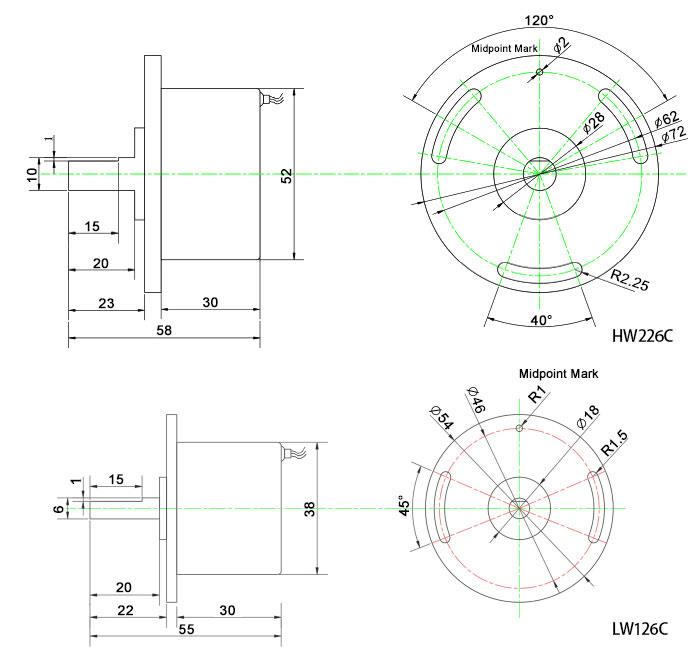
Dimensions (Unit: mm)

Dimensions of angle sensor non-contact rs485

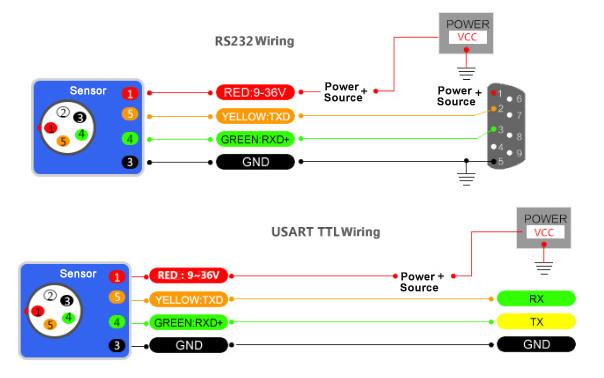
Wiring Diagram

Angle sensor non contact rs485 wiring diagram

Electrical ConnectionLine Color Function
12345
RedWhiteBlackGreenYellow
RS232VCCNCGNDRXDTXD
RS485VCCNCGND(B, D-)(A, D+)
TTLVCCNCGNDRXDTXD


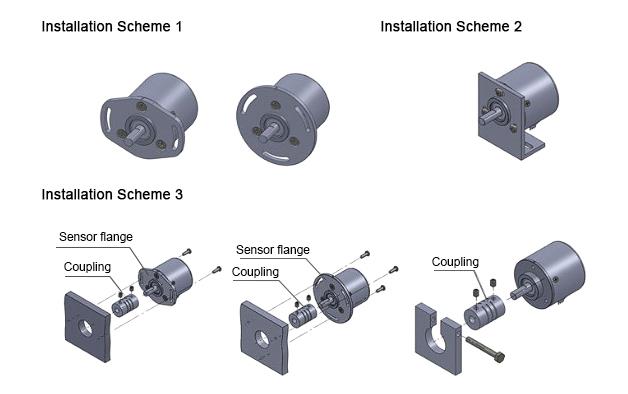
Installation Methods

Magnetic angle sensor installation method

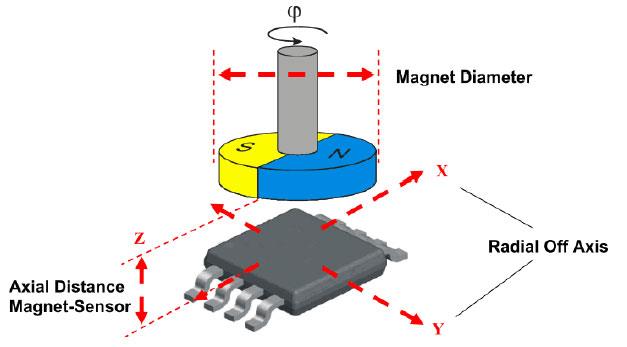
Working Principle

Magnetic angle sensor working principle

The angle sensor utilizes the Hall principle with a high-precision core control unit that detects changes in angle primarily by internally mounting a grating on a shaft that rotates and cuts a magnetic field. Using Triaeis™ (triaxial Hall) technology independent sensor chip as the core design of a programmable angle sensor. The angle is derived by amplifying, filtering and converting the capacitance.

Applications

Magnetic angle sensor application

Tips: Angle sensor for car

The car steering angle sensor is used to detect the rotation angle and steering direction of the steering wheel. The steering wheel turning left or right will be detected by the steering angle sensor, so that the car's electronic control unit will issue the correct steering command. The turning angle of the steering wheel is to provide the basis for the car to realize the steering range, so that the car can drive according to the driver's steering intention.

The steering angle sensor is composed of a photoelectric coupling element and a slotted plate. The photoelectric coupling elements are light-emitting diodes and phototransistors. The slotted plate is placed between the light-emitting diode and the phototransistor. The slotted plate has many small holes.

When the steering wheel rotates, the slotted plate will follow the rotation. The phototransistor operates according to the light passing through the slotted plate and outputs a digital pulse signal. The car's electronic control unit uses this signal to identify the steering angle, direction of rotation and speed of the steering wheel.

In this video, ATO will show you top ten most used sensors (sensing technologies).

Product reviews
Worth buying
5
Vickey
Avatar
11/16/2021 6:54 PM
I bought a magnetic angle sensor from ATO to replace my old one. It solves the problem of inaccurate angle measurement. All in all, I am very satisfied with it and it is worth buying.
Was this review helpful? Yes No (0/0)
Write your review
  • Only registered users can write reviews
*
*
  • Bad
  • Excellent
*
*
*
*

ATO hall effect angle sensor is powered by 9V~36V power supply, with reverse and anti-pulse peak voltage protection function, suitable for water, oil, gas, vibration, shock and other harsh industrial environment.

Specification

ModelATO-LW126CATO-HW226C
Full Range Precision±0.3°±0.1°
Temperature Drift±0.0015°/°C
Sensitivity Temperature Coefficient<150ppm/°C
Measuring Range0~30°, 0~60°, 0~90°, 0~180°, 0~270°, 0~360° (Optional)
Output SignalRS232, TTL, RS485, Modbus (Optional)
Output Load240Ω
Voltage Input9-36V DC
Typical Voltage12V
Sampling Frequency1KHz
Linearity0.5%-0.15%
High Vibration Resistance>20000g
Frequency Response100Hz
Angle Resolution0.022°
Full Range Accuracy±0.3°
Operating Temperature-40°C~+85°C
Storage Temperature-55°C~+100°C
Power-on Startup Time0.2s
Response Time0.01s
Average Operation Time≥55000 Hour/Time
Cablewith 1.5m length shielded cable 3*0.3mm2
Power Reverse Protection40mV
Signal Reverse Protection40mV
Running Torque<10mN·m
MaterialShell: Aluminum alloy oxidation
Back Cover: Stainless steel
Shaft: Stainless steel
Protection GradeIP66
Weight1kg


Dimensions (Unit: mm)

Dimensions of angle sensor non-contact rs485

Wiring Diagram

Angle sensor non contact rs485 wiring diagram

Electrical ConnectionLine Color Function
12345
RedWhiteBlackGreenYellow
RS232VCCNCGNDRXDTXD
RS485VCCNCGND(B, D-)(A, D+)
TTLVCCNCGNDRXDTXD


Installation Methods

Magnetic angle sensor installation method

Working Principle

Magnetic angle sensor working principle

The angle sensor utilizes the Hall principle with a high-precision core control unit that detects changes in angle primarily by internally mounting a grating on a shaft that rotates and cuts a magnetic field. Using Triaeis™ (triaxial Hall) technology independent sensor chip as the core design of a programmable angle sensor. The angle is derived by amplifying, filtering and converting the capacitance.

Applications

Magnetic angle sensor application

Tips: Angle sensor for car

The car steering angle sensor is used to detect the rotation angle and steering direction of the steering wheel. The steering wheel turning left or right will be detected by the steering angle sensor, so that the car's electronic control unit will issue the correct steering command. The turning angle of the steering wheel is to provide the basis for the car to realize the steering range, so that the car can drive according to the driver's steering intention.

The steering angle sensor is composed of a photoelectric coupling element and a slotted plate. The photoelectric coupling elements are light-emitting diodes and phototransistors. The slotted plate is placed between the light-emitting diode and the phototransistor. The slotted plate has many small holes.

When the steering wheel rotates, the slotted plate will follow the rotation. The phototransistor operates according to the light passing through the slotted plate and outputs a digital pulse signal. The car's electronic control unit uses this signal to identify the steering angle, direction of rotation and speed of the steering wheel.

Product reviews
Worth buying
5
Vickey
Avatar
11/16/2021 6:54 PM
I bought a magnetic angle sensor from ATO to replace my old one. It solves the problem of inaccurate angle measurement. All in all, I am very satisfied with it and it is worth buying.
Was this review helpful? Yes No (0/0)
Only registered users can write reviews