
Hydraulic winch is a device that uses hydraulic power to reel in or let out a cable or rope. It is commonly used in heavy-duty applications such as towing, construction, and off-road vehicles. The hydraulic system provides the necessary force and control for efficient pulling and lifting operations.
Specification
| Model | ATO-HW30-20 | |
| The 1st Layer | Pull | 4000 lbs (2 ton) |
| Rope Speed | 0~40 m/min | |
| Working Pressure Differential | 15 Mpa | |
| Oil Flow Supply | 75 L/min | |
| Applicable Rope Diameter | 12mm | |
| Hydraulic Motor | BMR-245 | |
| Planetary Reduction Ratio | 1:5 | |
| Layer | Wire Rope Capacity | |
| 1 | 18m | |
| 2 | 38m | |
| 3 | 59m | |
| 4 | 80m | |
| 5 | 110m | |
Note*:
- Never exceed working load limit.
- This hydraulic winch does not include wire rope.
- If you want to purchase wire rope, please contact us.
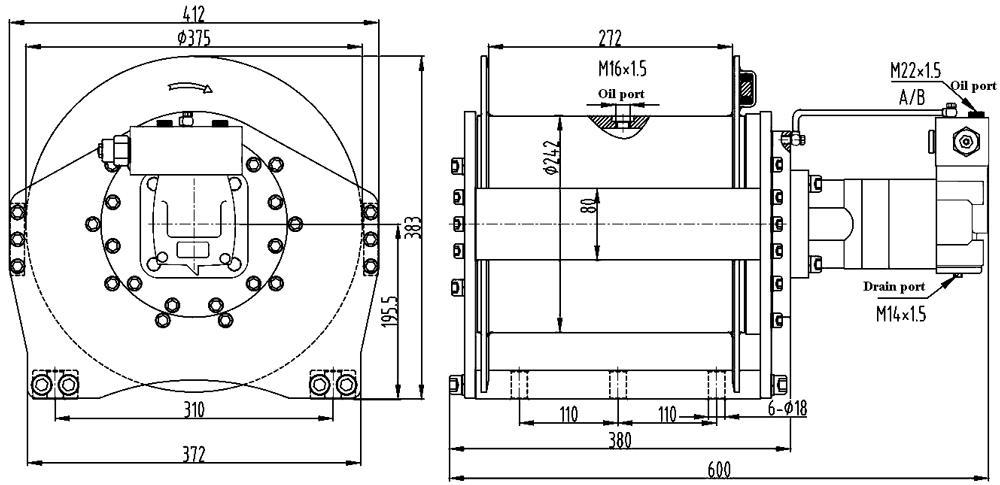
Dimensions (Unit: mm)
Tips: Difference between crane and winch
A crane and a winch are both mechanical devices used for lifting and moving heavy loads, but they have different designs and purposes. Here are the main differences between a crane and a winch:
- Design and Construction
A crane is a complex machine that consists of a hoist, a boom (or jib), and a base or mounting system. It typically has a rotating structure that allows it to move loads horizontally and vertically. Cranes are commonly used in construction sites, manufacturing facilities, and ports.
A winch is a simpler device consisting of a drum or spool around which a rope or cable is wound. It is usually mounted on a fixed structure or a vehicle. Winches are commonly used in towing applications, off-road vehicles, boats, and other situations where pulling or lifting is required. - Mobility and Range of Motion
Cranes are designed to have a wide range of motion and mobility. They can rotate 360 degrees, and some cranes have telescopic or articulated booms that can extend or reach great heights. This allows cranes to lift and move loads over a large area.
Winches are typically fixed in one position and have limited mobility. They are mainly used for straight-line pulling or lifting in a specific direction. The range of motion of a winch is determined by the length of the cable or rope wound around the drum. - Load Capacity
Cranes are designed to lift and move heavy loads, ranging from a few hundred kilograms to several tons or more. They are equipped with various mechanisms, such as hydraulic systems and counterweights, to handle these heavy loads safely.
Winches are generally used for lighter loads compared to cranes. While winches can handle significant weights, their load capacity is typically lower than that of cranes. They are commonly used for pulling or lifting loads up to a few thousand kilograms. - Applications
Cranes are versatile machines used in a wide range of industries and applications. They are commonly used in construction for lifting materials and equipment, in shipping ports for loading and unloading cargo, in manufacturing plants for moving heavy machinery, and in the oil and gas industry for various tasks, among other applications.
Winches are primarily used for pulling or lifting applications. They are commonly employed in towing vehicles, recovery operations, off-road vehicles, and marine applications for anchoring, mooring, or pulling boats.
Product reviews
Handles heavy pulling without trouble
Richard

8/26/2026 7:30 PM
This winch is being used for fairly demanding pulling work and has performed as expected. The 2-ton first-layer pulling capacity is suitable for our application, and the 0–40 m/min speed range gives us good control depending on the job. The construction feels heavy-duty without being unnecessarily complicated.
Was this review helpful? (0/0)
Only registered users can write reviews
Related products

5000 lbs Hydraulic Winch
ATO-HWINCH-5000
$3,135.89
Buy 5000 lbs (2-1/2 ton) hydraulic winch at factory price. Planetary reduction ratio 1:5, rope speed 0~35 m/min. Industrial hydraulic winch is a tool for lifting or pulling tractor, skid steer, rollback, truck and excavator using hydraulic power.

6000 lbs Hydraulic Winch
ATO-HWINCH-6000
$3,493.39
Buy heavy duty 6000 lbs (3 ton) hydraulic winch at factory price. Planetary reduction ratio 1:5, rope speed 0~35 m/min. Industrial hydraulic winch is a device for lifting or pulling tractor, skid steer, rollback, truck and excavator using hydraulic power.

8000 lbs Hydraulic Winch
ATO-HWINCH-8000
$6,883.49
Hydraulic winch is a tool for lifting or pulling heavy loads using hydraulic power. ATO 8000 lbs (4 ton) hydraulic winch comes with planetary reduction ratio 1:6, rope speed 0~45 m/min, widely used for tractor, skid steer, rollback, truck and excavator.

10000 lbs Hydraulic Winch
ATO-HWINCH-10000
$7,437.39
Heavy duty hydraulic winch for sale at factory price, 10000 lbs (5 ton), planetary reduction ratio 1:6. This hydraulic winch uses hydraulic power to lifting and pulling tractor, skid steer, rollback, truck and excavator, etc.