
Note: This Y type strainer cannot be used for drinking water.
Ductile iron 4 inch Y strainer filter features PN16 working pressure and flange connection. 100mm wye strainer is easy to install and use, can effectively remove unwanted particles and debris from fluid systems.
Specifications
- Model: ATO-GL41H-16Q
- Type: Y Type Strainer
- Size: 4 inch (DN100, 100mm)
- Connection Method: Flange Connection
- Material: Ductile Cast Iron
- Pressure: PN16
- Applicable Temperature: -10~200℃
- Suitable Medium: Water, oil etc.
- Design and Manufacture: GB/T 14382
- Pressure Test: GB/T 14382
- Applications: Food, medicine, chemical industry, environmental protection, water treatment, water supply and drainage.
Note: If you require ASME Class 150 flanges, please contact us.
Dimension (Unit: mm)
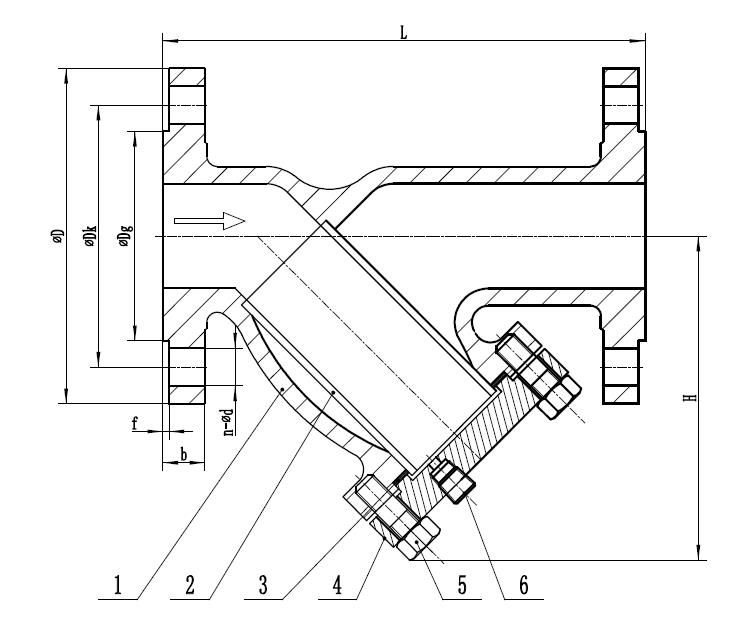
| NO. | Name | Qty. | Material |
| 1 | Body | 1 | GGG50 |
| 2 | Screen | 1 | 304 |
| 3 | Body Gasket | 4 | Graphite |
| 4 | Bolts | 1 | Steel 8.8 |
| 5 | Cover | 1 | GGG50 |
| 6 | Plug | 1 | Steel |
| DN | L | D | Dk | d | n | Dg | f | b | H |
| 100 | 350 | 200 | 160 | 19 | 8 | 156 | 3 | 24 | 200 |
Applications
Y-type strainers can remove impurities, debris, and solid particles from fluid or gas pipelines in industrial and commercial applications. They are typically used in applications where a high flow rate is required, and where there is a risk of damage to equipment or processes from the presence of solid particles.

Tips: Brass vs. Ductile Iron Y-type Strainer
- Material Strength: Ductile iron is stronger and more durable, making it suitable for high-pressure and heavy-duty applications, whereas brass is less strong but offers better corrosion resistance for less demanding environments.
- Corrosion Resistance: Brass has superior corrosion resistance, especially in water and chemical environments, while ductile iron may require additional coating to resist corrosion effectively.
Only registered users can write reviews
Related products

2-1/2 inch Cast Iron Y Strainer
ATO-YTS-65
$379.84
2-1/2 inch Y strainer is made of high-quality ductile cast iron, nominal diameter DN65, working pressure PN16, and can work at high temperatures of -10~200℃. Flanged wye type strainer is suitable for increasing equipment efficiency by preventing clogging and damage caused by particulate matter.

3 inch Cast Iron Y Strainer
ATO-YTS-80
$452.14
3 inch (DN80) flanged Y strainer features working pressure PN16, ductile cast iron material and -10~200℃ working temperature, used for various industrial applications, such as chemical processing, oil and gas, water treatment, and food processing.

5 inch Cast Iron Y Strainer
ATO-YTS-125
$759.84
Get a 5 inch (DN125) flanged Y strainer at a low price. With PN16 working pressure and ductile cast iron material, the y strainer filter is widely used in the chemical industry, heating, refrigeration, petroleum, construction, wind power, etc.

6 inch Cast Iron Y Strainer
ATO-YTS-150
$992.94
Reliable 6 inch Y type strainer manufacturer direct sale. It is equipped with DN150, working pressure PN16, ductile cast iron material and flange connection. High quality Y strainer valve is suitable for chemical processing, oil and gas, water treatment and food processing.