Fanless IP40 rated 20 ports Layer 2 full Gigabit industrial switches, operating temperature range is -40 to 70° C to satisfy any special needs of industrial automation, outdoor applications, and harsh weather conditions.
Specification
| Model | ATO-CIEN3020G-4GC-16GT | ||
| IEEE Standard | 802.3, 802.3u, 802.3z, 802.3ab | ||
| Protocol | CSMA/CD | ||
| Processing Type | Store and Forward | ||
| Backplane Bandwidth | 56 Gbps | ||
| Memory Buffer | 4.1 Mbit | ||
| MAC Address Table | 8K | ||
| Transfer Rate | 14,880 pps (Ethernet Port) | ||
| 148,800 pps (Fast Ethernet Port) | |||
| Jumbo Frame | 10,000 bytes | ||
| Gigabit Port | 16 × 10/100/1000Base-T + 4 × 1000Base-LX ports | ||
| 20 × 10/100/1000Base-T | |||
| Copper Port Parameters | Physical Interface | RJ45 with shielding, IEEE 802.3 standard | |
| RJ45 Port | 10/100/1000Base-T (Gigabit), supports auto-negotiation | ||
| Transmission Distance | 100 m (standard CAT5/CAT5e cable) | ||
| Fiber Port Parameters | Luminous Power | >12 dBm (single-mode), >17 dBm (multimode) | |
| Receiver Sensitivity | <−38 dBm (single-mode), <−35 dBm (multimode) | ||
| Wavelength | 1310 nm (single-mode), 1550 nm (single-mode) | ||
| 850 nm (multimode), 1310 nm (multimode) | |||
| Transmission Distance | Multimode fiber 850 nm—2 km; 1310 nm—2/5 km | ||
| Single-mode fiber 1310 nm—20/40/60 km; 1550 nm—20/40/60/80/120 km | |||
| Connector Type | LC | ||
| Transmission Rate | 1.25 Gbps (Gigabit) | ||
| Power Parameters | Input Voltage | 220 VAC/DC (85–264 VAC / 110–370 VDC), compliant with SELV requirements | |
| Input Power Consumption | 24 W (maximum) | ||
| Overcurrent Protection | Built-in | ||
| Heat Dissipation Method | Aluminum alloy single-rib chassis surface heat dissipation | ||
| Cable Exit Method | Front and rear cable exits | ||
| Mounting Method | Standard 19" 1U rack-mount | ||
| Enclosure Protection | IP40 | ||
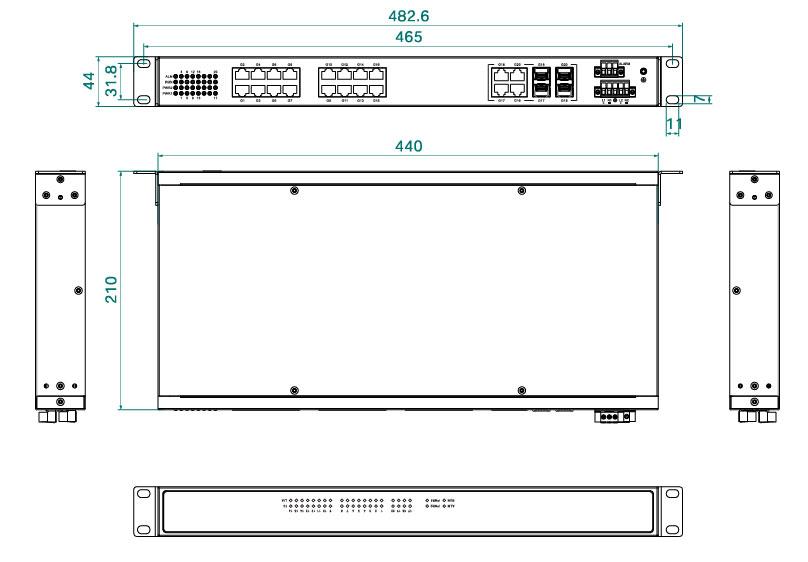
| Dimensions | 482.6 × 44 × 210 mm | ||
| Working Environment | Operating Temperature | −40 °C to +70 °C | |
| Storage Temperature | −40 °C to +85 °C | ||
| Operating Humidity | 5% to 95% RH (non-condensing) | ||
| EMI | FCC Part 15 Subpart B Class A; CE EN 55032 Class A; EN 61000-6-4 Class A | ||
| EMC Standards | CE EN 55024 Class A; EN 61000-6-2 Class A | ||
| IEC 61000-4-2 (ESD), Level 4 | |||
| IEC 61000-4-5 (Surge), Level 4; Network ports support 6 kV surge protection | |||
| IEC 61000-4-4 (EFT), Level 4 | |||
| IEC 61000-4-3 (RS), Level 4 | |||
| IEC 61000-4-6 (CS), Level 4 | |||
| EN 61000-4-8, Level 5 | |||
Dimensional Drawing (mm)
Tips: Half-duplex and full-duplex
Half-duplex means that the sending and receiving of the same media is asynchronous. In contrast, full duplex has separate transmit and receive paths. Full-duplex links are the key to extending Fast Ethernet (100Mbps). A full-duplex link network segment cannot exceed two devices, and can be a network card or switch port.
10BASE-T and 10BASE-FL have separate transmit and receive paths, and full duplex can be performed depending on the complexity of the network card or switch port. If these interfaces are configured in half-duplex mode, the synchronous detection of receiving and transmitting will trigger the collision detection. The same interface is set to full duplex, and collision detection is disabled because full duplex does not follow the shared CSMA/CD rules.
As mentioned above, the network range at 100 Mbps has been reduced due to collisions. For twisted pair segments and switch ports, the longest distance of the segment is 100 meters (within the collision domain). The problem is that on fiber ports, for multimode fiber, the length of the network segment is 2 kilometers. For single-mode fiber, it is 15 kilometers. In the half-duplex mode, it is limited by the collision domain, and the network segment distance is 412 meters. Therefore, only in full-duplex mode (CSMA/CA is ignored), the extension of the fiber segment can reach its limit.