

I have received the motor drive (see picture below, BLD-100A).
The picture shows that SW1 (Dip switch) is for the pole selection:
OFF = 2 poles, ON =4 poles
There is no 8 pole setting.
Our motor model is D110BLD1500-48A-30S, and I believe the motor has 8 poles.
Is BLD-100A the “correct” motor drive for the above motor?
What is the setting for SW1?
Economical price 1500 W DC planetary gear motor for sale online, optional 36V or 48V power supply, gear ratio from 3:1 to 250:1, rated speed 2000 rpm, rated torque 4.78N·m, motor dimension 110mm, brushless designed for electric car and industrial equipment.
Features:
- 36V and 48V DC are available.
- The planetary gearbox ratio is up to 250:1.
- Power, voltage, speed, shaft, motor length and lead can be customized.
- BLDC motor with a planetary gearbox has low power consumption, high efficiency and longer battery life.
- Planetary gear motor provides high torque at low speeds.
- Easy for speed adjustment and reversible direction.
Specifications:
| Motor Model | D110BLD1500-36A-30S | D110BLD1500-48A-30S |
| Motor Type | BLDC Motor | |
| Power | 1500W | |
| Voltage | 36V DC | 48V DC |
| Rated Current | 52.8A | 39.06A |
| No Load Current | <20A | <15A |
| No Load Speed | 3300 rpm | |
| Rated Speed | 3000 rpm | |
| Rated Torque | 4.78 N·m | |
| Peak Torque | 14.33 N·m | |
| Motor Dimension | 110mm | |
| Construction | Permanent Magnet | |
| Direction of Rotation | CW/CCW | |
| Certificate | CCC, CE, ROSH, LVD, EMC | |
| Recommended drive model | BLDC-100A | BLDC-100A |
| Gear Ratio | 3, 4, 5, 7, 10, 16, 20, 25, 28, 35, 40, 50, 70, 80, 100, 125, 140, 175, 200, 250 | |
| What Parameters of ATO Planetary Gear Motor Can Be Customized? | ||
| Power | Yes | |
| Voltage | Yes | |
| Speed | Yes | |
| Shaft | Yes | |
| Motor Length | Yes | |
| Motor Lead | Yes | |
Note: If you would like CAD drawings of the motor and planetary gearbox, please contact us.
Speed-torque curve
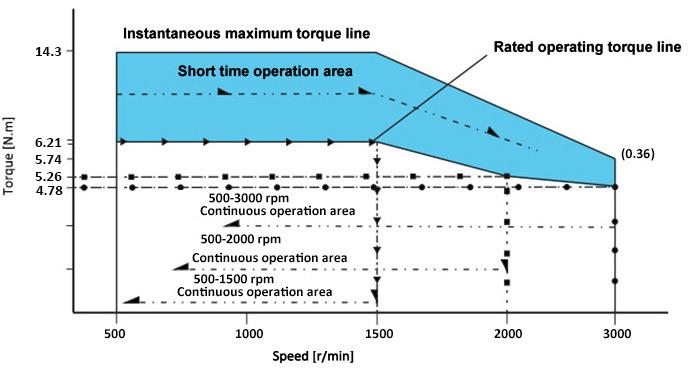
- Instantaneous maximum torque line
The maximum torque momentarily impacts the load when the motor is started.
Beyond this torque, the over-current protection of the driver will cause the motor to stop. - Short time operation area
The motor can run at a short time within this torque range at different speeds.
If the operation time is too long, the motor will generate heat, which may cause the motor to stop or burn. - Rated operating torque line
The rated torque of motor running at different speeds, and the motor can run for a long time at this torque. - Continuous operating area
When the motor rotates at different speeds, it runs continuously in this corresponding zone.
Tips: Causes of planetary gear motor noise
- When using a planetary reducer, noise may sometimes be generated. In this way, many people who don't understand planetary reducer will think that there is a problem with the planetary reducer and dare not use it. In fact, the noise produced by the planetary reducer is caused by many factors.
- The rotation of the motor bearing produces natural sound under normal circumstances, and there is almost no problem except for the case of a precision miniature motor or a geared motor. However, the natural vibration of the bearing and the resonance of the material of the motor components, and the gas spring constant of the bearing axially cause the rotor to vibrate axially, and poor lubrication produces frictional noise.
- When the brushes slide, DC motors or commutator motors with brushes will generate brush noise.
- The fluid noise and ventilation noise generated by the fan or rotor are unavoidable. In many cases, the overall noise of the micromotor will be affected. In addition to the air whistle sound caused by fan blades or iron core teeth, pay attention to the resonance of ventilation.
- Electromagnetic noise refers to the noise caused by the unbalance of the magnetic circuit or the unbalance of the magnetic force of the air gap and the electromagnetic wave, and the magnetic noise caused by the saturation of the magnetic flux density or the eccentricity of the air gap.
- Mechanical vibration noise is the unbalanced weight of the rotor, which produces a considerable number of rotations.
Related products

100 W DC Planetary Gear Motor, 12V/24V/48V
ATO-GEAR-P100
$438.81
Buy a low price 100 watt 12 volt DC planetary gear motor, 24V/36V/48V power can be selected. 3000 rpm, 0.32Nm rated torque, speed ratio up to 250, a kit ( 3 phase BLDC motor and a planetary gear motor) provides high torque at low speeds, smooth running, widely used in industrial machines.

150 W DC Planetary Gear Motor, 12V/24V/48V
ATO-GEAR-P150
$463.79
Low noise 57mm/60mm 150W planetary gear motor with 3000rpm rated speed for sale, 0.48Nm rated torque, 4 to 250 gear ratio, buy 12V/24V/36V/48V power supply BLDC motor with a planetary gearbox, offers greater efficiency and increase torque transmission.

200 W DC Planetary Gear Motor, 12V/24V/48V
ATO-GEAR-P200
$530.62
Hot selling 86mm 200W brushless dc motor with a planetary gearbox is from reliable planetary gear motor manufacturers, 3000rpm and 0.64Nm, 12V/24V/36V/48V power supply planetary gear motor has long battery life and low noise, provides high torque for industrial equipment.

300 W DC Planetary Gear Motor, 12V/24V48V
ATO-GEAR-P300
$572.75
300 watt high quality brushless DC motor equipped with a planetary gearbox, works at 12V/24V/36V/48V, rated torque 0.96Nm, 3000rpm rated speed, 86mm planetary gear motor provides greater efficiency and increases torque transmission for electric vehicle and industrial machines.