
Note: This swing check valve cannot be used for drinking water.
Wholesale price 10 inch swing type check valve uses CPVC for chemical resistance, corrosion resistance and high-temperature resistance. 250mm swing check valve is commonly used in piping applications where reliable backflow prevention is required, such as water supply, wastewater treatment, irrigation and industrial processes.
Features
- The check valve can prevent the phenomenon of liquid counter-current from protecting the pump equipment.
- Because it is a cantilever check valve, there is less resistance to flow.
- The 10 inch swing check valve uses CPVC materials and plays a strong corrosion resistance to prevent acid and alkali fluid.
- Not only can the valve body be removed from the pipeline, but also the valve cover can be opened for internal inspection and maintenance.
Specifications
- Model: ATO-H44F-10S
- Check Valve Type: Swing
- Nominal Diameter: 10 inch/250mm
- Nominal Pressure: 10kg
- Drive Mode: Manual
- Pressure Environment: Low Pressure
- Type (Channel Position): 2 Ways
- Flow Direction: One Way
- Body Material: CPVC
- Connection Form: Flange
- Weight: 48kg
- Applicable Medium: Acid-Base concentration higher than 30%, lower than 60%, except hydrochloric acid.
Dimension (Unit: mm)
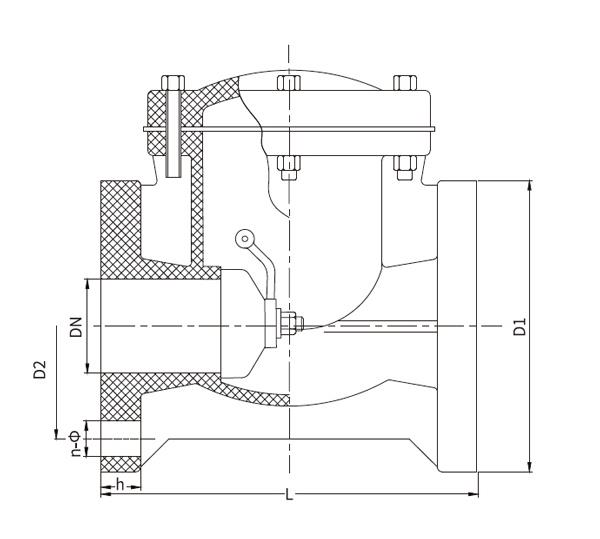
| Nominal Diameter | D1 | D2 | |
| GB | JIS | ||
| DN250 | 350 | 355 | 290 |
| L | h | n-Φ | |
| GB | JIS | ||
| 575 | 38 | 4-Φ23 | 4-Φ23 |
Applications

Tips: Why choose CPVC material for the check valve?
CPVC (Chlorinated polyvinyl chloride) is a thermoplastic material that is frequently used for check valves in a variety of fluid-handling applications. Here are some reasons why CPVC may be a good choice for check valve material:
- Corrosion resistance: CPVC is highly resistant to corrosion, making it an excellent choice for use in applications where the fluid being handled may be corrosive or aggressive.
- Temperature resistance: CPVC can withstand a wide range of temperatures up to 95 degrees Celsius, making it suitable for use in high-temperature applications.
- Mechanical strength: CPVC is a strong and durable material that can withstand high pressures and stress. It has a high tensile strength and can resist impacts and shock.
- Chemical resistance: CPVC is resistant to a wide range of chemicals, including acids, alkalis, and organic solvents. This makes it a good choice for use in chemical processing plants, water treatment facilities, and other applications where exposure to chemicals is common.
- Low thermal conductivity: CPVC has a low thermal conductivity, which means that it does not transfer heat as easily as other materials. This makes it a good choice for use in applications where heat loss or gain needs to be minimized.
- Low flame spread: CPVC has a low flame spread rating and is self-extinguishing, making it a safe choice for use in applications where fire resistance is important.
Only registered users can write reviews
Related products

12 inch Swing Check Valve, DN300, CPVC
ATO-SCV-012
$4,357.69
Popular 12 inch check valve comes with a 300mm nominal diameter and 10kg nominal pressure. With high-temperature resistance, chemical resistance and corrosion resistance, CPVC swing check valve can transport weak acid and alkali medium, widely used in water treatment and distribution systems, as well as industrial and commercial applications for handling various fluids.

2 inch Swing Check Valve, DN50, CPVC
ATO-SCV-002
$321.33
Best selling check valve is a 2 inch swing check valve, CPVC material offers excellent chemical and heat resistance. 50mm swing check valve can prevent backflow and ensure one way flow in piping systems, widely used in iron and steel, metallurgy, petroleum, chemical industry, fertilizer, pharmaceutical, electric power, environmental protection, sewage treatment management and other industries.

3 inch Swing Check Valve, DN80, CPVC
ATO-SCV-003
$537.84
Buy a lightweight 3 inch swing check valve from ATO.com. It is a CPVC check valve that can transport weak acid and weak alkali medium. 80mm swing type check valve is commonly used in pipelines where reliable backflow prevention is required, such as water supply, wastewater treatment, irrigation and industrial processes.

4 inch Swing Check Valve, DN100, CPVC
ATO-SCV-004
$799.23
4 inch check valve is made of CPVC material, which has high heat resistance and chemical resistance. 100mm swing check valve is a non-return valve commonly used in water treatment and distribution systems, as well as in industrial and commercial applications that handle a variety of fluids.