
Multilayer ceramic chip capacitor is stable and has high capacitance. Laminated monolithic structure, excellent solderability and solder resistance, MLCC capacitors are suitable for reflow and wave soldering, various filtering and coupling circuits.
Specification
- Model: ATO-25V106K0603
- Series: Multilayer Ceramic Chip Capacitor
- Capacitance: 10μF (10000000pF, 10000nF)
- Rated voltage: 25V
- Tolerance: 20%
- Operating Temperature Range: -40℃ - 105℃
- Lead Type: SMD
- Size: 16mm
- Thickness: 0.8mm
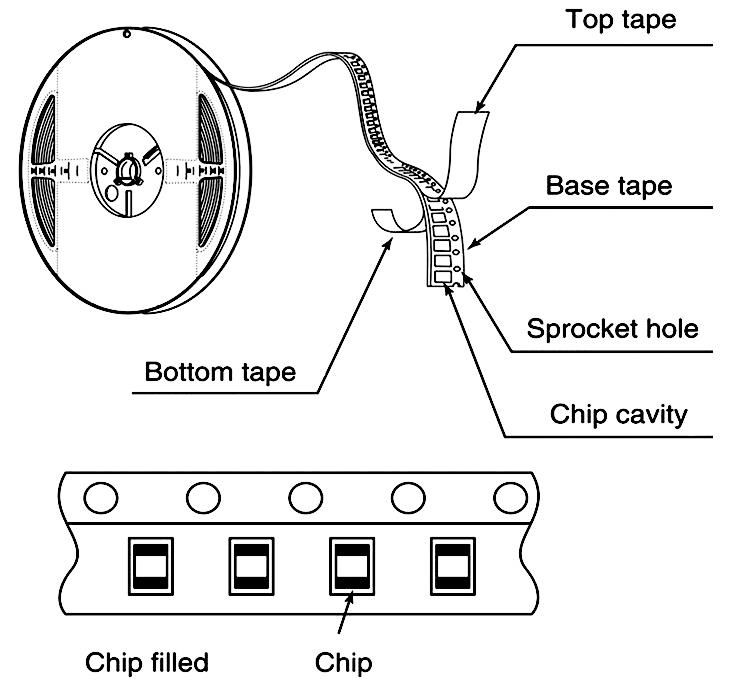
- Package: 4000PCS / roll
- Application: Household Appliances
- Medium Material: Ceramic (Porcelain)
- Loss: 0.01%
- Weight: 0.8kg
Structure
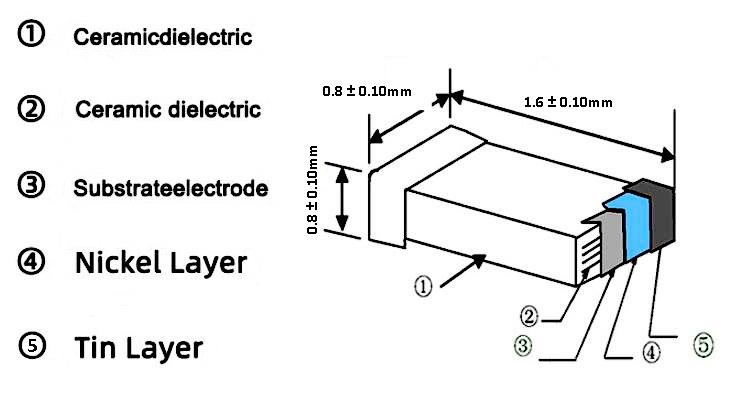
Tips: Causes of leakage of multilayer ceramic capacitors
- Void
The cavity formed by the volatilization of foreign matter inside the capacitor during the sintering process. Voids can lead to short circuits between electrodes and potential electrical failure. Larger voids not only reduce the IR, but also reduce the effective capacitance. When the power is turned on, it may cause local heating of the cavity due to leakage, reduce the insulation performance of the ceramic medium, aggravate the leakage, and cause cracking, explosion, combustion and other phenomena. - Crack
Sintering cracks are generally caused by rapid cooling during the sintering process and appear in the vertical direction of the electrode edge. - Delamination
The occurrence of delamination is often caused by poor lamination or insufficient debinding and sintering after stacking, air is mixed between layers, and jagged lateral cracks appear from external impurities. It may also be caused by a mismatch in thermal expansion after mixing different materials.
Product reviews
Meet my needs
Masca

8/27/2024 12:09 AM
In my recent project, I used this multi-layer ceramic chip capacitor. The capacity of 10 μ F is just right for our filtering requirements, and the rated voltage of 25V also provides sufficient margin to ensure the reliability of the capacitor in actual operation, which is suitable for our design requirements.
Was this review helpful? (0/0)
Only registered users can write reviews
Related products

10μF 50V Multilayer Ceramic Chip Capacitor
ATO-MLCC-50V106K
$36.49
Economical price SMD multilayer ceramic chip capacitor for sale, 10μF (10000000pF, 10000nF) capacitance, rated voltage 50V, 10% tolerance, 1000PCS per roll. This MLCC surface mount capacitor is widely used for household appliances, operating temperature range from -40℃ to 105℃.

1μF 16V Multilayer Ceramic Chip Capacitor
ATO-MLCC-16V105K
$25.89
SMD multilayer ceramic chip capacitor for sale at economical price, 1μF (1000000pF, 1000nF) capacitance, rated voltage 16V, 10% tolerance, 1000PCS per roll. This MLCC surface mount capacitor is widely used for household appliances, 0.5mm thickness, ceramic (porcelain) medium material.

1μF 25V Multilayer Ceramic Chip Capacitor
ATO-MLCC-25V105K
$28.72
SMD multilayer ceramic chip capacitor for sale at low price, 1μF (1000000pF, 1000nF) capacitance, medium rated voltage 25V, 10% tolerance, 1000PCS per roll. This MLCC surface mount capacitor is widely used for household appliances, 2.5mm thickness, and ceramic (porcelain) medium material.

2.2μF 16V Multilayer Ceramic Chip Capacitor
ATO-MLCC-16V225K
$33.16
Cost-effective SMD multilayer ceramic chip capacitor is widely used for household appliances with ceramic (porcelain) medium material, 2.2μF (2200000pF, 2200nF) capacitance, medium rated voltage 50V, 10% tolerance, 1000PCS per roll. This MLCC surface mount capacitor is compact and high performance.