
1μF 35V tantalum capacitor is small in size, easy to carry and operate. The capacity error of 1μF tantalum capacitor is small, so it can be more accurate in operation.
Features:
- Small volume and small capacity error
- Wide temperature range, high temperature resistance
- Long life, high insulation resistance, small leakage current
- Equivalent series resistance (ESR) has good high frequency performance
Specification:
| Model | ATO-TC-1UF35V | |
| Nominal capacity | 1μF, 35V | |
| Type | DIP | SMD |
| ESR | 1 | |
| Size | 1 mm | |
| Tolerance | 10% | |
| Height Mounting (Maximum) | 1 mm | 125 mm |
| Leading Spacing | 2.54 mm | Leadless |
| Working Temperature | -40 ℃—125 ℃ | -85 ℃—125 ℃ |
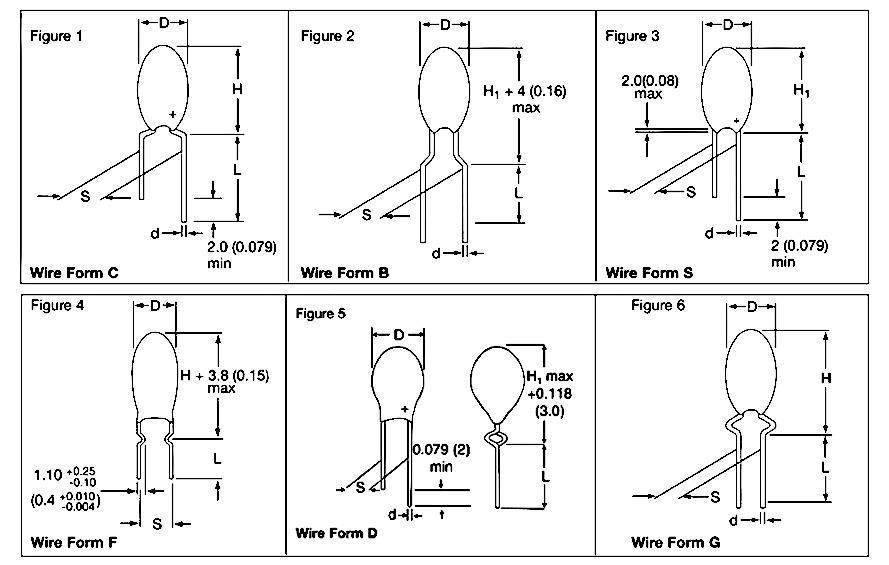
DIP Tantalum Capacitor Dimension: (Unit: mm)
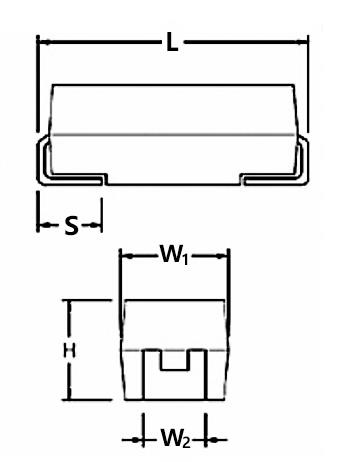
SMD Tantalum Capacitor Dimension: (Unit: mm)
B: L= 3.5, S= 0.8, W1= 2.8, W2= 2.2, H= 1.6
Tips: Tantalum Capacitor vs Ceramic Capacitor
- Polarization. The majority of tantalum capacitors are polarized. This means they can only be linked to a DC power source while maintaining proper terminal polarity. Non-polarized ceramic capacitors, on the other hand, can be safely connected to an AC source. Ceramic capacitors have a higher frequency response because they are not polarized.
- Temperature Response. Tantalum capacitors have a linear capacitance change when exposed to temperature changes, whereas ceramic capacitors have a non-linear response. On the other hand, Ceramic capacitors can be made to trend linearly by narrowing the operating temperature ranges and taking temperature response into account during the design phase.
- Voltage Response. Tantalum capacitors have clear capacitance changes as a function of applied voltage, whereas ceramic capacitors do not. The permittivity of the dielectric shrinks inside the ceramic capacitor in response to higher applied voltages, causing capacitance changes. While most ceramic capacitor capacitance changes are linear and easily accounted for, some higher permittivity dielectrics can lose up to 70% of their initial capacitance when operated at rated voltage.
Only registered users can write reviews
Related products

0.1μF Tantalum Capacitor, 35V
ATO-TC-01UF35V
$1.51
Small and cheap 0.1μF tantalum capacitor for sale online. DIP tantalum capacitor with high insulation resistance and small leakage current. Working temperature between -40 ℃ and 125 ℃. DIP or SMD tantalum capacitor can be chosen. 0.1μF tantalum capacitor applies in mobile phone, printer, elecrtic bicycle and electric tool.

10μF 16V Tantalum Capacitor
ATO-TC-10UF16V
$1.57
Lower cost 10μF tantalum capacitor for sale online. ATO offers 16V voltage of this type tantalum capacitor. DIP tantalum capacitor and SMD tantalum capacitor can be chosen. 1 mm 10μF 16V tantalum capacitor is suitable for a variety of scenarios, such as industrial equipment and video equipment.

10μF 25V Tantalum Capacitor
ATO-TC-10UF25V
$1.52
Economical price 10μF 25V tantalum capacitor for sale online. DIP tantalum capacitor and SMD tantalum capacitor can be chosen. Operating temperature range from -40 ℃ to 125 ℃. Solid tantalum capacitor to be used in a wide variety of circuits.

10μF 35V Tantalum Capacitor
ATO-TC-10UF35V
$1.79
10μF 35V tantalum capacitor at affordable price for sale. 10μF tantalum capacitor is a subtype of electrolytic capacitor. 1 mm 10μF 35V tantalum capacitor is suitable for a variety of applications, such as printer electric bicyle and mobile phone.

2.2μF Tantalum Capacitor, 35V
ATO-TC-022UF35V
$1.29
2.2μF tantalum capacitor at affordable price for sale. DIP tantalum capacitor is suitable for wide temperature range and high temperature resistance. Tantalum capacitor has a distinctive yellow casing. 2.2μF tantalum capacitor to be used in a wide variety of circuits.